Requests Around Town

Perhaps because it has been hosted at a place that fosters the Quaker way of doing business, but when I first tried to describe why I thought it was time to leave off having a regularly scheduled practice at William Penn House, the first phrase that came to mind, was that the practice was being “laid down.”
Very generally, much Quaker business is done by a committee consisting of members who are nominated by the meeting and willing and able to address whatever the issue that is the purpose of the committee. A committee may be formed to address a particular issue that a meeting is encountering or for general ongoing work for the life of the meeting. After a committee’s purpose is done–which may or may not be clear, depending on the nature of the issue–the meeting may choose to lay down the committee. Laying down a committee is not passing judgment. Sometimes, the committee has served its purpose well, but is no longer needed as much as the resources of the committee (it’s members) are needed elsewhere–either for the meeting or for their own personal lives.
The William Penn House group practice started over 10 years ago. Its initial purpose was to keep going a class from a studio that closed for several months. Having the practice at William Penn House was also a good way to create neighborhood, Quaker, and yoga connections, provide support for the work of William Penn House, and provide an unconventional community donation practice space.
In the years since the class was established, the whole tenor and climate of the world has changed. The neighborhood, too has changed. Among the changes, there are now several yoga studios on the Hill and there are lots of choices for a practice every night of the week without leaving the neighborhood. In the broad group that has participated in the practices, there have been graduations, marriages, births of children and grandchildren, illnesses, injuries, world travel, joys and sorrows, death, career changes, and it is time for those still in the habit of Tuesday night practice to reconfigure what and when we practice for our own good and for the great web, including together.
I will always be grateful to all the practitioners/friends who joined with me in collective exploration of the practices and to William Penn House for being a welcoming and nonjudgmental host for a really long time.
As a member of the Board of Directors and a neighbor, I will still be part of the life and practice at William Penn House. I am still offering small group and private classes in my lovely home studio. Send me a message, if you’d like to practice. I’m looking forward to scheduling practice on a more flexible basis.
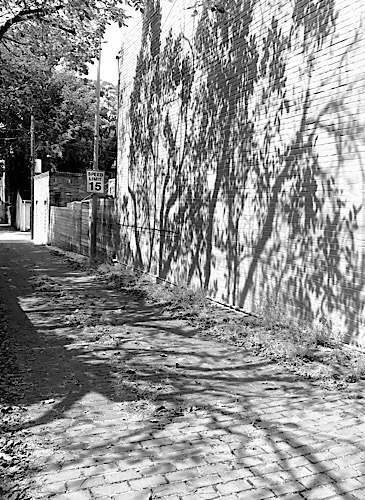
I was having an anxiety provoking type of morning. When I walked out to address one of the things that needed to be addressed, the trees reminded me to pay attention to beauty, while I was doing what needs to be done.

Rabbi Hillel is famous for having said, “If I am not for myself, who will be for me; if I am not for others, what am I? If not now, when?” Taken in its best light (and not as the recruiting technique for going to war this quote has served), this means we must, as they say on the airplane, “put on our own oxygen mask first before helping others.”
I often think of this principle, when I am emphasizing the fundamental physical alignment principle of shins in/thighs out. If you have taken even just a few Anusara classes, you have probably heard the teacher say “shins in, thighs out.” It is really short hand for the action of muscular energy that hugs the legs to the mid-line, followed by the spiraling upward and backward expansion of inner spiral.
When applied with enthusiasm and in the right sequence, “shins in/thighs out” protects our knees and opens the groins, hips, and pelvic floor in a way that gives us greater access to finding the strength of our pelvic floor, low back and abdominal muscles. It is a perfect example of an appropriate personal boundary: it leaves us open and available to receive and observe all that is good, while creating a protective and appropriate boundary from which we can grow safely better to serve.

Peace and light, E — Posted with WordPress for BlackBerry.
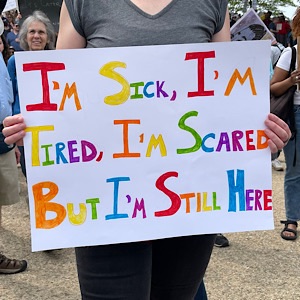
April 19, marching from the Washington Monument to the White House