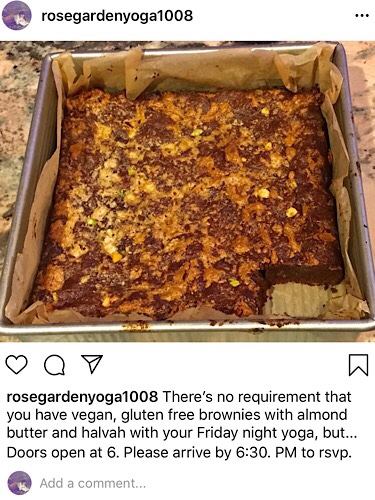
Who’s in for Friday Night Yoga Practice?
Classical yoga philosophies (as opposed to tantra) teach us that our mind/body are not real; what is real is “God,” and when we truly know this, we will experience freedom. I personally don’t ascribe to teachings that hold a concept real, but ourselves unreal.
I do think, though, that the practice that comes from this theory that advises us to pause, to step back, and to notice when our reactions to things are so bound in previous limited experience or expectation or dogmatic teaching that we’ve created unnecessary constrictions and suffering.
What appears to be caught or bound or stuck might not necessarily be so.
The tantric yoga philosophy ascribes the characteristic of svatantriya or ultimate freedom to the energy that infuses all of us. We all want to be free, but when we get stuck in our embodiment, forgetting that we ourselves are manifestations of spirit, then we lose sight of our true freedom. To find our own freedom of spirit, we need to be disciplined, to practice, to study, to live in a way that brings us into better alignment with ourselves and world with which we are inextricably interconnected.
In this country, one of our principle ideals and buzz words in dialogue about how we should live is freedom. What can so often be forgotten in this dialogue, though, is that freedom is a contract. To be in a society where all have the opportunity to experience freedom, we need to agree, with discrimination (viveka) to certain limitations (for example, we agree to stop for red lights so that we can be free to drive and walk without a constant risk of being hit in crowded city).
Granted, I am grossly oversimplifying here, but part of the great losses of freedom we are currently experiencing is the abdication by individuals of the responsibility to shape the agreement to maximize our collective freedoms. Like the agreement with ourselves to practice steadily to experience inner freedom, we need to stay engaged, even when it seems impossible or deeply frustrating, in order not to lose sight of the ideal entirely. Here’s some information from FCNL on why it is important to lobby despite how fruitless an act it may appear to be.
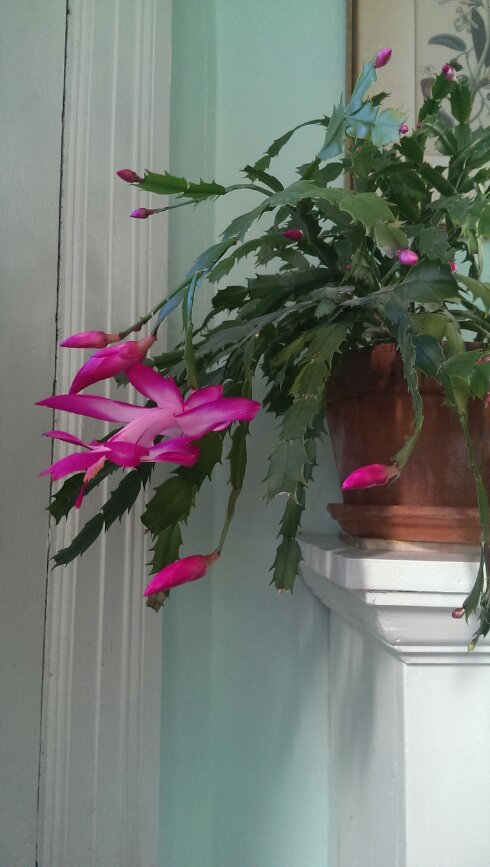
Well over a decade ago, I bought this and another “Christmas” cactus at a yard sale, the two for a dollar.
The woman selling them complained that they had stopped blooming. She still didn’t want to keep them even after I explained that they only bloom once a year.
I brought them home and tended them. They have bloomed faithfully every Thanksgiving or a little closer to the solstice, getting more luxuriant.
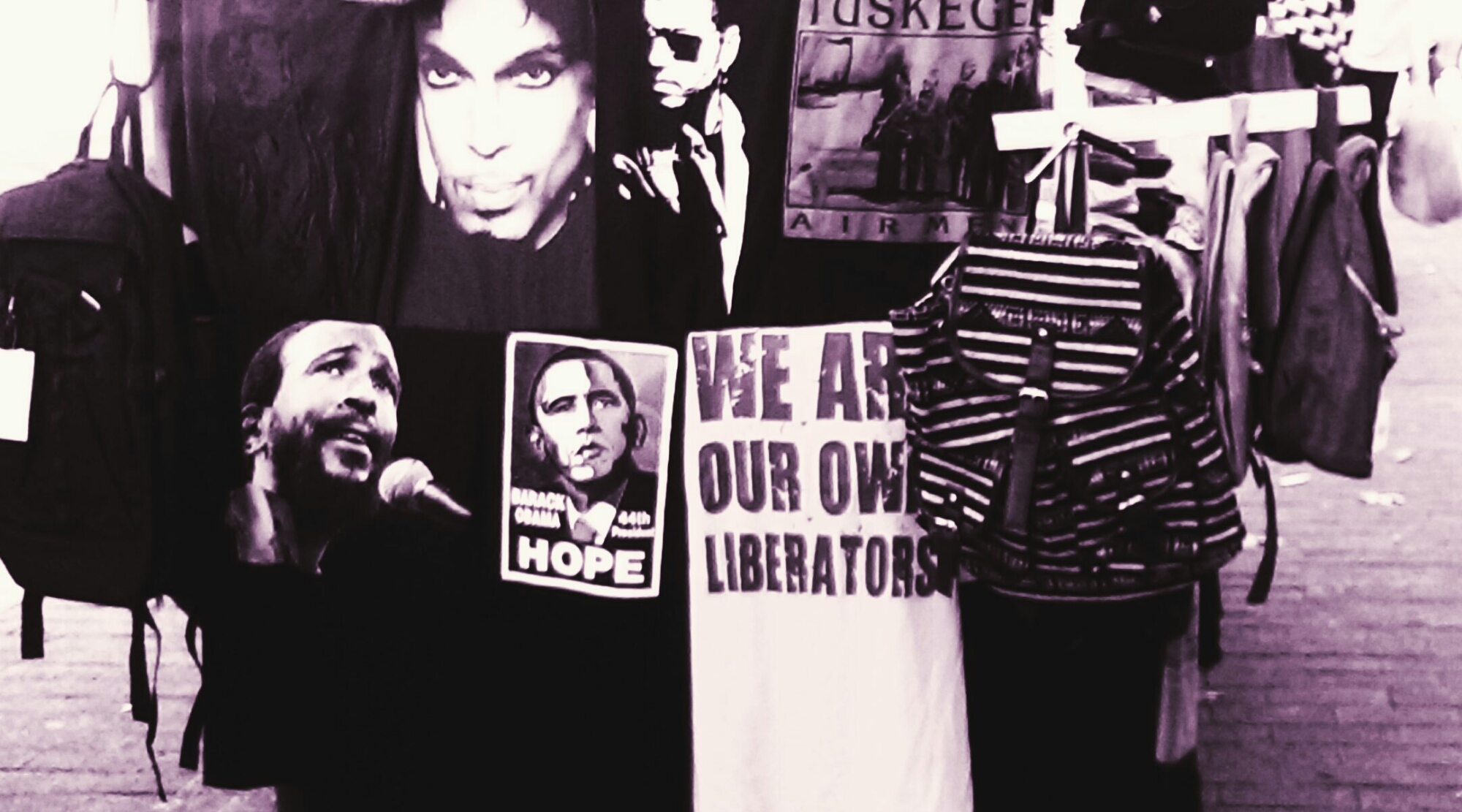
We are our own liberators…
From the small picture to the large, the large to the small, from the perspective of another?