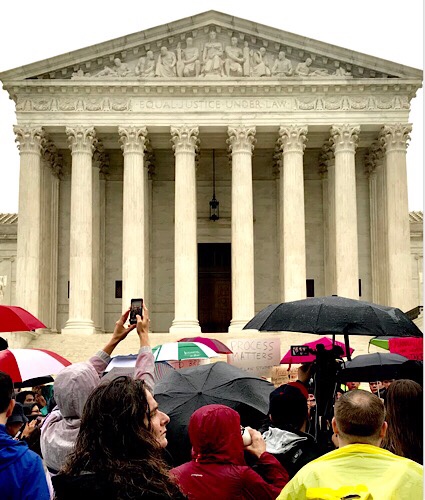
Process Matters

US Supreme Court, September 24, 2018

US Supreme Court, September 24, 2018
When is garden statuary merely a decorative object and when is it a murti–an object of devotion, a representation of some aspect of the divine? It may well seem different for the artist, the person who chose its location, and the viewers.
Would you have a different reaction if this angel was on the grounds of a church? What about a temple? A national park? Your workplace? A sculpture museum?
Last night I dreamed that it snowed a couple of inches and then turned to rain, which melted the snow. As happens more and more often with my dreams, I was conscious that I was dreaming and knew that the snow still fell madly outside. As I practice more and more over a long period of time, I am experiencing a growing ability to discriminate between dreaming and waking. Yoga talks about the principle of viveka, the ability to discriminate between the real and the unreal. Being able to distinguish among the four states of being (waking, dreaming, unconsciousness, and turiya — the fourth state) is part of this practice.
As I practice more, I have experienced that when waking, with this type of discrimination, I am more subtly able to discern the difference between empty wishes or anxieties (so as better to release them) and what are possibilities (so to be able to expand my boundaries and awareness). Cultivating such discrimination can bring greater personal peace by allowing for a combination of fuller acceptance and growth.
Although I was disappointed the snow did not turn to rain, I will do my best to enjoy it. I’m not going to be able to melt it anywhere but in my dreams.
Several years ago, I was introduced to Don Miguel Ruiz’s The Four Agreements in a yoga book group. I come back to them periodically. I am not usually one for self-help books, but I think the agreements are a wonderful teaching.
I have them taped to the bottom of my computer monitor at the office because I find them especially useful in the office setting. In particular, they are helpful in my relations with a co-worker senior to me in the chain of authority who tends to be very critical or speak in a strained or loud voice when anxious about work. As it involves my projects (or we wouldn’t be talking in the first place), it is hard not to react and take it as personal criticism. Today, I found myself in two different discussions about them. First, I found myself reading them aloud to someone who called me to talk about a painful situation through which he is living. The response was “thank you” and, in particular for Agreement 2, “amen.” In the second situation, I was talking to two co-workers. One was describing a work situation, and she said she had found it very helpful to come back to her desk and read “agreement number two.”
The Four Agreements are (I found them on the Facebook page for The Four Agreements, so I feel OK printing them in full here; you can also see them on the “inside flap” view on Amazon.com (I have honored copyright by buying the book long ago for the book club meeting):
Agreement 1: Be impeccable with your word – Speak with integrity. Say only what you mean. Avoid using the word to speak against yourself or to gossip about others. Use the power of your word in the direction of truth and love.
Agreement 2: Don’t take anything personally – Nothing others do is because of you. What others say and do is a projection of their own reality, their own dream. When you are immune to the opinions and actions of others, you won’t be the victim of needless suffering.
Agreement 3: Don’t make assumptions – Find the courage to ask questions and to express what you really want. Communicate with others as clearly as you can to avoid misunderstandings, sadness and drama. With just this one agreement, you can completely transform your life.
Agreement 4: Always do your best – Your best is going to change from moment to moment; it will be different when you are healthy as opposed to sick. Under any circumstance, simply do your best, and you will avoid self-judgment, self-abuse and regret.
I find Agreement 1 the most challenging. When I am under stress, I tend to fall back into the ways in which I was raised and use “the word” to diss myself pretty fiercely, though I am getting better at not doing so persistently. With Agreement 2, the tricky thing is simultaneously not to take things personally and keep perspective, but still to listen openly for ways in which one might still want to seek to grow and shift in response to what is said.
Are you familiar with The Four Agreements? How have they assisted you in giving perspective in your relationships and life?