Shadow and Light
Another day without rain. Please water your trees.
Another day without rain. Please water your trees.
A number of years ago I had a conversation with a cherished friend and co-worker who is no longer in this body. I was explaining to her the yoga practice of samtosha (contentment), which is one of the five niyamas that make up the second limb of the eight-limbed path of yoga set forth in Patanjali’s Yoga Sutras. My friend said it felt like a great revelation to think of contentment as a practice. She had thought of it as a state you were either lucky enough to have — or not.
Many states or characteristics or attitudes that we tend to think of as only being innate characteristics or good fortune can be cultivated.
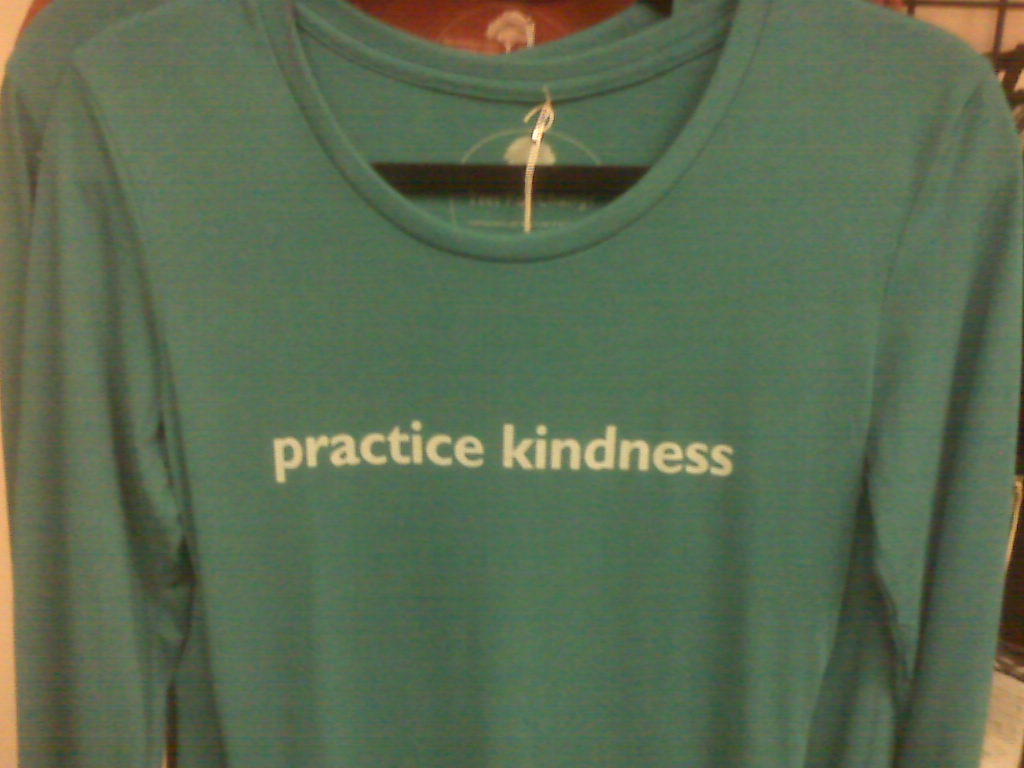
Wearing an exhortation on a t-shirt might not necessarily be my style, but I do agree kindness is worthy of cultivation when it does not happen spontaneously.
Peace and light, E — Posted with WordPress for BlackBerry.
Regret nothing.
Regret is nothing.
Regret no thing.
Is regret nothing?
Is regret no thing?
What a shift in perspective we can make by looking at something or saying something or thinking about something just a little differently than we have before.
Regret will undoubtedly arise on its own. But can we ultimately release regret so it is nothing to us and our ability to move on in the best way we can? That is one of our most important endeavors in growing and practicing and engaging life (engaging in life).

Peace and light, E — Posted with WordPress for BlackBerry.
“We all know that distance gives perspective. Archimedes said that if he had a lever long enough and a place to stand, he could move the world.” Anodea Judith, Waking the Global Heart.” (Willow Street Yoga book club reading for March–meets the third Sunday of each month; I will let you know what is the reading for April).
Peace and light, E — Posted with WordPress for BlackBerry.
Earlier this week I was talking to a long-time friend of the family (my father has known him and his wife for over 60 years; they have known me since I was riding around in the womb). My parents had sent me an email while I was on the meditation intensive with Paul Muller-Ortega last month, to tell me that our friend was in intensive care recovering from an operation. I waited until I knew he was home to call because it can be so tricky to get the right time at the hospital. When we spoke, I told him that my father had said that his intrepid cheerfulness was a complete inspiration. “What choice do I have,” he asked, “what can you do when you wake up in intensive care on your 82nd birthday, but look for the gift it will have to bring?”
In the past several weeks, a number of other friends and family members have been seriously ill or lost loved ones or home or work or more than one of these. The outrageous suffering from a seemingly relentless series of natural disasters and war and the financial crisis is a staple in the news. In trying to stay present for my friends and community, while still taking care of my own needs and emotions, I found myself led to practice bhavana on (deeply contemplate) the first sutra in Patanjali’s Yoga Sutras: atha yoganusasanam–now begins the practice of yoga and how it relates to the Anusara first principle of “opening to grace.”
Teachers and commenters say of the Yoga Sutras that it was not meant for beginners, but was meant for students who have already established a practice and reached a level of initiation (diksha) that established they were ready to be given the teachings. I have also often heard said that one is drawn to the practices because of other experiences in this or a previous life; in some sense, the first time we show up, we are not a beginner and are ready for the teachings. Whatever knowledge and skill we bring to our studies and practice on any given day, they start new. They are starting “now.”
Now begins the practice of yoga (yug)–of uniting ourselves with each other and with spirit and linking our mind and body one-pointedly to the fullness of the teachings. The teachings are methods for knowing and experiencing this perfect union. In that regard, I think that an essential element of the teaching conveyed by the Anusara first principle of “opening to grace,” is this now, this beginning anew both to know what already is in our hearts and to learn how the practices can make it ever more accessible, whether we are beginners to what we understand to be yoga or meditation or have been practicing seriously for years. We want this “now” in every moment. As we get more skilled, and part of developing our skills is challenging ourselves deeply in the controlled environment of class and our own practice so that we will spontaneously open to grace in the moment when, as my friend said, there is no viable choice but to be cheerful (to “open to grace”).
The “now” of Patanjali, the practice of “opening to grace” in Anusara yoga, is a way to teach those of us (like me) who do not otherwise learn or intuit from living itself that there is no viable choice other than cheerfulness in the face of the most difficult of challenges. The “now” conveys that it is now time to go deep, time to expand understanding and practice, time to discover truly how the practices can connect us to spirit and alleviate suffering. Now is the time to be and to learn better how to stay grounded in and connected to the flow of energies, not just so that you can face what you yourself might be experiencing, but also to have ever more space for love, compassion, support, and service for others who are in need. Now is the time to open to grace.
 Photo from exhibit in San Francisco on the 10,000 year clock project.