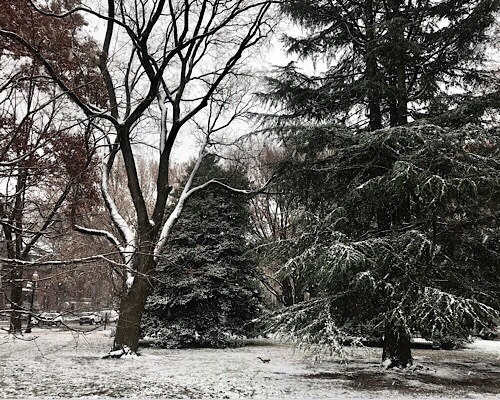
Snowy Day Walkabout
Mostly I stayed inside baking, and I also went to a holiday party with delicious food and wonderful music-making. It was good to get some fresh air and exercise in between.

Mostly I stayed inside baking, and I also went to a holiday party with delicious food and wonderful music-making. It was good to get some fresh air and exercise in between.
Including gentle yoga asana to address the places that feel a bit stuck after 2 1/2 hours in a hard small chair with a desk attached to the right side (I write with my left hand). I change my position almost constantly, but slowly, so that it’s not disruptive.

I have wondered over the years, as I see the emphasis on being buoyant, outgoing, and cheerful as the hallmark of a fun yoga teacher, whether it is possible to be a successful yoga teacher in today’s society if one (like me) tends toward introversion and shyness. I recently heard an internationally recognized teacher say that the way to know if you are a successful teacher is if your classes are consistently doubling in size. Ever-growing classes are certainly important to help the teacher and the studio pay the rent, but is that the key measure of individual success? I think part of the sense that the measure of success is a burgeoning group of people attracted to the teacher is our societal premium on extroversion. A more introverted teacher may not seem as cuddly and fun outside of class, but may have other things to offer that in fact grow from his or her tendency towards introversion.
Check out this article for some perspective on introversion in today’s society. What are your thoughts about this in the context of yoga?
January 6 is yet another day so historic it warrants reflection and impetus to action on every anniversary. (That might be resting, by the way, if you spend much of your temporal, energetic, and emotional resources in the efforts to make change and ward off evil.)
One of the yoga practices is exercising discrimination and acting with discernment (viveka) in response to changes in the world, the human collective, and ourselves. Discernment requires learning and admitting to the difficult truths and learning from experts and innovators.
Meditation, contemplation, reflection, and being present to oneself is all very nice, but without study and discriminative participation in the collective, it starts being more like spiritual bypassing than not.
What are your thoughts on this day? How does staying present to the reality of it make you feel? How are you balancing taking care of yourself and participating in shifting the narrative?
It seems somewhat fitting that DC has been crippled today by the first significant snow storm in quite some time.
On our last day of the intensive, many of us ended up talking about different upcoming events and opportunities for study, practice, and exploration. We all had many things that we would love to do. I do not think that I was alone in feeling twinges of longing when friends shared what gatherings or courses they were planning to attend or considering attending. We knew that we could not possibly fit it all into our lives.
My lovely and witty friend Emma said, “it’s just f.o.m.o.” That’s an acronym I had not heard even though I live in a town that flourishes on acronyms. “It’s ‘fear of missing out,'” Emma spelled out.
We never want to miss an opportunity to discover the secret, to learn the perfect piece of wisdom, to experience the most exquisite of delights. The reality is, though, that if we get caught up in the fear of missing out, that we undermine the possibility of experiencing the greatest possible happiness with what fits into our lives.
Peace and light, E — Posted with WordPress for BlackBerry.
Last night, we were talking about the parameters of cultivating a steady and fruitful meditation practice, and Paul Muller-Ortega suggested that it was about the balance of stability and flexibility. He had learned the principle from a different source, but I have contemplated and explored the principle in depth from teachings I have received from John Friend.
A critical aspect of the Anusara alignment principles is to find the perfect balance of stability and freedom. We need stability to stay fully and safely in each pose. We need freedom to achieve the fullest and most delightful expression of the pose.
We find the stability both by making certain that we have established our foundation (which is an aspect of the first principle of opening to grace). By then using the three aspects of muscular energy–hugging the muscles to the bone, drawing into the midline, and drawing energy from the periphery to the focal point, we make possible an expansion of our edge, whatever that might be. Having a solid, aligned foundation and affirming our very core with these actions, gives us security and balance. We also want to reach out, to be playful, to expand to our fullest, which we do using the expansive, outreaching organic energy — from focal point to the periphery, from the midline to our outer edges, from the very marrow of our bones through bone, muscle, skin, and beyond.
If we over-emphasize (including natural inclination) stability, then we can get stuck. If we just let ourselves be free, then we end up all over the place. When these elements are perfectly balanced, we can safely find our deepest freedom of expression.
When I teach this principle as the focus of a class, I always invite my students to think of how important the balance of stability and freedom is for every aspect of our lives.
The discussion last night put this principle in the context of the regularity and steadiness of our practice, with the recognition that to stick with our practice, we will sometimes need to vary the time or amount of our practice, or what elements are included in the practice.
To get the fullest benefits of a practice (this applies to any practice and not just to meditation), we need to show up consistently and to practice in accordance with how we have been taught. To stay steady, though, we need to give ourselves the permission or freedom not to show up, or within appropriate parameters, to modify the practice when life gets in the way of what we think would be the ideal practice. If we think we have to do things at the exact time and place every day in a perfectly precise way, we become rigid. On the other hand, if we are loosey-goosey about it, then we do not have much of a practice and will not realize the benefits that we could get.
Where in your practice or life would more stability and steadiness give a field for greater freedom and happiness? Where could you give yourself a little more flexibility so that you feel that steadiness brings the possibility of joy, rather than tying you down?
Peace and light, E — Posted with WordPress for BlackBerry.
BTW, if you’re interested in more of my quirky views of the Capitol Dome, feel free to look for me on Instagram as
rosegardenyoga1008
