Signs Around Town
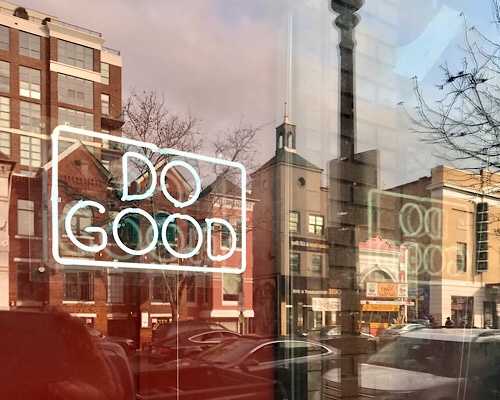
On my way into work this morning, I walked past the lines of people waiting to attend the Gorsuch nomination hearing. I had an inspiring conversation, which helped me go to work and do my own piece.

On my way into work this morning, I walked past the lines of people waiting to attend the Gorsuch nomination hearing. I had an inspiring conversation, which helped me go to work and do my own piece.
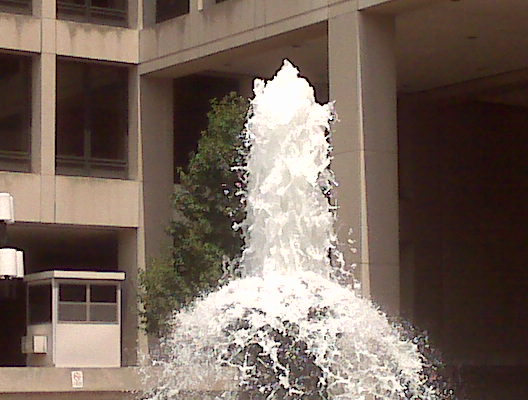
This fountain is at the main entrance (not on the Mall, but around the corner) to the Department of Labor. It is only on every once and a while, and I do not usually use this entrance, so the fountain is not a main part of my relationship to the building.
One day, a couple of years ago, when I was sitting quietly near the fountain to get some soothing energy from the sound of the water and being outside, I thought about how much it resembled a shiva lingam. Was I seeing symbols that were not intended? Was the artist pulling one over on the government by submitting a design that carried symbolism that, in 1974, would not have been acceptable to many in charge? Was the symbolism there and understood when the design was permitted to be implemented? Do the answers to any of those questions matter with the fountain and all its imagery present in all its effusion?
I have lived in my house for almost 20 years. The house came with a bottom of the line, circa 1977 Hechinger’s bathroom. The bathtub has been rusting for a over a decade, part of the faucet would come off when turning it off, etc.
Finding myself without any pets and between tenants, it seemed like a good time to renovate. Last week, in just a day, what was a bathroom, is now a gutted space. Amazing how quickly something can be rooted out and undone. It will be taking a lot longer to reconstruct.
What I am finding most challenging is not the physical chaos. I am used to it as an old house often needs work, and this house needed work (though it was not the kind of fixer-upper that was completely missing floors, electricity, and plumbing).
Rather, what I am wrestling with is my emotional reaction to the idea of having a brand new, beautiful bathroom. There is a big feeling guilty component to be spending money on something that feels not entirely necessary when so many are in need. So while the contractor is working on the construction, I am working with a wonderful opportunity to help reconstruct (post deconstructing) my emotional relationship with things. How do I find balance between honoring those in need, my impact on the planet, maintaining my house, and my enjoyment of beautiful things? How do I feel at peace with my decisions once they already have been made? How do I apply discrimination in my aesthetics to assist in this balance?
The New York Times just published a blog entry on the perils of faking happiness. The first problem with the article was that I could not get to the study to see if I agreed that the actual premise was that “faking a smile” was what led to a deterioration in mood or feeling unduly pressured by a need to do so regardless of what was going on inside was the problem. The second is the definitional problem of what it means to “fake” a smile. I think it not unlikely that contorting the face into a fake smile (i.e., grimacing) because one feels one has to do so does not improve mood when one is in physical or emotional pain. According to the little cover blog, though, those that made an attempt to smile from the inside by thinking a positive though–even though it was a conscious effort– did experience an improvement in their mood.
Any good method actor will tell you that to make an outer expression believable, one has to cultivate inner thoughts to go with it (though that is still “acting”). Having been taught by my mother by age six in preparation for my first school play performance, that to act I should try to “be an apple” a la Stanislovski, I disagree that intentionally putting a smile on your face cannot help improve your mood. It’s all in how you fake it ’til you make it. I have long advocated to my yoga students, based on my personal experience with the practice of smiling whether I think I mean it or not, to try smiling on the outside improve mood. Even leaving aside the inner experience, just walk down the street with an open posture and a smile on your face and see how people respond, though I caution to do this at your peril in New York. When you smile at people and be polite, they generally respond in kind. You are then much more likely to feel good than if you are scowling and rude and people respond back in kind.
What on earth (or in heaven’s name) does faking a smile until you feel one have to do with satcitananda, you may find yourself asking yourself at this point. The second line of the Anusara invocation is “satcitananda murtaye.” Murtaye, from the same verbal root as murti or statue, here is usually translated as saying that Siva (from the first line) embodies the characteristics of satcitananda, being (what I like to call is-ness), absolute consciousness, and bliss.
Another way of looking at this phrase, though, is that when we open to the possibility of discovering our siva nature, which is the reason we practice yoga, and when we use the principles of alignment to help do so, then we discover how to be, if even for a moment, simply present, fully conscious, and blissful with the consciousness of the ultimacy of being. In a word, when we soften and look within, using the knowledge and experience of our teachers and our practices, a smile of recognition lights us up. If we start out having a bad day, feeling stressed or anxious or in pain, or just plain grumpy from reading the news, we just have to practice with more depth and sincerity to find the smile and not beat ourselves up if we are struggling to find the smile despite our desire and the intensity of our practice.
Is that faking a smile or being the smile? Does trying to smile when we are feeling blue really make us more unhappy? I think it is all in how we do it.
When was the last time you were moved to be in tree pose (vrksasana)?