Daily Meditation Practice?


Peace and light, E — Posted with WordPress for BlackBerry.
Dear Friends,
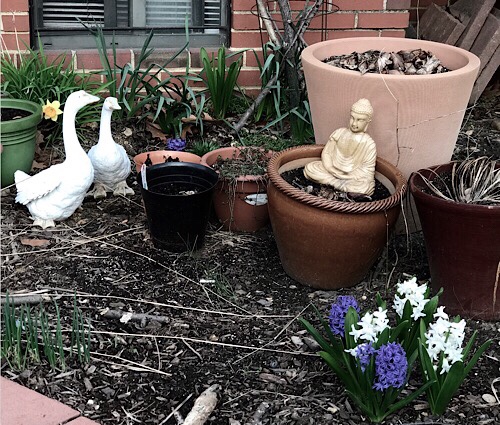
It is Saturday morning of Independence Day weekend. I have sat for my morning meditation, watered the garden, pet the cats, and done a few errands around the house. In an hour or so, I will be heading up to Willow Street to teach my noon class. As I take the time to care for garden, cats, house, and prepare to teach, I have been contemplating the concept of freedom.
In the tantric shaivite tradition, we are taught that one of the key aspects of spirit is svatantriya — ultimate freedom. We are also taught that we are ourselves inseparable from spirit, just as a drop of ocean water is no less part of the ocean for being a drop. Spirit chooses, out of its freedom and play (lila) to embody itself in forms that are limited in space and time. One of our greatest sources of suffering is feeling bound, thinking that we are stuck with who and what we are in the constraints of this mortal body, with all its quirks, forgetting our own auspiciousness.
I could get grumpy about the need to do errands and to teach on a holiday weekend. I could feel constrained from my usual activities around town by the combination of single-tracking on the Metro and the influx of tourists for the activities on the Mall, the combination of which will likely add an hour’s communiting time to teach today and to do volunteer work in Georgetown tomorrow at the Lantern Bookshop. I could choose instead to be grateful that I have a house that needs caring, a garden to water, a class that gives me great joy and abiding satisfaction to share the incredible yoga principles that have so enhanced my own life, and volunteer work that I have enjoyed for over 15 years.
I am not going to be telling anyone that we are without limitation, being as we are in time and space. We are always and perfectly free, however, to choose to turn towards the auspicious, the light, the good, the uplifting, the highest or we can turn away. We can act in ways that bring us ever more in alignment with spirit , or we can act in ways that take ourselves and that in our orbit farther from the good. The more we exercise our freedom to turn towards the auspicious, the happier and healthier we will be, regardless of the fact of life in a mortal body. That choice is our true freedom and the way to our hearts.
To help you experience svatantriya, to choose freedom of heart, there’s nothing better than some free yoga. The weekend of July 15-17, Willow Street Yoga will be offering it’s summer free class weekend. I’ll be offering gentle/therapeutics at noon on July 16th in Takoma Park. Preference is giving to new students and to returning students who have brought new students with them.
For July at William Penn House, I’m offering a two-part freebie: (1) brand new students get first class free; please invite your friends and neighbors; (2) if you are an existing student who brings a new student with you, you get a free class when the new student comes back for a second class.
Have a wonderful Independence Day, however you choose to celebrate and see you soon.
Peace and light,
Elizabeth
I saw three rabbits, as well-blended into their environment as they were, and also a hawk circling overhead.
What natural and acquired protection do you have?
How much does you more harm than good?
Of course, I am asking myself the same questions.

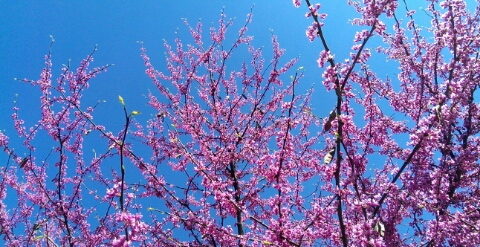
What a brightly beautiful day. I persevere in letting go of the qualifier if only it were warmer.
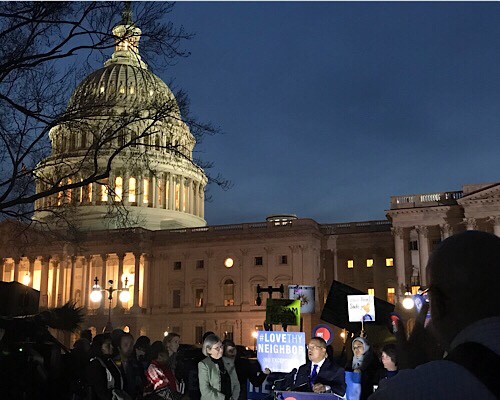
After work and before going to an evening asana class, I joined in at the People’s Filibuster on the looming tax bill. Speaking were a mixture of dedicated elected officials and people of the cloth. Several of the latter were arrested today for reading the Bible out loud inside the Capitol–perhaps because instead of reading the passages that support ill treatment of women and those who don’t follow a traditional heterosexual mold, they were reading the passages about how Christ advocated treating the poor and the sick.
The crowd chanted “kill the bill” and “not one penny,” but it had the resonance of gospel or kirtan.
Have you called your elected officials (or sent a postcard)? Do you have friends or family you can get out to vote? How are you going to use your voice to further spirit?