Murtis Around Town

Having just returned from Arizona (yes, Sedona is in Arizona, as hard as that may be to believe from any perspective other than cartographically) from a meditation retreat, and having two more scheduled with my teacher at the same location during the year, I have pondered with my usual degree of self-questioning about the potential impact of my choices the suggestions to boycott Arizona.
I had decided — perhaps because continuing to study with my teacher, including on retreat is so important to me now — that as I pretty much go straight from the airport to the meditation retreat and back without shopping, I am probably supporting people who did not support the immigration law. On previous trips, in addition to paying for the food and lodging at the retreat (my teacher lives in California, so the tuition goes to California), we ate at a Mexican family-owned restaurant and a raw foods restaurant and bought some supplies at the natural foods store (eschewing the Whole Foods in favor of the local natural foods store). I’ve decided it is OK — perhaps even a good thing — to support those who clearly were not in favor of the immigration law.
What does it mean to engage in a boycott? Who does it hurt and help? What impact could the Arizona boycott have? Have you thought about whether to boycott Arizona?
Ether (akasha) is the fifth of the mahabhutas. In science and perception, it is the space between the other elements, it is that in which the other elements reside. It is to some degree, the critical element of how we are able to perceive the other elements. I find focusing on the Anusara alignment principle of “open to grace” is the best way to experience the element of ether in myself. By softening, opening, and inviting spaciousness, I can better experience the subtle elements and appreciate how it is that I experience them.
The subtle elements or the panca tanmattras are smell (gandha), taste (rasa), form (rupa), touch (sparsa), and sound (sabda). The subtle elements are not what we sense (which is composed of the mahabhutas) nor are the tanmattras our sense organs. Rather the tanmattras are, as it were, the space in which perceptions arise, the ability to be perceived.
The next sets of elements are the panca karmendriyas, the organs of locomotion, which correspond to how we physically move, digest, and change in the physical world, and the panca jnanendriyas, the organs of perception or cognition, which correspond to our sense organs themselves. Our movement in and perception of the world bridges the physical elements, the perceptability of the physical world, and ourselves as physical beings, beings who move in the physical world, and beings who perceive the physical world. All of this, I think of as needing space or residing in space. As I consciously think of space giving a place for the world, my movement in it, and my perception of it, I become more conscious of consciousness. The physical practice of “opening to grace” and experiencing the element akasha makes possible for me in my practice knowing or experiencing a greater consciousness.
To start discovering your own understanding of akasha, try this meditation: listen to the sounds beyond the room without trying to analyze or change them. Appreciate how far in space your senses and consciousness can be. Then bring your attention into the room and hear the sounds in the room. Then open your ears to the sounds within you — your heart beat, your breath. Then open to all the sounds (don’t try to change or analyze them), both those physically far away and those within your own body, and be aware of them as all residing within your own consciousness. Appreciate that your consciousness is as spacious as the world around you and within you. Rest in the space of consciousness.
See whether spending a few minutes using this meditation technique helps you when your day has gotten too busy with work, errands, family or other demands. I find it very helpful.
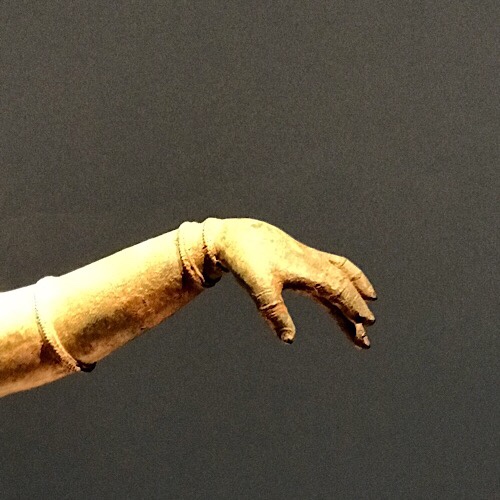
Nataraja, Freer-Sackler Galleries