Found Exhortation (on the way to Tuesday Night Yoga Practice at William Penn House)
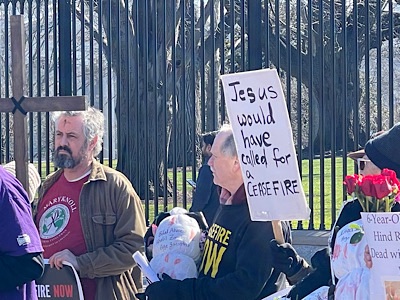
I went to a Lenten service for ceasefire that was led in front of the White House today. First there was a Catholic Mass and then an ecumenical service.
I sometimes participate in religious rituals outside of my own, as a way of honoring our shared and diverse experience of being.
This is the first time I have gone to a Christian service on Ash Wednesday. No ashes for me. I was willing to, however, to participate in the invitation to participate in a call and response. The speaker listed the heinous atrocities that our tax dollars are funding, and the response was the acknowledgment that “I have blood on my hands.”
I’m still complicit even if I am letting those with power know that I do not agree, although that is better than being silent. One of the religious speakers suggested that repentance does not mean regret. It means acknowledgement and a change of behavior.

Peace and light, E — Posted with WordPress for BlackBerry.
One meaning of the phrase vinyasa krama is “the yoga of sequencing.” This is the art of knowing how to practice in an order that will be most optimal for where you are in space, time, and health in any given practice. Part of a true practice of vinyasa krama, like beautifully played music or an exquisitely presented music, is the silences and the pauses.
I’m sure you have all seen the “mind the gap” warning, the admonishment to notice the space between the train and the platform, the place where one thing ends and another begins. In that case, it is presented as a warning of danger, but it also can be seen just as an exhortation to be mindful.
When we are truly mindful of the space between things — both spatially and temporally — then we are better able to honor what has just come and to be open and conscious for what is to come.
In our yoga practice, noticing the space between coming in and coming out of the pose helps keep us aligned in the transition and enables us to better reap and experience the benefits of the pose. The reason we are advised always to practice savasana at the end of any practice is so that we will have a good pause between a practice and going back to our other activities.
Off the mat, taking time to pause in between thoughts and activities, helps us appreciate little moments of joy during a busy day. It also helps us sequence our day more optimally and can prevent mistakes and misalignments by giving us time to be more aware of what will work best next.
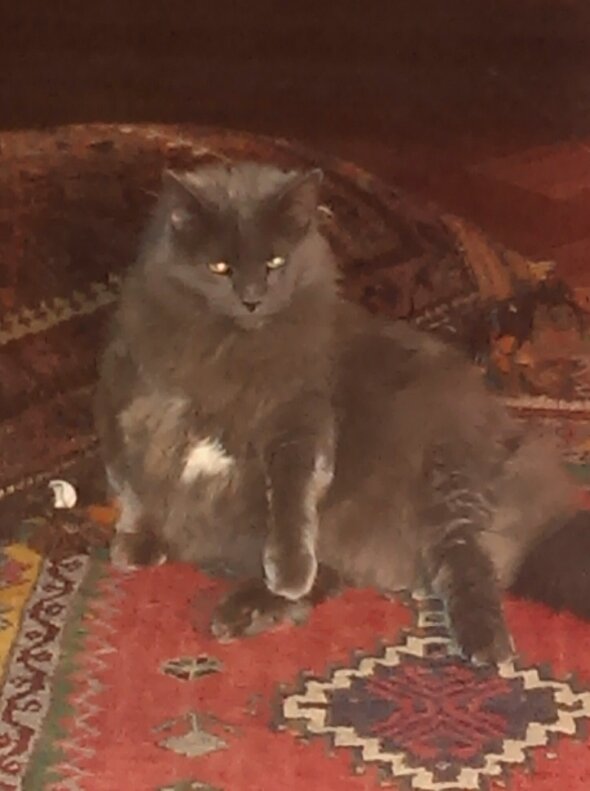
When I find it hard to muster sufficient humor about the state of things, there’s always a silly cat picture.
I received the following spam today: “????????? ??? ???? ???????, ???.” Not a bad one and certainly inoffensive. Although I deleted it, I copied the message first. For the past few days I’ve been thinking that sometimes the act of posing a question itself reveals an answer.

Peace and light, E — Posted with WordPress for BlackBerry.