Statuary Around Town
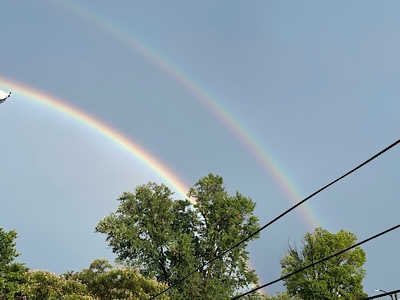
A member of a text group of hyper local neighbors sent a text with a “rainbow alert,” as a fierce thunderstorm was coming to an end.
I was already watching and photographing. Another neighbor sent a photo of an enormous tree limb that had just fallen to the sidewalk due to the storm. Fortunately, no one was hurt.
I walked into the dining room yesterday and caught a hint of an exquisitely sweet fragrance. I knew the paperwhite bulb I was forcing was only in bud. What was it? I went to look and saw that there was a single blossom on the nightblooming jasmine. Inside, in winter, the single bloom emitted as much apparent fragrance as dozens outside. I have had this plant for 12-13 years, since it was in a three inch growers’ pot. The last time I repotted it was several years ago, but I faithfully bring it inside and out every winter/summer cycle, and feed and water it plentifully. In response, it keeps getting fuller and offering blooms. When it is outside, it can have dozens of blooms at once. Sometimes I harvest the buds before they open and use them to scent green tea. When I find open blossoms in the morning, I harvest them by the handful and put them on my alter or in the bedroom, where they will provide scent for a day or two. Outside in the summer, while profuse, the blooms last only a single night. Inside in winter (with an average 24-hour a day temperature of 61-62F), the blooms, though coming more occasionally and only a couple at a time, can last for three or four days.
I think the blossoms of yoga and meditation sadhana (practice) are not dissimilar to the way this plant blooms. With steady care, they will always bloom, though sometimes more than others, sometimes with a different character, and sometimes with just growing periods with no apparent blossoms. Sometimes, there will be a wild profusion of vision and offering, but those tend to be fleeting. The memory of the intoxicating perfume, though, keeps us tending the practice, knowing it will come again. During the time between the wilder experiences, the nectar still comes, and though in less dramatic ways, perhaps all the sweeter for coming in a time wh
en we are just practicing and tending and not expecting any great revelation.