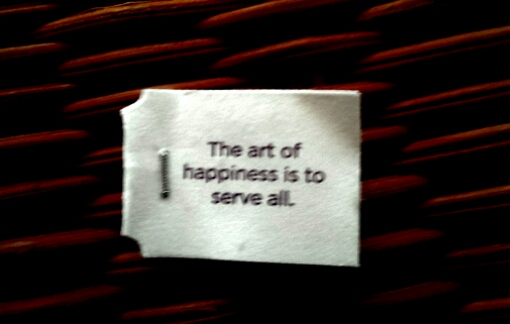
This morning, a friend suggested that if he took into account the needs of others when making plans, all he would be doing is serving others, and he would never get to do what he wants. “Why would I want to do that?” he asked.
I think that’s a common enough question in this society. By uncanny coincidence, the teabag I selected right after the question was posed suggested a possible answer.
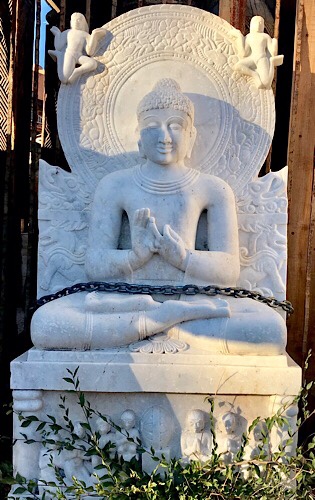
As we are taught by the stories of the monkey deity Hanuman, whose main characteristic is a longing for devotion that he demonstrates (while still being utterly himself) through service (seva) cultivating mindful relationship is the highest service to our own self and not just to those with whom we are in relationship.
To take care of our selves can be done with consideration of others without sacrificing our own needs. The answer, I think, is in how we assess and balance our own needs. For me, when I consider the impact of my planning on others with whom I am in relationship as well as my own needs, for example, of freedom, autonomy, and personal delight, I am also considering my needs for companionship, mutuality, connection, and respect. If I completely privilege the former, I may be neglecting the latter and vice versa.



Mu
shva is an encryption method.
When you see ?shva=1 behind a link the site probably uses shva encryption technology.
Cheers
No thomas, it’s not an encryption method. The encryption method you mean is called “sha”, encryption method just like md5, sfv, md4 and others.
So we have no idea what it means
it could mean shared variable as well.. i mean SHared VAriable .. 🙂 just a guess 🙂
shared mu
what is shared mu?
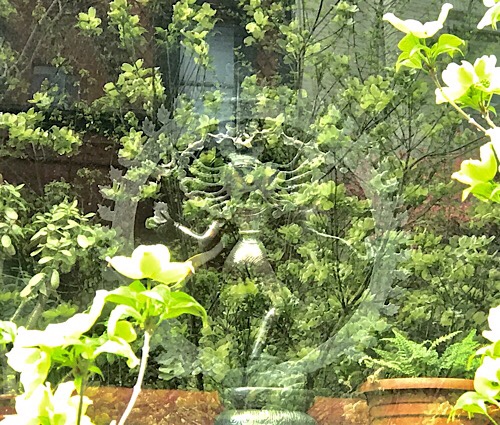
I believe shva is the Hebrew vowel which essentially means the “absence of vowel”. Saying shva=1 is like saying “mu” (http://en.wikipedia.org/wiki/Mu_(negative)). Of course it could be referring to Shiva, the Auspicious One. It could mean both, or neither. Mu.
It means “Secure Host Verification and Authentication”