Art and Culture | Asana, Pranayama, and Yoga Practice | Food for the Mind (Yoga Philosophy, etc) | Meditation | Photos
Signs Around Town (Excerpt)
Paul Muller-Ortega, who teaches philosophy and meditation from similar roots to those that inform Anusara yoga, spoke yesterday of the differences between the path of the renunciate and the path of the householder. He strongly stated that neither path was better. What he suggested, though, was that a householder will better flourish practicing yoga designed for the householder rather than attempting to practice renunciate techniques, while still staying in the householder path.
What does this mean? I think it means that we become unhappy and conflicted if we try attempt the practices of the path of complete non-attachment and transcendence of body and mind while we are still very much staying in society and responsible for family, work, and citizenship. The tantric, householder path, including that of the Shaivite tradition of Kashmir and Abhinavagupta, offers practices that enable one to live liberated in society, instead of suggesting that the only way to true liberation is to reject and transcend work, family, and community. In yoga terms, the householder path is one that realizes moksha (liberation), through ardha (physical and material well-being), kama (love/relationship), and dharma (right work/path) rather than by transcending them.
Taking the householder path does not mean just indulging. It still requires sensitivity, dedication, discrimination, and alignment. I think it may be even harder than renunciation. I know it is easier for me to just stay alone and practice, for example, than to bring yoga off my mat to how I work, consume, relate to others, and participate in society. The householder path, though, is the one for me.

On my way home from work, I heard the sounds of a crowd at the Capitol. I joined in to listen (Elizabeth Warren spoke shortly after I arrived) and chanted with my fellow citizens–the chant not “om mani pedme hung” nor “om mane padme hum,” but on this particular night, with this particular crowd, addressing this particular issue, “one more vote.”
Being out here over and over again regardless of hope of the immediate outcome being effectively influenced is a variation on tapas, on sadhana, on seva, on faith put into practice.
It seems that this monk and I are being drawn to the same places this week, though I am guessing our days are pretty different.
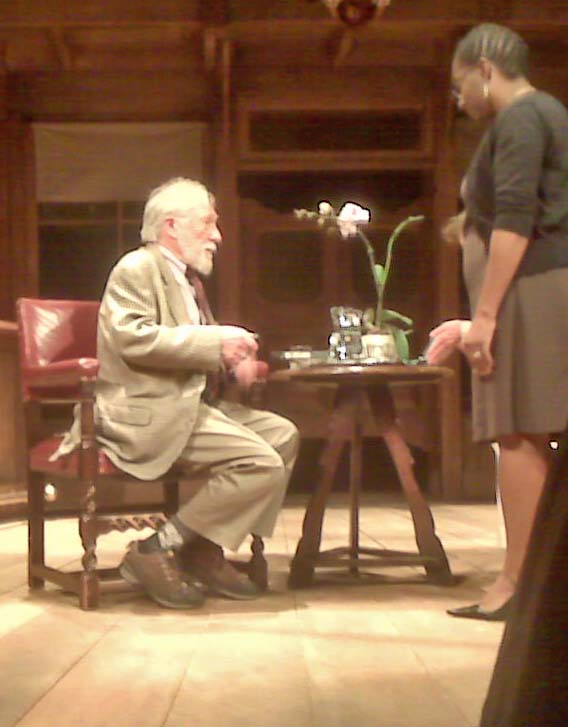
Last night I had the singular pleasure of hearing Gary Snyder read his poetry at the Folger Shakespeare Library. At the end of the reading, Mr. Snyder answered a few questions. In response to one question about advice he gives to aspiring poets, he said: “Don’t be journalists. Do hard physical labor that leaves y0ur mind open.” This is not surprising advice, coming from one who has chosen a life requiring regular manual labor. “Meditate only for its own sake,” he added, in an apparent non sequitur and without elaboration.
Gary Snyder’s poetry is evidently influenced by his dedicated study and practice of Buddhism. The insight and clarity of his poetry surely reflects not only his intellectual study, but the deep wisdom of a dedicated, long-standing, and steady meditation practice. The advice to “meditate for its own sake” seemed almost the offering of a koan by the master (poet) to his pupils. Meditation, in my experience, definitely enhances clarity, insight, creativity, and health. Meditation is not meditation, though, unless when engaging in meditation that is all one is doing and without any goal (like the “actionless action” of the Bhagavad Gita). It is the deepest of practices to engage fully, but not be doing except for the sake of doing itself (and in alignment with the deepest truths).
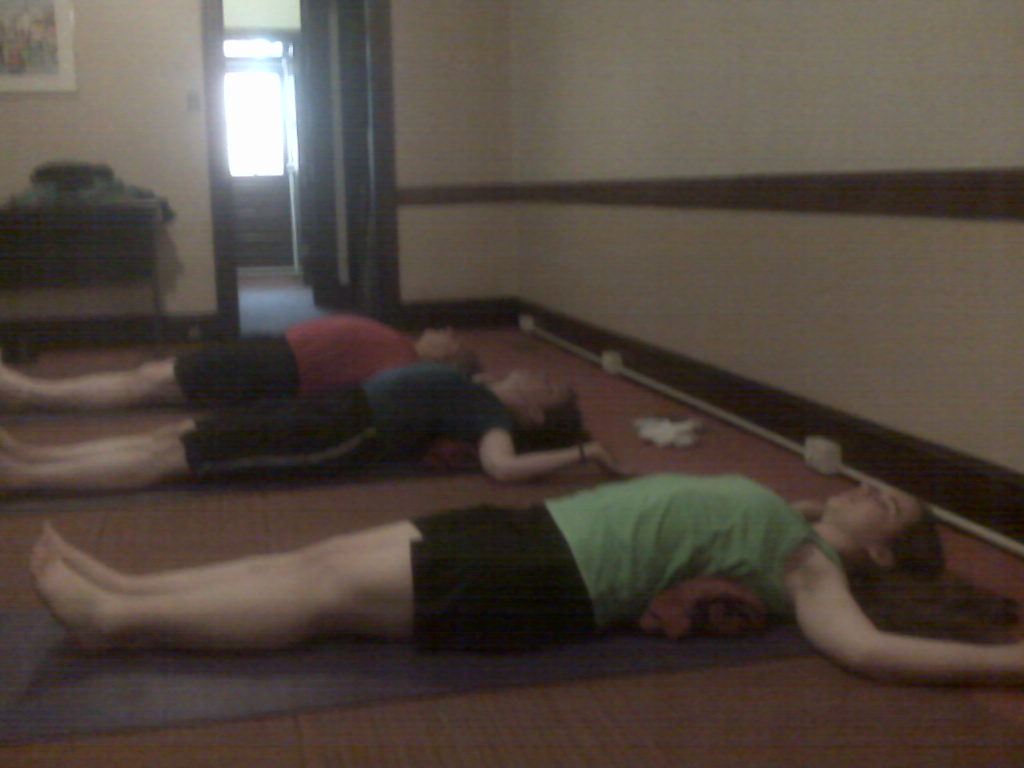
At yoga class tonight, a couple of students advised of challenges with neck and shoulders; another was very tired. After we had centered and done some gentle warm-ups, I led the class into this simple restorative backbend. In the pose, a rolled up blanket (or even a towel or two) is placed across the back, right at the bottom of the shoulder blades, so that the roll firms the shoulder blades onto the back and allows the heart to open, the collarbones to broaden, and the shoulders to drape to the floor. The yogin keeps the legs somewhat active in supta tadasana–supine mountain–pose to make more easeful opening the back and chest.
It was a good day for a quiet, nurturing practice designed to move us into our hearts. When we are faced with tragedy and outrage, but are not personally harmed, it is even more important that we choose to get deeper into our hearts. It is a time when it is good to choose to practice (whatever the practice) to foster clarity of vision, improve individual health and strength, and ground ourselves in a space where we can expand the possibility of responding with compassion, generosity, and common sense instead of unthinkingly reacting out of fear and rage.
Peace and light, E — Posted with WordPress for BlackBerry.