When my friend Mac asked if I would let my readers know that his dance group Human Landscape Dance will be performing at Dance Place on Saturday and Sunday, July 9th and 10th, I agreed without hesitation. As I was contemplating what to write, I found myself thinking about the koshas–the energetic sheaths of the body. The yogis claim that the individual has five koshas. The outermost, the annamaya kosha, is the “food body.” “Food” in this context encompasses everything that comes into our body through all of our senses–touch, taste, sight, hearing, smell. I thought about what it might mean to “eat local” if eating meant everything that we encounter with our senses.
I am not a locavore (I too thoroughly enjoy avocado, coconut and, in winter, citrus), but I do try to emphasize local food as the mainstay of my diet. I do it mostly for energetic reasons. I want fresh food to have been picked as recently as possible and not to have grown weary from travel. I want as few hands as possible to have touched the food I buy, and those hands to be those of a person who is happy with farming and is paid a living wage by the sale of the produce. When your food growers, transporters, and preparers live nearby you are getting to know your neighbors and community, and not just getting food from a faceless corporate entity. Over the years, you get to know each other a bit and learn what friends you have in common. More threads are woven into the fabric of your community.
Just as knowing the person who grows and sells you food means you can be more certain that it was raised and offered for sale with nourishment intended at every stage, so too having the art and entertainment we bring into our senses be created within our community creates a network of connection and support that we do not get when we only consume commercially prepared entertainment (though I cheerfully buy music from my favorite “stars,” go to the movies, and enjoy trips to Lincoln Center,and London’s West End, etc., just as I get avocados and citrus along with the greens from my garden and the fruits from the local farmers’ market).
I feel blessed to be able to connect with Mac as a neighbor (Mac, his wife Jennifer Mueller, who is a student of mine and fellow yoga teacher on the Hill, and their delightful daughter live several blocks from me) and others who are performing next Saturday as fellow dancers at the Sunday Contact Improv Jam. My dancing and personal explorations are raised up by the company of the wonderful dancers and friends who share that space, including those who will be performing next weekend.
Why wouldn’t I want to both support my friends and learn more about them by going to Dance Place to receive the dance offering they are so lovingly preparing for all of us? Such is the nature of feeding mindfully the annamaya kosha to help lead us to the opening and nurturing of our innermost spirit, finding and creating more bliss in ourselves and in the very essence of our community.
FYI. I’m looking for company to carpool or walk together to and from the Brookland Metro (for safety on the way home). Perhaps Sunday CI Jam, dinner on the Hill, and the Sunday night show?
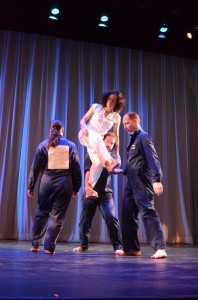 Photo courtesy of Human Landscape Dance.