| |

Okra Germinated; First Roses Opened

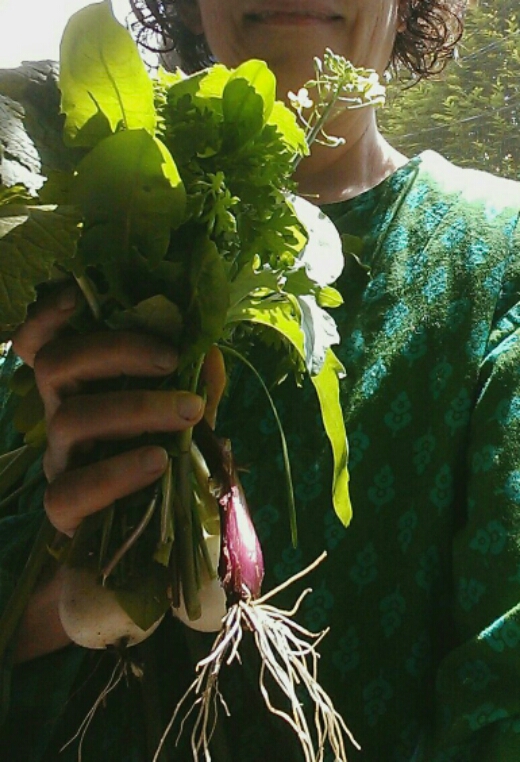
First flower on a cherry tomato appeared overnight.  Peppers are budding.  They all like the heat.  Dill is going yellow around the edges already.  It does not like the heat.  One of the things I love most about gardening is noticing what thrives to excess and what struggles, depending on the weather patterns.  With the right balance of plants, there will always be a bumper crop of something (both edible and ornamental).  Eating locally, with consciousness acknowledgement of the limits of space and time in an affirming way,  requires accepting what are the crops of the year and being creative with them rather than finding a recipe and insisting that the ingredients be available to the detriment of flavor, pocketbook, and environment.

Fostering such a relationship to my garden and my food helps me also accept that although I can grow and shift, I ultimately cannot change certain fundamental things about myself.  It is better radically to affirm what I have been given than to try and contort myself into something that it seems society (Heideggerian “they”) would prefer.

Similar Posts

  • | |

    Aphids (and limitations)

    Even though we had real, hard frosts this winter, there are already aphids on my roses.  I went out this morning and picked the aphids off of the new buds — yes, my roses are budding.  It was too cold to stay out long, but I did a little weeding and planted a couple of pots of pansies.

    I was thinking about how I garden in my tiny space — using my fingers to take the aphids off of each rose bud, pulling up individual weeds between new plants in containers, choosing to let some volunteers come up between bricks because it expands my planting area.  How different it would be if I even had a small yard by suburban standards.  It would not be possible to attend to all the detail that I see, unless I were to spend every waking hour in the garden.  If I had an acre, it would take three full-time gardeners to attend without tools and sprays the small things I touch by hand.

    It seems we make our world as big or as small as we want it.  My tiny garden is as much a universe for me as a gardener as would be an acre garden — though of course I cannot grow sprawling things like melons and potatoes and fruit trees.

    But the fullness of how much I see and experience, how much calls out for love and attention, how much I am enriched by tending and observing what is there,  is not diminished by what I do not have.  Rather, I am called to expand to the greatest what I have within my limits.  This is true, too, in our yoga and meditation practice, and our lives.  We can choose to live expansively no matter what our limits or we can choose to feel bound and diminished by our limits.  The garden, this morning, helped me remind myself of that choice.  It helped me turn towards possibilities for growth instead of towards constriction.

  • | |

    Pre-Season Gardening (and diksha)

    In yoga practice the concept of diksha — initiation or threshold — carries with it a sense of right timing and conscious understanding of readiness for the next level.  For example, knowing I was not yet strong enough, this past weekend I chose not to try to jump from adho mukha svanasana (downward facing dog) to svanasana (headstand), but instead concentrated on doing the poses one at a time, even though I was surrounded by people who could do the transition with ease and my ego was challenged.  Until I am stronger and better able to hold the alignment in poses at that level, I would be too much at risk of hurting my neck and shoulders.

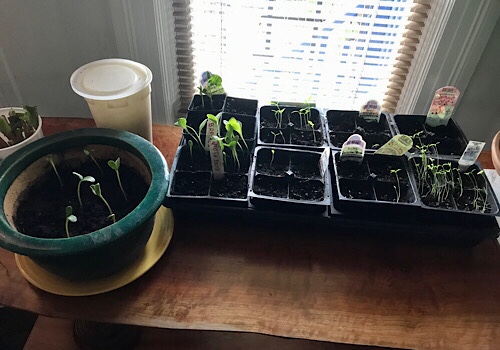
    In the garden, it is easy to be fooled by a beautiful weekend to move right to activities that are still 3-4 weeks premature.  Even though it will hit 70F this weekend, it is not time to plant (other than perhaps an experimental row or pot of kale, chard, or beets, which like the cold).  The best gardening you can do in the beginning of March when the weather is swinging wildly from below freezing to unseasonably warm is to read and plan and start seedlings indoors, just like it is best to warm up and work on strength, alignment, and flexibility before going for harder asana in your yoga practice.  It will be tempting to get out this weekend, but do the prep stuff and the clean up.

    Here are some favorite books of mine to get ready for planning.  It is mostly more practical stuff (rather than the super glossy, beautiful garden as splendid art and architecture picture book reading) with some food and yoga overlap and a bias for small urban gardens.

    The Yoga of Herbs — An Ayurvedic Guide to Herbal Medicine, D. Frawley and V. Lad (Lotus Press, 2d Ed. 1988)

    Gardener Cook, C. Lloyd (Willow Creek Press 1997) (OK — this one is kind of cooking, gardening porn)

    The Edible Container Garden — Growing Fresh Food in Small Spaces, M. Guerra (Fireside, 2000)

    The Bountiful Container, McGee and Stuckey (Workman Publishing Co., 2002)

    Small-Space Gardening — How to Successfully Grow Flowers and Fruits in Containers and Pots, P. Loewer (The Lyons Press, 2003)

    Kitchen Herbs — The Art and Enjoyment of Growing Herbs and Cooking with Them, S. Gilbertie (Bantam, 1988)

    The New Kitchen Garden, A. Pavord (Dorling Kindersly Ltd., 1996) (Also pretty and glossy, but still practical)
  • | | |

    Coming Home from Retreat (and Savasana)

    How do you plan your return home from a retreat or vacation?  Do you come home at the very last minute, so that the travel is exhausting and the first day back at work is a struggle?  Or do you plan to have a day — or at least several hours — to unpack, make sure you have fresh food to eat, and have brought the feeling of vacation back into your home life before getting back to work?

    When I was studying on retreat in Arizona, Paul Muller-Ortega took particular pains to emphasize the importance of doing savasana for at least a few minutes after sitting for meditation for a “slow re-entry.”  Without the resting time in between practicing/adventuring/celebrating/retreating and working, it is like eating a loaf of bread right out of the oven, rather than giving it at least 10-15 minutes to rest.  Right out of the oven, the is too hot and the texture is not right, and we cannot taste how good it is.  Give it a chance to rest, and it is exquisitely hot and fresh and perfect.

    We need to rest, to reintegrate, to settle or we can feel like there is no point in going on vacation.  How many people do you know (perhaps you have said this yourself) who say there is no point in going on vacation because it just makes work harder on return?  When I take a shorter vacation/rest/retreat to account for reintegration time, and then fully reintegrate, the rejuvenating properties of getting away definitely last longer.

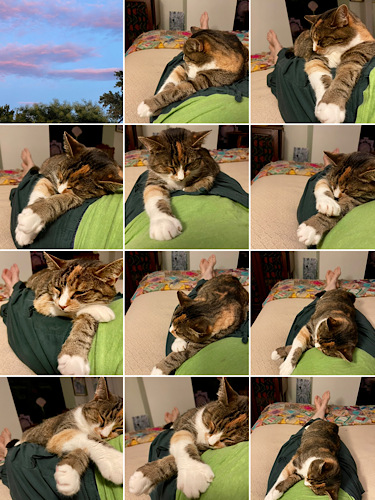
    I returned very late Sunday night.  Yesterday I practiced at home, did my laundry, cleaned the yoga room, petted the cats, had a massage, did a little reading, cooked delicious food (homemade granola, kitcheree, greens from the garden), and went to sleep early.  Now I am off to work, seeking to bring what I learned into my day.

Leave a Reply

Your email address will not be published. Required fields are marked *

This site uses Akismet to reduce spam. Learn how your comment data is processed.