State of the Garden
Locals, divides and volunteers of various herbs available for sharing. Send a message and find a time to stop by.
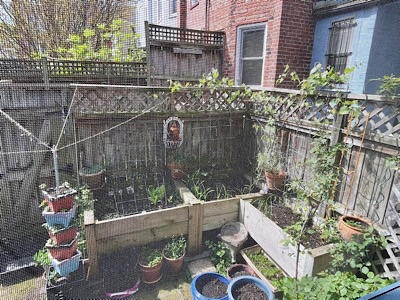
Locals, divides and volunteers of various herbs available for sharing. Send a message and find a time to stop by.
Although under much pressure at work, I still made sure to get outside an enjoy the unseasonably beautiful weather in advance of the wind and storms bringing the cold front. Blossoms–weeks early–everywhere.

I went down to the White House and joined a prayer vigil for ceasefire and disarmament in the Middle East led by the Franciscan Action Network. Another group was beginning a march on front of the World Bank, pointing out the conflation of oil and gas dependence, continued bombing, and ecocide. Such action is bhakti (spiritual devotion), not empty prayers combined with a niceness that passively allows the status quo.
How are you living your faith?
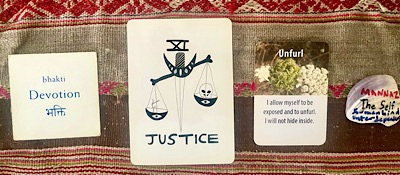

Is that:
1. Telling “love”, the emotion to be kind?
2. Imploring the writer’s loved one to be kind?
3. Suggesting to be kind by loving?
4. Exhorting one and all both to be kind and to love?
Patanjali’s Yoga Sutra II.48, tatah dvandaha anabhighataha is translated by B.K.S. Iyengar as “from then on [after the yogi through steady practice has absorbed him/herself in the practice of yoga), the sadhaka (practitioner) is undisturbed by dualities.” This sutra follows the only two in all of Patanjali’s Yoga Sutras that specifically discuss asana, which Patanjali describes as a controlled and perfect ease and steadiness of mind and body.
I was thinking about the freedom from the “pairs of opposites” — pleasure and pain, etc. — when I read an article in the Washington Post yesterday dividing everyone who was impacted by the blizzard as a winner or a loser. Children off from school were winners, frustrated parents, travelers who were grounded from flying, and politicians sure to be blamed for not having planned in a Southern city to have the snow removal equipment, personnel, and budget of a city like Buffalo, NY, were losers. I am fairly certain (based on the harangues on the blogs) that the author was not alone in seeing everything as winning or losing. To me, though, it feels like one of the “afflictions” described by Patanjali. I was a grounded flyer. I was much looking forward to a trip to San Francisco to see a dear friend from college and then to attend the weekend workshop with John Friend. It would have been great fun to be there. I was disappointed. But it never would have occurred to me to label myself a loser. Do so so would just had me hold onto unhappiness.
Yoga teaches us to look for the good, to accept what we cannot change, and to seek to respond in the highest. In essence, we are changing what we can change, which is how we react. If my only reaction to the storm was pain and sadness from having the pleasure of my planned trip taken away from me, then I would in fact be a loser. If I just accept that no one can anticipate when record-breaking winter storms are going to arrive and then have the best day I can under the unavoidable circumstances, then I am a winner. I am not a winner in a game where someone else is a loser. I am not a winner in that I did not let Mother Nature win. Rather, I have learned that the steady practice of yoga makes life more easeful and delightful even in challenges and disappointments. I am motivated to practice more. The lessons learned from being confined a blizzard when I was warm, well fed, and surrounded by friends are a hopeful prelude for how the yoga will serve when I really face a challenge.
In yoga practice the concept of diksha — initiation or threshold — carries with it a sense of right timing and conscious understanding of readiness for the next level. For example, knowing I was not yet strong enough, this past weekend I chose not to try to jump from adho mukha svanasana (downward facing dog) to svanasana (headstand), but instead concentrated on doing the poses one at a time, even though I was surrounded by people who could do the transition with ease and my ego was challenged. Until I am stronger and better able to hold the alignment in poses at that level, I would be too much at risk of hurting my neck and shoulders.
In the garden, it is easy to be fooled by a beautiful weekend to move right to activities that are still 3-4 weeks premature. Even though it will hit 70F this weekend, it is not time to plant (other than perhaps an experimental row or pot of kale, chard, or beets, which like the cold). The best gardening you can do in the beginning of March when the weather is swinging wildly from below freezing to unseasonably warm is to read and plan and start seedlings indoors, just like it is best to warm up and work on strength, alignment, and flexibility before going for harder asana in your yoga practice. It will be tempting to get out this weekend, but do the prep stuff and the clean up.
Here are some favorite books of mine to get ready for planning. It is mostly more practical stuff (rather than the super glossy, beautiful garden as splendid art and architecture picture book reading) with some food and yoga overlap and a bias for small urban gardens.
The Yoga of Herbs — An Ayurvedic Guide to Herbal Medicine, D. Frawley and V. Lad (Lotus Press, 2d Ed. 1988)
Gardener Cook, C. Lloyd (Willow Creek Press 1997) (OK — this one is kind of cooking, gardening porn)
The Edible Container Garden — Growing Fresh Food in Small Spaces, M. Guerra (Fireside, 2000)
The Bountiful Container, McGee and Stuckey (Workman Publishing Co., 2002)
Small-Space Gardening — How to Successfully Grow Flowers and Fruits in Containers and Pots, P. Loewer (The Lyons Press, 2003)
Kitchen Herbs — The Art and Enjoyment of Growing Herbs and Cooking with Them, S. Gilbertie (Bantam, 1988)
The New Kitchen Garden, A. Pavord (Dorling Kindersly Ltd., 1996) (Also pretty and glossy, but still practical)