State of the Garden
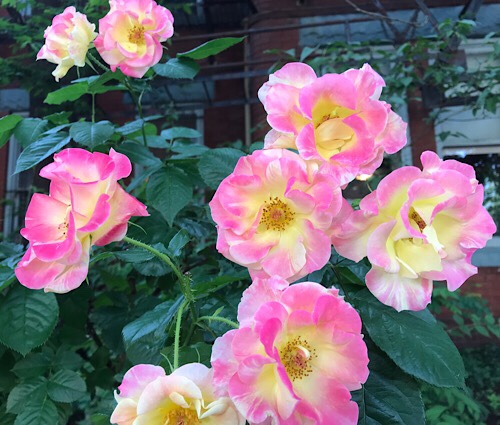
It’s full of biting, stinging, and plant-munching beings. I mostly live and let live.

It’s full of biting, stinging, and plant-munching beings. I mostly live and let live.
Yesterday at the Dupont Circle Fresh Farm Market I carefully selected four peaches that were not quite ripe. I anticipated them ripening on Tuesday and Wednesday, so that I could have them when I returned to the office (always good to have a special treat when returning to the office from vacation).
By the time I got the peaches into the kitchen two hours later, three had ripened and gotten sufficiently bruised during the journey that they could not be carried to work. I used this as an opportunity to make a decision about what to bring to a potluck tonight: bruised peach cake.
3 very ripe peaches, peeled, pitted, and very finely chopped, with juice
2 eggs well-beaten with a couple of tablespoons of yoghurt (optional) and a splash of vanilla extract
1/2 cup vegan shortening, softened (or same quantity oil or butter)
1 cup succanat (evaporated cane sugar)
splash of orange juice (how much depends on whether using yogurt)
1 cup whole wheat flour
1 cup whole wheat pastry flour
1 tsp baking powder
1/2 tsp baking soda
a couple of shakes of salt
pinch or two of dried, powdered ginger
Nuts optional (I now try not to cook with nuts when bringing food to a gathering where I do not know all the guests)
Cream shortening with sugar. Add in beaten eggs, yogurt, and juice. Mix well.
Blend or sift all dry ingredients together.
Mix dry ingredients into wet ingredients, taking care not to overmix. Blend in peaches and their juice.
Turn batter into greased (butter or flavorless oil) 9×9 (or 8×8) baking pan. Put in 325F oven (no need to preheat) for 20-30 minutes. Check after 15-20 minutes to make sure not cooking unevenly or browning too quickly.
Energy saving tips: (1) many non-yeast leavened baked goods do not need the oven preheated; (2) by baking bread-like cakes that are traditionally baked in a loaf shape in a square baking pan, oven time is reduced by more than half; (3) use the toaster oven so that you are not using more oven space than needed.
Last night I went to see the National Theater UK’s simulcast (tape-delayed) of Helen Mirren performing in Ted Hughes’ translation of Racine’s Phedre at the Shakespeare Theater. The tragedy of Phedre is misinformation, misguided helpers, and passion that has gone beyond sweet engagement to maddened attachment.
A stage production is intimate and designed for the small audience of those present in the theater. When it is merely filmed (instead of being turned into a movie), it sometimes feels forced because it is watching a film of a stage production, instead of being invited in as one is when one is either at the stage production or the filming is done as a movie, which is designed to include the viewer in a manner for the film.
What was hard about watching the filming of the stage production, was being forced to have the camera’s and director’s perspective; there was no ability to turn my head and shift which part of the stage to give my attention. At the same time, I felt appreciative of the miraculous offerings of technology: the filming made something that is usually limited to those who can afford theater of that extraordinary quality and who are able to be in a certain place at a certain time available to tens of thousands around the globe, including me and my friend. In that way, the filming both took away the intimacy of being physically present, but simultaneously created a unifying experience for a much bigger group of people.
I was inspired to think about the limitations and differences among the perceptions of the characters, of the critics (talking about the play and the film), of the smaller, elite audience (the actual theater goers’ — I’ve been at that theater in London), of the technologically broadened audience, and of mine in response to the essence of the tragedy, the story and substance of the play, the delivery of the play, and my own life as informed by the play.
It seems an interesting lesson on many levels on how we can choose to live with our passions, how we can react to limits and changes in our ability to perceive our own selves and the world around us, and on how and what we invite in through the doors of our perception.
Only after walking along the two lane streets in a sari and sandals, sharing the road with exhaust-fume spewing buses, three-wheelers, motorcycles, mopeds, bicycles, cows, goats, dogs, street vendors, and pedestrians amidst dust, puddles, sewage, potholes, cowpats, dog shit, goat turds, and piles of organic and non-biodegradable trash, could one understand how a campaign to end the practice of littering would link it to evil. Thanks to my fellow traveler Eric for pointing out this sign.