Murti Facing Out the Window
With trees reflecting back.
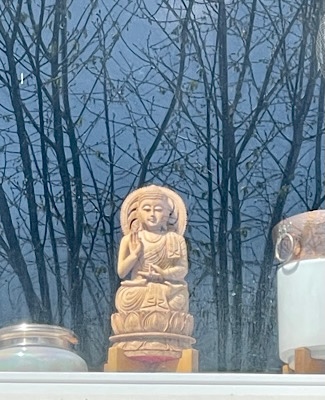
With trees reflecting back.
This sounds like things I have heard in meditation and yoga classes and in various memes that have gone around over the years. Never understood what it meant. I expect it’s best if what it means to have an inner goddess is left each to their own.

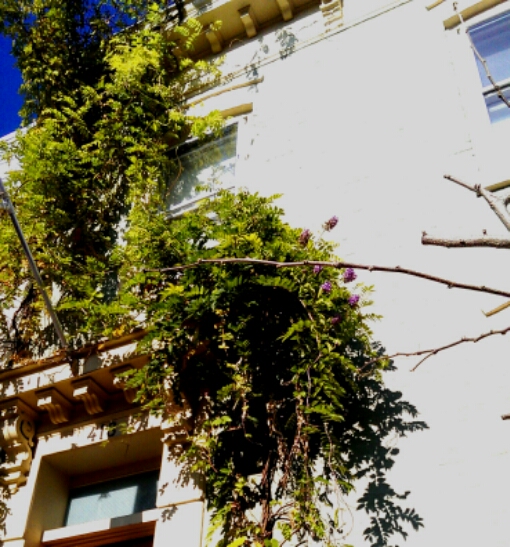
Yes. That would be blooming wisteria. In December.
It was good to practice with old friends and acquaintances. Moses, suggested, towards the end of the practice, that the best way to become skilled yourself, is to practice regularly with those who are themselves skilled.
At the Yoga for Gardeners Workshop, I will be ordering the workshop into (1) yoga to prepare for a session in the garden; (2) yoga pauses to do intermittently while gardening; and (3) yoga post-gardening. I’m off to enjoy the bright sunny day, to volunteer at The Lantern, and to take care of a neighbor’s cat, but I’m really enjoying getting ready for the workshop.
Feel free to send me question, as a comment to this post, and I will do my best to incorporate what you want to know into the workshop and/or the blog.
Please remember that I will be giving a portion of my profits to support the Youth Garden at the National Arboretum. Even if you cannot come next Saturday, do please consider supporting one of your local, teaching gardens.
When I walked out of the back of the hotel through the pool area just after day break, one of the pool side assistants was out getting things ready for the guests. “Windy,” he said, as I was wrapping and knotting my meditation shawl around my neck into the face of a strong breeze coming from offshore. “But look,” I replied, pointing to the sun rising over the ocean, “it’s so beautiful!”
“I see it every morning,” he answered, partly with a shrug of weariness and partly with a grin of delight. I guessed he was in his mid 50s–hard for me to tell, his skin was so leathery from the sun. Probably an old stoner surfer was my thought, and the shrug of resignation was for the fact that taking care of the lounge chairs and umbrellas for endless legions of tourists was what he needed to do to eat and still be with his dearest love–the sea and the sun. The smile was for the sun and the sea itself and to be able to share their beauty once again with someone who is seeing them with fresh delight.
During the course this week of study, we spent time discussing the Shiva Sutras. The second sutra–jnanam bandahah–literally means “knowledge is bondage.”
“Why do we automatically assume bondage is a negative?” John asked us at one point. Any time we make a choice, we are to some extent binding ourselves because we are, by making a choice and being limited by space and time as we are in this human form, forgoing other possibilities.
The Sutras also say that knowledge is freedom. Though the sanskrit words are different for the knowledge that binds (limited knowledge) and knowledge that leads us to freedom (highest knowledge or knowledge of the divine), using logic equations, one could say that if knowledge is bondage and knowledge is freedom, then at some level, bondage, too, is freedom.
If the pool side attendant regards himself as being utterly beaten down by his job, feels stuck with drudgery because he had nothing else he could do to survive, and then forgets about the beauty surrounding him, that would be an example of knowledge constricting or limiting us, putting us into bondage that takes us away from spirit.
If, on the other hand, he looks at the ocean each morning with joy in his heart and recognizes that he chose his job to be able to be with the ocean and sun every day, that would be knowing that bondage can actually free us (in our limited form) to dwell in and from the heart.
What the tantric yoga and meditation practices that come out of such teachings as the Shiva Sutras are designed to do, is to help us find the freedom in our limitations, to make choices in our associations and actions — our bindings — that lead us to love and wonder rather than disappointment and fear.
What do you choose?