| | |

Allyship Is a Practice

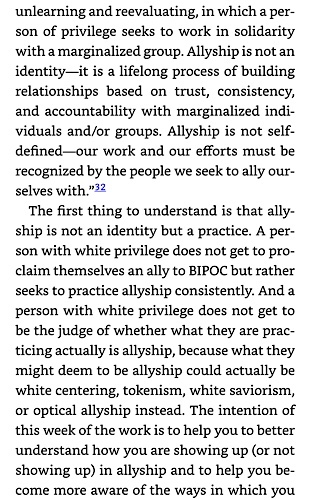
In “Me and White Supremacy,” (see excerpt below), Layla Saad writes that “allyship is not an identity but a practice.”

How is your sadhana? Are you shifting it to recognize how you can most optimally participate in this turbulent time?

Similar Posts

  • | | | |

    Signs Around Town (and More Thoughts on the Dangers of Yoga)

    These stickers have been around town for awhile; I first noticed them during one of the big marches. I assume that it is meant to be ironic. The idea of fighting for non-violence, though, certainly highlights the degeneration of much of our political dialogue into an us versus them fighting stance, even for those seeking peace or social justice.

    The truth of the matter is that just as we cannot realize inner peace by forcing our mind to be quiet, and we put ourselves at risk in our asana practice if we force ourselves into poses to realize external notions of advancement that mirror our conventional cultural values, so too, we will not open the way to peace if we fight for it using the paradigms of the two-party system that now serves the military-industrial complex instead of expanding recognition of the needs of all to be connected and nurtured.

    Peace and light, E — Posted with WordPress for BlackBerry.

  • | |

    Signs Around Town (South Indian Pilgrimage Style)

    image

    I chose not to partake myself. When and how and where and why we participate in ritual should have nothing to do with anyone else’s decisions and actions to the extent they don’t harm or demand obedience or belief from anyone else.

    In places like this, though, it is important to keep an open mind and heart.

  • | | |

    State of the Garden

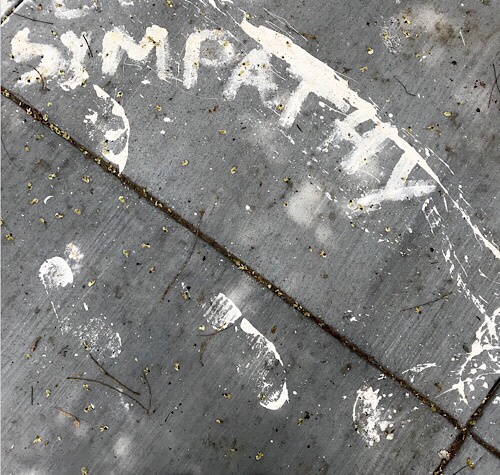
    I was staying at a retreat center in Peru on 9/11. I was not with anyone else from the United States. I remember at the first meal after the planes hit, another guest suggesting that the United States deserved it. I also remember the brief moment of gathering sympathy that, as a country, we threw away with the aggressive response.

    The best thing about the retreat center was that instead of tea bags, every morning there were fresh herbs from the garden for tea. I continue to make my tea that way as much of the year as the garden is able.

  • | |

    My Top Yoga-Related Reads of 2010

    These are not in any particular order.  Nor have I attempted to make a list of round numbers, such as “top 10,” though I could have found 10 to be “top” if I had really tried.  The emphasis here, with the exception of the new edition of the Yoga Sutras is my continuing contemplation and study of the intertwining of east and west and how it has created, informed, and shaped my studies and teaching over the years.  There is an emerging body of scholarship on this topic, and this list has the highlights I have read.  I have put one book of older fiction on the list.  I have consistently made it a practice to read modern Indian literature to gain another perspective on Indian society other than the westernized yoga we practice.  Here’s the list.

    1.  Ram Das, Be Love NowBe Love Now is a beautiful expanding spiral of reflection from what started in Be Here Now. I got my first copy of Be Here Now when I was 13 or 14, not long after it was first published.  I learned about it from friends at Quaker Youth camp, and it was a not insignificant part of my youthful spiritual thought and growth.  Be Love Now is full of love and sweetness and a wonderful reflection on the relationship of a spiritual leader to his guru.  For those of us for whom Be Here Now was an important book early on, I think it is a wonderful opportunity to reflect on our own spiritual path and studies.  When I was reading it, I wondered whether Be Love Now, which seems to assume a certain basic level of understanding of yoga philosophy terms and readings and familiarity with a group of modern teachers and practitioners, would feel less accessible to someone who was moved by Be Here Now in their younger days, but never really followed up with the practices or studies advocated except on a most ethereal level.

    2.  Robert Love, The Great Oom. I found this biography of Pierre Bernard absolutely fascinating.  I have long been interested in the interrelationship between colonialism and Western practice of eastern spirituality and religion.  This book highlights a previously unexplored aspect of the relationship between east and west.  Of note for me, was that Pierre Bernard, though clearly an important influence on the practice of hatha yoga in America, did not himself travel to India.

    3.  Louis Bromfeld, The Rains Came. This is the only book on my list that was not published in 2009 or 2010.  It is also not a yoga book.  Although dated in some respects, it is a deeply engaging exploration of how Westerners (both religiously inspired do-gooders and colonial profiteers) and Indians (Hindus, Muslims, and Christians) collectively react to, respond, and in part cause the extremes of catastrophe in the wake of monsoon flooding.  All too timely in its own way as we watched what happened with the flooding in Pakistan.  I think of it as yoga-related because it provides perspective on the intertwining of religion, community, and society with colonization, which I think is an essential part of our understanding of our own western practice of hatha yoga and eastern styles of meditation.

    4.  Mark Singleton, The Yoga Body:  Origins of Modern Posture Practice. My friend Jane — fellow yogini and ever intelligent conversationalist on yoga philosophy and practice, and frequent commenter on this blog — lent me this book to read after we had been talking about our reactions to The Great Oom. It’s a bit of a tough read, as is common for dissertations turned into books, but it provides fresh perspective and interesting research and insights on our modern physical practice of yoga and, yes, still more information on the dance between east and west.

    5. Edwin Bryant, The Yoga Sutras of Patanjali:  A New Edition, Translation, and Commentary.  I haven’t read this through cover to cover, as that is not the point for books like this, but I have been dipping in and out of this translation and commentary from the moment I got it and expect to be doing so for years to come.  The scholarship and perspective is an excellent supplement the many translations and interpretations of Patanjali’s Yoga Sutras that I already have in my library.

    6. Stephen Phillips, Yoga, Karma, and Rebirth: A Brief History and Philosophy.  I bought this book several months ago after having overheard Dave Kennedy mentioning it to John Friend.  I am still working my way through it.  Like Singleton’s book, it is another slow read, but useful in its tying together and giving perspective on the relationship between traditional eastern thought and western practice and understanding.

Leave a Reply

Your email address will not be published. Required fields are marked *

This site uses Akismet to reduce spam. Learn how your comment data is processed.