On the Way Home from Work
This past weekend I went to a group meditation practice with a friend because I was in the mood for companionable silence. I am not formally trained in “mindfulness meditation,” but I attend group practices occasionally and have read a number of books and incorporated aspects of the practice into my own over the years, so I expected to be comfortable attending.
Because I was new to the group, the leader asked me questions about what I experienced after most of the segments of the practice.
After the “meditation” segment, the leader asked me whether I’d had any thoughts. Of course I had thoughts. If not, as I think of thought, I would be brain dead.
For me the question is not whether I had thoughts (I include meditative awareness as thought), but whether I got stuck in dwelling on something from the past or some kind of planning or problem-solving. My training would have me let go of attention on such thoughts to refocus on the chosen focus for my meditation, i.e., the breath or a mantra, but for me, that is not the absence of thought.
Some of the quibble might be semantics. Part may be an underpinning philosophy to a practice that categorizes an ideal of pure awareness/consciousness as something higher or better than human thought.
If you practice or teach meditation, feel free to weigh in.
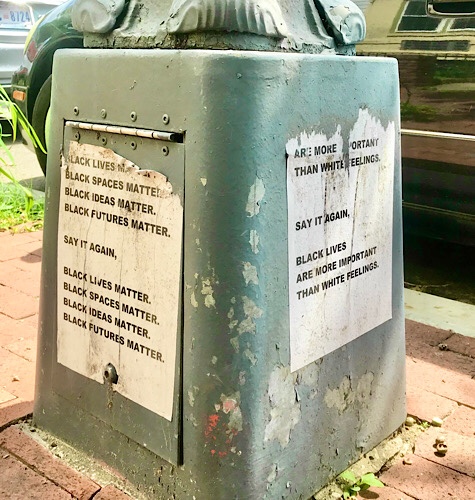
Keep saying it–and act accordingly.
Some great reminders and interesting new tidbits of information in this article/book review about globalization and Columbus. With a little help from our friends, some dedicated scholars, and a willingness to learn, we can have a better understanding of the complicated web of being.
It wasn’t so much the Columbian trade that did it as much as other international trade and travel, but our modern Western yoga practice has much of the same cross-culturing, ocean-criss-crossing intermingling as does our diet and agriculture.
In Anusara yoga, one of the ways the first principle of “opening to grace” can be experienced and practiced is as a radical expansion of the capacity to receive and appreciate the very wonder of being. During my visit to India with Professor Douglas Brooks, I found myself repeatedly thinking of the concept of radical expansion and also the preamble to the Isha Upanishad (long a favorite of mine; Shantala on their first CD, Love Window, have done an exquisite rendition), which can be roughly translated as saying that adding fullness to fullness is itself fullness (fullness can also be translated here as perfection).
What I believe this is saying that being itself is infinitely full; thus, we cannot make it more infinite by adding to it. Human consciousness of the infinitude of being, though, is limited by the filters of space and time. One of the key reasons to practice yoga (including meditation) is to expand both our capacity to appreciate the fullness and to receive its full wonder by uniting our own consciousness with the infinitude. When we can appreciate ever more the wonder of our being, we will naturally be more joyous, and I believe, led to be more compassionate and generous with ourselves and others.
Day after day on the India pilgrimage, just when I thought my heart and mind were already full to bursting, there were yet more experiences of the beauty and extraordinariness of life and creativity and nature. I found myself chanting the Isha Upanishad—purnamadah, purnamidam, puranata purnamudatacyate. Fullness and fullness is fullness. “Let me expand still more to appreciate to its utmost yet more beauty,” I thought to myself again and again. Though I already thought I’d developed a fairly full understanding of the concept through study and practice, I thought, “this is what John Friend means when he is talking about radical expansion.” I look forward to studying and practicing to experience and share ever more beauty.

What if for a whole day you did every single thing with the intention of becoming blissful? If you have them, taking care of pets or kids or elders? Every thing that you did at work? How you went from one place to another? Every morsel of food and drink you selected, prepared, and ate? All your errands? Your getting dressed and undressed? Your correspondence?
Would you even need to “practice yoga” by doing postures or meditating if you were living yoga–fully unifying the day to day with the conscious intention of experiencing the full bliss of consciousness at every moment?
Why not try it for a day and see what happens? And then let us know.