Trees Around Town

Ruda, who is both the ancestor of Shiva and another name for Shiva, is known as the howler. Rudra is wild and fierce. Rudra rages. I heard Paul Muller-Ortega recently describe Rudra. He said Rudra rages, but offered that there are lots of things against which to rage, such as injustice and inflicted suffering.
The idea of Shiva/Rudra raging has filled my contemplations for the last week. The questions that arise for me is “what is divinely inspired rage?” “When is fierceness or rage serving to expand love and compassion rather than just destroying the self or others?”
When are rage and destruction necessary to optimize the flow of energy? I think of Rosa Parks, Nelson Mandela, Gandhi. I think of a surgeon removing a tumor. When I think of the ongoing war in Iraq; the newest reports of torture; the potential that corporate interests, ignorance, and bigotry may completely undermine this country’s coming to agreement on providing basic health care for all, I think that living a quiet life is not fully engaging a life of the spirit. How do I find a place of non-attached, but fierce action? How do I find Rudra and not get distracted by personal desires for outcome (and personal desires for simple peace and quiet)? When should I howl, to whom should I howl, and what?
This rage, this fierceness, must come from a grounding in the heart with the discrimination of study and practice. If I cannot find it myself, can I at least support those with the courage and wisdom to be directly engaged?
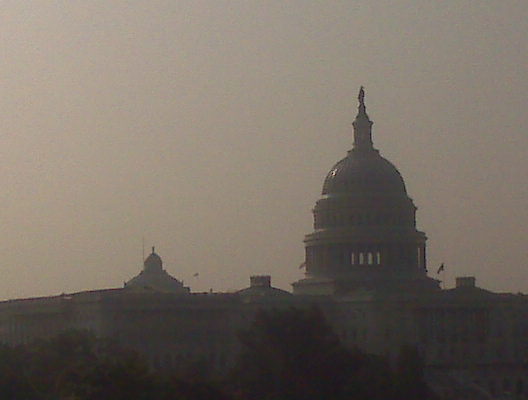
By 8:30 this morning, the sky was already an engorged white, thick with heat and humidity. There is no prospect of a thunderstorm for relief. If any come, they will be to the south and east or north and west of the space inside the Beltway. (I am convinced that the pattern of storms parting and dissipating within the Beltway is due to the hot air generated within the Dome).
I walked to work earlier than usual this morning and wore a sleeveless dress, sandals, and a sun hat. The co-worker who shared the elevator was wearing a suit, tie, dark socks, and heavy shoes. A few of the men are brave enough to wear short sleeves or go without the tie, but all are wearing long pants, close-toed shoes, and dark socks. In the cafeteria, people are picking out foods heavy with meat, fat, and sugar. The building is air-conditioned to a temperature for the comfort of those who neither dress nor eat for the weather. In the building, I am wearing a wool cardigan over my weather appropriate dress.
Last year, in response to a call to government workers from the White House for ideas to save money, I suggested that the dress code be changed from “business” attire to seasonally appropriate attire (my sleeveless dress is long and plain and does not expose anything other than my arms; it is perfectly “appropriate” and not beach wear). That way, the temperature in government buildings could be raised a few degrees in summer and lowered in winter, saving millions of dollars in heating and cooling expenses, as well as helping the environment.
It needs to be a policy to wear clothing right for the weather. If it is not policy, those who want to get ahead will continue to believe that there is no possibility of succeeding without wearing the suit and tie/lined skirt and jacket, pantyhose and heels. (Why is it that people believe that our brains focus better when our clothing is uncomfortable?)
I did not get a response. The winner was someone who suggested storing their office’s records electronically–something that is gradually happening every where in any event.
Being seasonally appropriate in our dress and diet can make an enormous difference in our comfort and in our impact on the environment. Same, too, for how we exercise. When it is over 90F, please do not crank up the air conditioning so that you can do a fiery practice. Instead, practice quieter poses. Concentrate on seated poses, cooling pranayama practices, and meditation. Enjoy the invitation to stillness and the fact that by virtue of the heat, you are already warmed up.
Peace and light, E — Posted with WordPress for BlackBerry.

What does it mean to be here? I ask myself how am I present? What am I doing while I am here?
My body does not respond well to cold. I’ve learned how to dress and to hold my body, so that I do not get stiff and paralyzed by the cold, but I am more easeful with heat. Still, there is a big upside to the continuing unseasonably cold winter: I won’t have aphids on my roses in February. It should also push back the mosquito season. That is a very good thing.
I highly recommend, amidst all that is going on, pausing to recognize at least a bit of beauty.