Found Exhortation

Excellent example of why it is good to look and pause before taking action–such as picking a blossom.
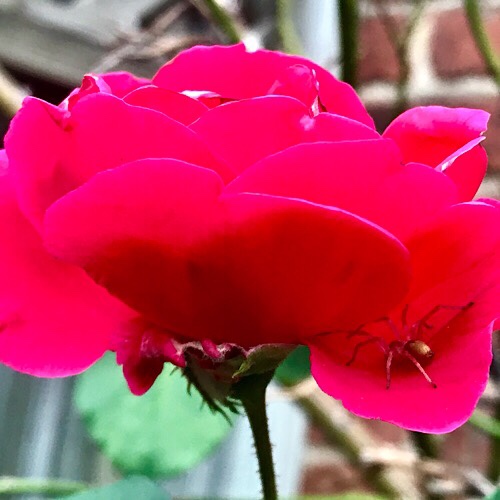
Don’t get too attached, including to ideas about yoga and practice.
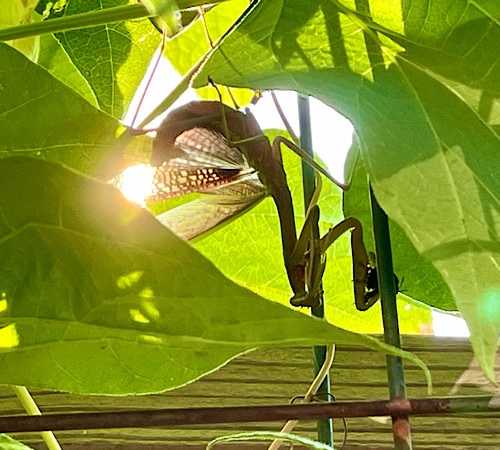
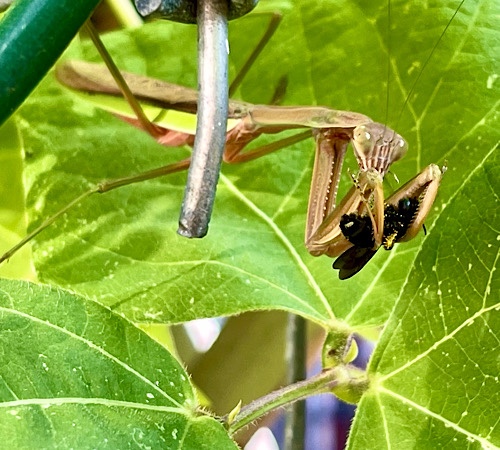
When I was out gathering vegetables and herbs and doing basic tending for the day, I realized a cardinal, who is a regular visitor, had let me get closer than ever before. Then I saw that he was about to try and swallow a praying mantis. I got almost face to face before he let go.
At first the praying mantis was turned upside down, and I wasn’t sure if it was ok. Then I realized it was holding on to a bee.
It still does not seem right to have daylight savings time start before the equinox. I remember it used to be the first night I cooked outside. Now it is always too cool and not quite light enough, and my morning meditation goes back to finishing before it is light. Whether it matches with the weather or my mood, though, it is here this weekend. I’ve had a much more intense work week than usual, which is resulting only partly from having been out of town for the previous week. The coming weekend promises to be very full (assuming all goes as anticipated) with teaching my own class and studying with Ross Rayburn up at Willow Street both Saturday and Sunday, trying to go out to see some friends dance Saturday night, going to the contact improv jam on Sunday, and then having dinner with neighbors.
To try and not get too off cycle by getting a socially induced equivalent of jet lag, I am starting to get ready for bed an hour early tonight and planning to get to the office before 8 tomorrow morning. Try doing the same things you would do if changing time zones. Get plenty of rest, drink lots of fluids, keep down the caffeine intake and if you really want to have caffeine, make sure you stop drinking it earlier in the day than usual; have any protein in the morning and then dine lightly on grains and vegetables in the late afternoon or early evening. Don’t eat anything heavy at night. That way you will have energy when you wake up too early and be sleepy when it is time to go to bed way before you think it is.
And most important, use the change in time as an opportunity to celebrate the respective joys of shadow and light by having extra attention brought to them whether you will it or not. It is always exciting the first night, particularly if it is warmish and bright as is in the forecast, that it stays light unnaturally late.

A fundamental precept of classical yoga is that of vairagya or renunciation. The yogin is meant to gradually renounce all of the life of mind and body until he or she transcends them and sees only spirit. I have been thinking about how renunciation fits in with the holidays and how we, as a society, have come to celebrate them. As some indulge to excess and all sorts of tinsel trappings, others denounce the excess as taking away from spirit and renounce the whole thing. A reactive renunciation of the holidays wholesale because they are so commercialized can feel just as harsh as full consumption of the holidays, as marketed on TV, can feel bloated and unhealthy.
When we approach yoga from a tantric perspective, the practice is not geared towards vairagya. We seek instead to be fully engaged in life, trying to live each moment, taste each bite, breathe each breath, take each step as a way of connecting more deeply to the spirit. This does not mean reckless indulgence. It does not mean heedlessly consuming and taking into ourselves that which does not nourish ourselves or which harms other beings or the earth. Through practice and study, we develop viveka or discrimination, which informs us of what will enhance our lives and lead us towards a place of light and health.
In the context of the holidays, to make them truly holy days, the tantric observer will not reject holiday celebrations out of hand simply because they have generally become commercialized and often unhealthy. Rather, he or she will discern ways to celebrate and honor earth, family, friends, and self that are in alignment with nature and optimize the connections among them. This may mean picking and choosing how and with whom to celebrate, but always with honor and respect. This is an art that I am working on personally; sometimes it is hard to know where to draw the line, especially if co-workers or family are living in ways that do not feel nourishing for us. Then the game is to not seem Scrooge-like to those who think that the holidays are about lots of heavy food and shopping, while we are choosing to honor the season in another way.
Those of you who are regular readers may sometimes wonder why this blog, which purports to be about yoga, only on the rarest of occasions goes into any detail about the physical alignment principles for asana. I just received a comment on a post that I wrote several months ago that reminded me of my conviction that the optimal place to discuss and practice physical alignment principles is in class. This conviction is not because there isn’t value in reading about the alignment principles–I look at the Anusara Teacher Training Manual on a regular basis–but because it is critical to understand the bigger picture, to have a loving eye on the alignment, and the opportunity to ask questions right away, which we can only get when we practice with a teacher. In this instance, the commenter said in response to a post in which I had indicated that “thighs out” was shorthand for part of inner spiral that she had heard that “thighs out” in the common Anusara alignment instruction “shins in, thighs out” was just hitting the thighs apart and was something separate from inner spiral. Would I mind clarifying.
I found the comment timely as I was recently at a workshop where the teacher had noted the injuries that can flow from overdoing an isolated action that is intended to describe one part of an element of the basic principles of alignment (in that case “taking the armpit back.”) I agreed with the teacher that just jamming the armpits back can stress the shoulder and limit freedom if it is done in isolation and as the first action in a movement involving the shoulder girdle. It can be an incredibly helpful alignment instruction, though, if the students recognize (as reminded by the teacher) that we don’t take the armbone back without first opening to grace, including softening and expanding and making the “inner body bright” and also practicing the movement in a way that recognizes the point of the instruction is to encourage students to integrate the head of the armbone into the shoulder socket by means of muscular energy.
Like taking the armbone or armpit back, I do not believe that taking the thighs apart should ever be treated as an isolated point of alignment. It should only be done in proper sequence and in proportionate action to the amount the yogi is able to work the other principles. “Shins in” should not be done without first opening to grace, including softening, expanding, listening to the body, and establishing a good foundation. It is also only one of the three aspects of muscular energy. “Shins in” is just one way a teacher might tell students to apply the principle of hugging to the midline, but the student should not neglect hugging the muscles to the bone or drawing energy from the periphery to the focal point of the pose just because the teacher only cued “shins in, thighs out.” After all, there are only so many words that can be said in a single class and only so much on which we can focus at a time, but that does not mean we should be neglecting the basics as we seek to become more refined in our practice. Just as “shins in” is only part of muscular energy, the companion shorthand instruction “thighs out,” emphasizes just one aspect of inner spiral — that which serves to broaden the broaden the pelvic floor by means of the movement of the thigh bones. That does not mean that it is independent of the other aspects of inner spiral–spiraling inward and expansively from the feet upwards and taking the thighs back, both of which sequentially come before the “apart.”
Wow. For those of you who read this for the gardening or cooking or to enjoy the photographs, this level of detail might seem mind-numbing. Part of the danger of getting into the weeds in writing about alignment is just that. Not only is it distancing, but it gets educated readers into a space of debating the finer points and wondering whether things have been said just right. It becomes far to easy to lose sight of the point of yoga in the first place, which is to bring us joy on and off the mat. Remembering the intention to cultivate joy (ananda) when we are practicing actually physically protects us from getting in trouble by over-efforting with regard to one small aspect of alignment. When we are (sat) consciously (cit) in the moment with an intention to cultivate bliss, then we are much less likely to do any physical action so hard or so precisely that we forget the big picture and how the principle or the pose fits in with the overall flow and alignment principles and do more harm than good.