Blossoms Around Town
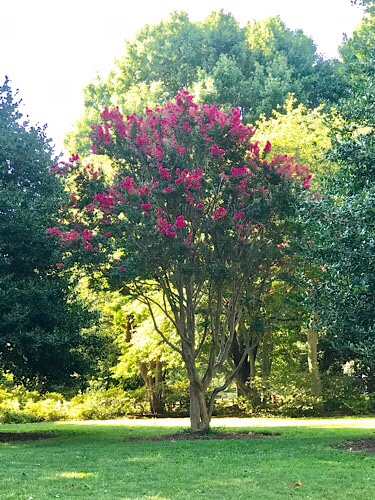
Looked at from one perspective, the yoga teachings say that outer peace will come from the cultivation of inner peace. I do think that it is hard to wage peace on a global level if one does not truly cultivate inner love and peace. Where I differ from some is that I do not believe it is sufficient to take care of your own inner peace without a care for how one fits into the global web.

Peace and light, E — Posted with WordPress for BlackBerry.
Dear Friends,
You’ve just received an unexpected gift that does good! rose garden yoga sent you a gift card from Oxfam America Unwrapped. Follow this link to see your card. And learn about how you’ve made a difference.
Much love and gratitude. News for the holiday and new year to follow in a separate e-mailing.
Peace and light,
Elizabeth

Peace and light, E — Posted with WordPress for BlackBerry.
Patanjali provides in the Yoga Sutras (2.32) that the second niyama, samtosha (contentment) is an ongoing practice. It is not something that we can expect to arise on its own and if not, lament its absence.
I feel hope, without which it would be hard to experience contentment, too, is something that requires steady practice.
My personal experience is that only thing that gives me hope when I am feeling despondent about the state of things is to do something, whether it is giving resources or time or connecting and expanding community.
What about you?
This morning, woken by the purring cat from an anxious dream in which I was not doing enough to make things better (I am not making this up), my first thoughts were of escalating war in Afghanistan and deepening economic crisis at home. It felt almost strange and abstract to be worrying about these things from my warm comfortable bed.
I think worrying can have a positive place in our lives. If we just get worried or anxious about things and get trapped in not doing or growing or reaching (both inward and outward) for a sense of connection and spirit, then worrying will cloak or limit us. If we recognize worries as showing us limitations, then we can use them to grow and change and spur us to action.
After the 25 tattvas describing the physical world and our being and understanding of the world that correspond in both the classical and Kashmir Shaivist systems, are Kashmir Shaivism’s six kanchukas — cloakings or coverings. The kanchukas are niyati (limitation of place), kaala (limitation of time), raaga ( attachment), vidya (limitation of knowledge), kalaa (limitation of action), maya (illusion of individuality/manifestation).
From a tantric perspective, experiencing ourselves as thinking, individual beings in the manifest world, constrained by time and space, only binds us if we think that is all we are. If we get completely entangled in these constraints, then our sense of spirit is cloaked, just as if we get stuck in worrying, instead of using worries as a spur to work for change, we become miserable.
I meditate and practice asana, as taught by my teachers, to reveal the restraints of physical being as only part of my being. Spiritual practice can serve to enable us to experience freedom of heart and mind, to bathe in the bliss of the essence of ourselves that is universal and unconstrained by the limitations of individual manifestation. The point of these practices not to escape our individual selves or to gratify them (that would still be “cloaked”), but to find the strength and stability to serve better and to work for a world in which all beings have an equal chance to seek the spirit and experience the bliss of connection.