Purna?
I have spent most of my life practicing one thing or the other. What attracts me about practicing in the sense of complete absorption that it brings. For a time, the absorption can be enough. Ultimately, though, the absorption should bring joy. I do not really think that it matters what it is that one is practicing as long as steady engagement brings a sense of inner peace and bliss that enables one to be kinder and to offer service in some way. I have quit some things along the way either because the practice did not bring enough joy or fulfillment or the practice was detrimental to my nature.
I know yoga and meditation are the right for me at this point in my life because sadhana (practice) continues to brings me ever increasing delight. I do not think of practice as work (though sometimes I need to use some self-discipline to remind myself to practice), but as an invitation to greater depth and understanding of not only the practice, but myself.
I have friends for whom the right practice is not yoga, but something else — a visual art, music, law. It is not what one does, but how one does it, and whether it brings a sense of fullness to life, a satisfaction with the engagement in the doing, rather than in what the doing achieves.

Peace and light, E — Posted with WordPress for BlackBerry.
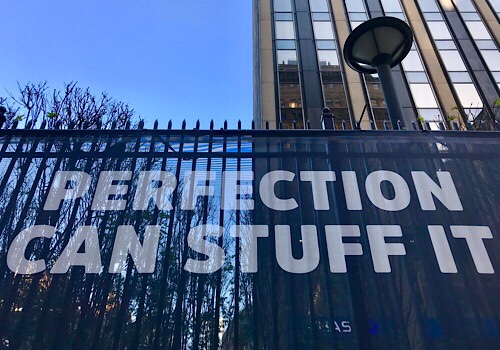
I haven’t photographed the t-shirt with the statement “it’s all good” to go with the sign below “needs work,” but I would need to if I wanted to show the apparent philosophical tangle of tantra.
The tantric texts do tell us that it is all good; more accurately, they tell us that all is divine and perfect, and that we are just an element of the “all.” It is hard to believe that when we can see suffering and bad behavior (including some of our own) all around us.
The tricky thing about the declaration that all is divine is that it does not mean that there is no work to be done. The work, though, is not to fix ourselves or what is wrong or bad. Rather, the work (sadhana) is to study so that with discrimination (viveka) we can determine what is out of alignment and causing our own suffering or contributing to suffering of other beings and move towards and unveil the perfection and fullness that we are.
It is sort of like finding a great treasure that has been neglected and misused out of ignorance or carelessness at a yard sale. It takes knowledge to recognize that the cheap, discarded thing is a treasure and skill and effort to restore its intrinsic worth.

Peace and light, E — Posted with WordPress for BlackBerry.
The New York Times just published a blog entry on the perils of faking happiness. The first problem with the article was that I could not get to the study to see if I agreed that the actual premise was that “faking a smile” was what led to a deterioration in mood or feeling unduly pressured by a need to do so regardless of what was going on inside was the problem. The second is the definitional problem of what it means to “fake” a smile. I think it not unlikely that contorting the face into a fake smile (i.e., grimacing) because one feels one has to do so does not improve mood when one is in physical or emotional pain. According to the little cover blog, though, those that made an attempt to smile from the inside by thinking a positive though–even though it was a conscious effort– did experience an improvement in their mood.
Any good method actor will tell you that to make an outer expression believable, one has to cultivate inner thoughts to go with it (though that is still “acting”). Having been taught by my mother by age six in preparation for my first school play performance, that to act I should try to “be an apple” a la Stanislovski, I disagree that intentionally putting a smile on your face cannot help improve your mood. It’s all in how you fake it ’til you make it. I have long advocated to my yoga students, based on my personal experience with the practice of smiling whether I think I mean it or not, to try smiling on the outside improve mood. Even leaving aside the inner experience, just walk down the street with an open posture and a smile on your face and see how people respond, though I caution to do this at your peril in New York. When you smile at people and be polite, they generally respond in kind. You are then much more likely to feel good than if you are scowling and rude and people respond back in kind.
What on earth (or in heaven’s name) does faking a smile until you feel one have to do with satcitananda, you may find yourself asking yourself at this point. The second line of the Anusara invocation is “satcitananda murtaye.” Murtaye, from the same verbal root as murti or statue, here is usually translated as saying that Siva (from the first line) embodies the characteristics of satcitananda, being (what I like to call is-ness), absolute consciousness, and bliss.
Another way of looking at this phrase, though, is that when we open to the possibility of discovering our siva nature, which is the reason we practice yoga, and when we use the principles of alignment to help do so, then we discover how to be, if even for a moment, simply present, fully conscious, and blissful with the consciousness of the ultimacy of being. In a word, when we soften and look within, using the knowledge and experience of our teachers and our practices, a smile of recognition lights us up. If we start out having a bad day, feeling stressed or anxious or in pain, or just plain grumpy from reading the news, we just have to practice with more depth and sincerity to find the smile and not beat ourselves up if we are struggling to find the smile despite our desire and the intensity of our practice.
Is that faking a smile or being the smile? Does trying to smile when we are feeling blue really make us more unhappy? I think it is all in how we do it.