Found Exhortation

The pouring rain is an inconvenience on a play day when I am toting baggage, writing materials, and electronic devices. It is hard to remember, when surrounded by concrete, glass, steel, and macadam, how urgently we need the rain. I am hoping for the trees, the farmers, and all of us, that it is also raining back home in DC.

In the middle of another
11-hour work day, not
Counting the time to
commute, the commute
Being the round trip walk
From home during which I
have been practicing japa–
Maha mrtyunjaya mantra–
For dear spirits recently
No longer in this body.
In between the work,
Between those walks,
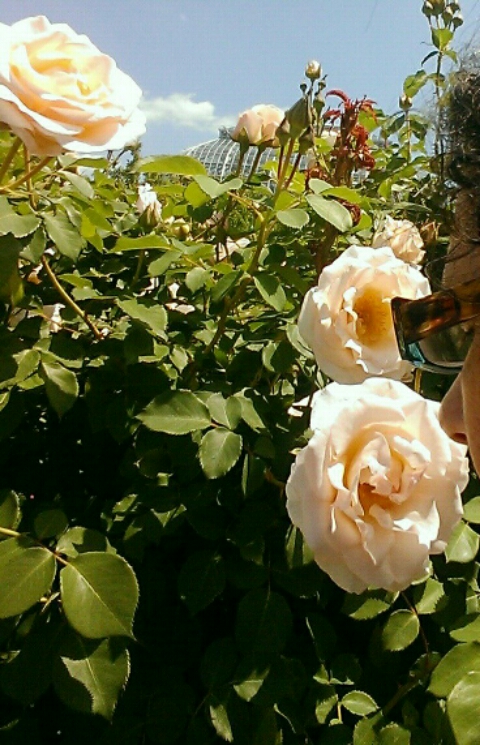
I stopped. I stopped
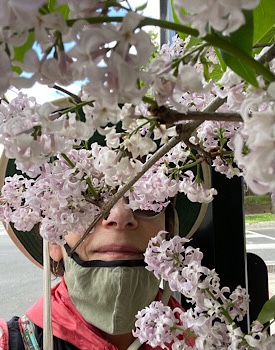
and smelled the roses.
Thus refreshed by visual
Beauty and warm sun
And intoxicating scent,
I had the energy to begin
Again–to continue,
To work well.
Walking has always been my preferred form of getting from one place to another; if time and distance require it, I intersperse a lift from bus, metro, or taxi on one end or in the middle of a walk. All I really wanted to do with my time off–I don’t have to go to the office or teach class until January 3rd–is to walk and practice and visit with friends and family and look at art and cook and read and study and eat and play with the cats and write and photograph and dance (an open-ended term) and maybe knit or draw. For me, walking is walking in itself; time to practice bhavana — deep contemplation; time to practice japa–repetition of mantra; opportunity to open the mind and senses to allow the flourishing of creative projects–mostly writing and photography; a way of going from one place to another for shopping, working, visiting, etc; and sometimes an activity to share with friends. And of course walking to get food is wonderful both for stimulating the appetite and for aiding digestion.
Yesterday, we were given 90 minutes of administrative leave. On leaving the office at 3:30, I walked west from my building to the last Thursday until spring of the Penn Quarter Farmer’s Market. I didn’t really need anything, but wanted to support the farmers who were braving the cold, so I bought a wild oyster to eat while I stood there and a bag of arugula and a few apples and pears. From there I walked back east, traversing the Capitol grounds to East Capitol Street and stopped in and browsed at Capitol Hill Books. It was turning dark when I walked east into Lincoln Park before turning north to go home.
In less than an hour, a good friend will arrive at the door in her walking shoes. We are going to head out on foot to the Mall to talk and to look at art and to share a meal in Penn Quarter or back on the Hill. Later in the day, I will walk along the bus route to Dupont or walk to the metro to go to a Christmas Eve potluck dinner at Friends Meeting of Washington.
Tomorrow, Christmas Day, I will celebrate Christmas in the manner of New York Jews (Chinese food and a movie). After walking through Lincoln Park and down Kentucky Avenue SE (where are some of the most beautiful trees in the neighborhood) to get a massage, I’ll walk to the U.S. Botanical Gardens to meet a friend I have known since third grade who is town with some of her NY friends for the holidays. We will probably walk up to Chinatown after that. Then I’ll go see a movie. Whether I walk or take the bus will depend on whether it is dark by the time the movie lets out.
On Boxing Day, I will go to Georgetown to volunteer at the Lantern Bookshop. I will walk some of the way and take the bus the rest of the way. The length of the walk will depend on the amount of time I spend making breakfast, caring for plants and cats and house, and writing. How much of the return trip ends up being on foot will depend on how many books I decide to take home from the Lantern. Sometimes I only get one or two.
After first looking
In all directions to see
No one was in sight.