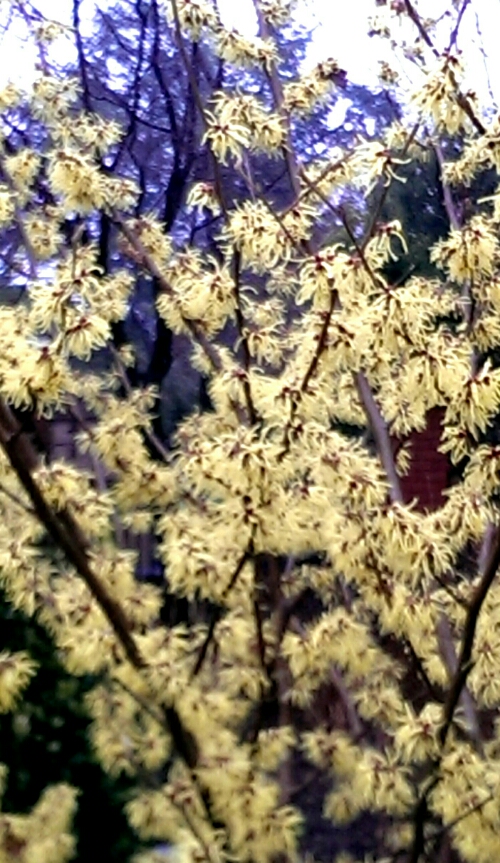
Blossoms Around Town
We hear the stories of a the tragedy unfolding in Japan, and our hearts cannot help but cry out. This is a wonderful aspect of humanity. A friend sent me an insightful article from Caroline Myss in which she very articulately lets all her readers know why we need to work to ensure that we do not have nuclear weapons (and, I would add, new nuclear power) with which I wholeheartedly agree.
The unfolding tragedy also drives home for me how important it is that we speak out against the wars in Iraq, and Afghanistan, and on the verge in Libya and for sustainable environmental policies. On the 11th of March, I wrote this in my journal: “Mother Nature is wild and fierce no matter how much control we try to exert. I pray that a nuclear disaster does not follow. U.S. military is working with [later note: I think that was just an offer] the Japanese to share experience and skill to get in back up power to bring water in to cool the reactors. Peaceful military work, I am behind. Some fearful reflection of Hiroshima.”
My question is this: why are we sending money to those living in the third largest economy in the world (Japan’s own citizens are reportedly wondering why their government is not doing more to help–sort of how people like us wondered and may still be wondering about the lack of assistance from the government of our wealthy country after Katrina)? We are denying money on a societal level to help those in the poorest countries or perhaps are not making offerings on an individual level (or not speaking to our elected officials about such topsy-turvy, anti-compassion policies?) Why do we send our hearts and prayers to those suffering from a sudden natural disaster, but forget to do so for the tens of thousands and their families our own country has killed or wounded? Why do we spend or allow to be spent in our name billions on killing, but let it be determined that we do not have millions on aid for the suffering or for enhancing life through the arts, education, taking care of our cities, our parks, the natural beauty around us?
I, like all of you, am filled with a sense of horror and loss and love and compassion and an impulse to help. How I am choosing to use the energy of my upsurge in awareness of suffering from the unfolding disaster is to give more than I usually give to organizations that work to heal the environment and to prevent new damage by virtue of the current political policies, to seek the end of war, and to give humanitarian aid to the poorest of the poor who are dying and suffering every day at home and around the world in numbers far exceeding the sudden loss in Japan, and to support the increase in light through the arts and education and parks.
What do you think is the best way you can transmute the natural compassion you have been feeling from reading the news of Japan into making the world a better place?
The grapes are starting to bunch, and for the first time, the kiwi is covered with buds. Two of the tomato plants have their first flowers. Snow peas are climbing up the trellises. Carrots, spring onions, radishes, and beans are sprouting. There are plenty of cool weather greens and herbs for eating already. The red roses are blooming. I pray for sufficient rain.
On the column that supports this bas-relief and a larger than life standing portrait of Daniel Webster, is engraved: “liberty and union now and forever one and inseparable.” Kind of sounds like a description of the absolute consciousness, the one self, though that was probably, mostly not the intent.

I have a set of cards that I keep on my altar that are designed to be used for contemplation. There are about fifty cards, each of which has a sanskrit word and its meaning. Just as one gets a fortune cookie randomly or picks a tarot card from a deck, but the message often seems right on point, the word that arises from the card picked from the stack often seems uncannily timely. Early Saturday morning, after not having used the cards in a few months, I picked a card from the middle of the stack to see if it would help guide my contemplation and meditations as I was getting ready to say good-bye to Becky. The word on the card I picked blind from the middle of the stack was “moksha” or liberation. In classical yoga, moksha does carry with it the implication of being liberated by transcending body and mind.
Later on Saturday, when I was on my way home from teaching for the appointment with the vet, I stopped at the metaphysical supply shop for a piece of rose quartz (to use in a ritual to assist with the transition and loss that a friend taught me). At the check out were “dolphin saying cards.” There was a sign next to the cards inviting customers to take one for free. The sign also said that it was not necessary to take the one at the top. The cards were face down; I did not look for a particular saying. I dug a few cards down, and the one I selected read: “freedom has its roots within yourself.” In other words, “moksha” for the second time on this day, when I was facing with Becky her transition of the spirit from the body.
Was it a message? Was it a coincidence? I do know that I knew when it was time, as I did with Henrietta. Becky just did not want to be embodied anymore. When I held her in her arms after she stopped breathing, she was released and relaxed in a way she had not been in months. That the signs were saying “moksha” resonated with Becky’s power and connectedness. I hope that when I am ready to go, I will truly understand moksha, that I will be released. It is so resonant of Becky’s life, for all her quirks, that she was still teaching me even as she was dying.