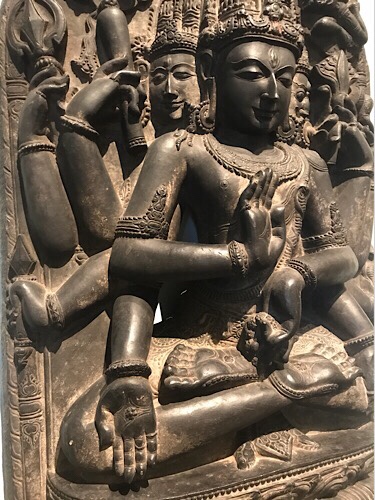
Sadasiva


A neighbor who lives in the top floor of the building across the street, and thus has a spectacular view of the maples in front of my house writes:
“The buds on your tree are more numerous than yesterday, and more visibly that color that Joni Mitchell sang about: “just a little green, like the color when the spring is born...” And we’re getting a good, soaking rain. Happy Spring!”
I have heard the song so many times, I do not need to look it up, except to share both with those for whom it is not part of an intimate map of a long ago period and with those for whom it is and who will have, by just seeing the words (and even more so by listening), some upsurge of memories and a revelation of the miraculous play of consciousness.
I got a ride home from the John Friend workshop in Bryn Athyn with my friend, colleague, and student Jen. Jen’s husband, who is a dance professor at a local college, and her three-year old daughter came up to Philadelphia and visited friends during the day while we were at the workshop. For the initial part of the road trip home, we sang several rounds of “if you are happy and you know it clap your feet,” a days of the week song, a counting song that involved a wiggle (or was it a wriggle) and a jump, the alphabet, and I think maybe “loop-de-loop,” and had some snacks, after which Jen’s daughter moved into silence and then sleep. Before moving into silence ourselves, we spent some time talking about what we had learned and experienced at the workshop.
“Do you have any good sound bites from the weekend?” Jen’s husband asked. I said I did not have any particular sound bites per se, although there were a few things that would definitely provide inspiration for teaching and blogging. “I have a good one that I think will make sense to you,” said Jen. “John said that we can use technique to express the virtue we wish to embody.” What I liked about the statement is that it put in universal terms that would appeal to a dancer and dance professor, or anyone who understands how technique assists the clarity of artistic expression, an essential element of the yoga philosophy and Anusara principles without requiring prior knowledge of the philosophy or principles.
The statement is an encapsulation of the “three A’s of Anusara” — “attitude, alignment, and action,” which are the essence of practice (also see my previous post on how these principles correspond to the tattvas). We always seek in every part of our practice and in every pose to open to grace, to soften and receive, to be open to the fullness of life and love, to see and reveal the good. This is our “attitude.” The universal principles of alignment are technique. They are not just technique for the sake of perfecting technique, to discipline ourselves, or to make ourselves or our practice “correct.” Rather, learning and practicing the alignment principles in an ever deeper and more refined way enable us to express more clearly and elegantly our attitude — in a word, embody the virtue of being open to grace.
The songs we were singing in the beginning of the car ride, with an attitude of delight, also can serve the purpose of helping a child naturally to embody virtue. Jen’s daughter was having fun with the sing-along toy. She wasn’t singing because she needed to learn numbers, days of the week, and the alphabet to pass a test or to make sure she was right or to please her parents. They were cheerful and fun for her. When she sang along, it was out of delight. She was, though, learning beginning language and arithmetic skills that will help her communicate and get on better in society. As she grows older, in the absence of these skills, it would be hard for her to express her joyous spirit in a way that deepens conversation, relationship, and ability to participate fully in the obligations of society. When we learn technique — in whatever area — we will be furthering our ability to embody virtue if we use the technique to enhance our skills to work for, offer, and express peace, love, nurture, and growth, rather than learning technique for the sake of accomplishment, worthiness of praise or remuneration, or needing to be correct.
In case you were looking for another reason to share the yoga with friends who might otherwise think that yoga would be too hard for them and to make your practice more regular. Go Kansas City!

And everything else, too.