Art and Culture | Asana, Pranayama, and Yoga Practice | Dance/Contact Improvisation | Food for the Mind (Yoga Philosophy, etc) | Meditation | Photos | Quaker
Found Exhortation
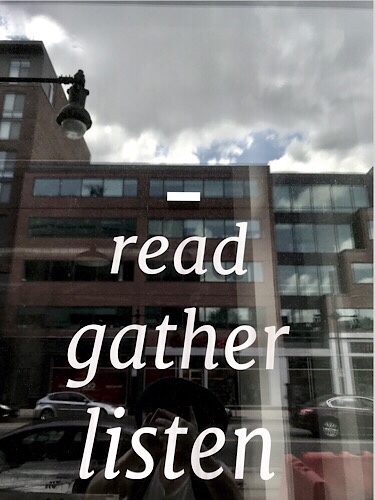
It isn’t sadhana unless it is steady, repeated, and over a long period of time (though form or emphasis might change).

United States Supreme Court, June 28, 2018
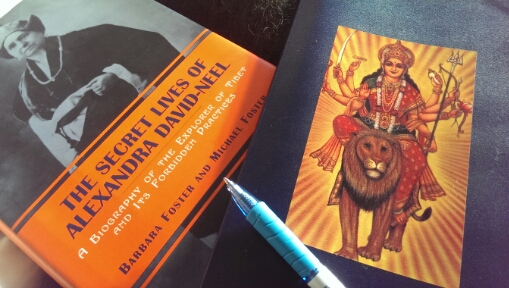
A friend gave me this sticker of Durga, which I put on my current journal. She’s looking kind of sweet here, and her lion somewhat Aslan-like. Some images show her looking much scarier.
She carries an array of weapons, knows how and when to use them, and undeniably and fully embodies her own power. She is also described as being infinitely compassionate.
I returned home yesterday from teaching my Willow Street classes and having a late lunch with a friend to a message on my answering machine from my mother advising me that a cousin had died. Although I was not close to my cousin, her parents, my great Aunt and Uncle, were a significant part of my formative years.
As I made telephone calls and sent emails to get coverage for work meetings on Monday and care for the cats so that I could leave for New York, I found myself flooded with long-ago memories of my cousin, my family, and myself. I could also hear and feel old patterns surfacing, as they tend to do in such situations.
In counterpoise to the tumble of memory, I felt a strong pull to go into the space of meditation.
In the spaciousness, I no longer feel trapped by the inevitable consequences from the events giving rise to all those memories that have partly shaped my path. The light of consciousness itself, as the ground of the play and the illumination of inner space, begins to reveal the links and sequnces of the memories, the cause and effect, thus allowing me to see other ways to react. Instead of remaining entangled by trying to dismiss or reject or cling to any part of my history, I could see shapes, sequences, and opportunities.
At lunch, one of the things my friend and I had been discussing was the idea of bringing into “luminous spaciousness” our relationships. John Friend had invited us to think about that concept at the Teachers’ Gathering last month, and I have been contemplating the practice in a variety of contexts and discussing with fellow Anusara yogis what it would mean to them to bring luminous wisdom to relationship by seeking to create the true spaciousness we can find in our practice of yoga and meditation. I had talked about it previously with the friend with whom I lunched yesterday. She asked, “where was your blog entry on luminous spaciousness; I’d been looking forward to it.” “I haven’t found the right context for describing it that would convey what I think it means for my practice,” I’d replied. When I came home to my mother’s message, because I had been continuing both the contemplation and the dialogue, I was focused on the practice when I found myself in a situation where I really needed it. (Great reminder of the need for a steady practice).
I am now on the Long Island Railroad, heading to my parents’ house. Tomorrow we will go back into the City for the memorial service.
As I allow my thoughts to be stirred up–giving myself space, as it were to have natural mind processes–I seek space and light for myself in my relationship with my family to try and foster more love and clarity.
It’s like this:
It’s this simple
(But being simple isn’t
the same as being easy):
If I open myself
To visions, I will
See, though no
Knowing what
will be seen.
Yesterday at the William Penn House class, we were emphasizing strong working of our tailbones. One of the regular students came to class even though she was still exhausted from recent and sudden major loss and upheaval in her life. She wanted to be with the spirit of the class even if she would not be able to do everything.
When we went to the wall to work on half and full arm balance, I advised her to give it a try if she felt up to it and then said to do legs up the wall if she knew trying to hold the arm balance would be too much. After all, I pointed out, legs up the wall (vipariti karani) is just half handstand upside down. And what is awesome about both the poses is that the both turn us upside down (albeit in energetically different ways) and can thus help give us a fresh perspective on how we are in our bodies and minds.