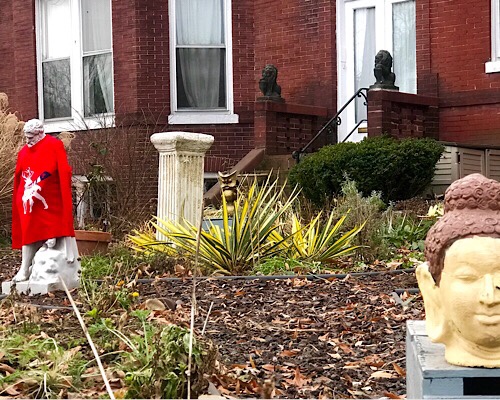
Statuary Around Town
This morning, woken by the purring cat from an anxious dream in which I was not doing enough to make things better (I am not making this up), my first thoughts were of escalating war in Afghanistan and deepening economic crisis at home. It felt almost strange and abstract to be worrying about these things from my warm comfortable bed.
I think worrying can have a positive place in our lives. If we just get worried or anxious about things and get trapped in not doing or growing or reaching (both inward and outward) for a sense of connection and spirit, then worrying will cloak or limit us. If we recognize worries as showing us limitations, then we can use them to grow and change and spur us to action.
After the 25 tattvas describing the physical world and our being and understanding of the world that correspond in both the classical and Kashmir Shaivist systems, are Kashmir Shaivism’s six kanchukas — cloakings or coverings. The kanchukas are niyati (limitation of place), kaala (limitation of time), raaga ( attachment), vidya (limitation of knowledge), kalaa (limitation of action), maya (illusion of individuality/manifestation).
From a tantric perspective, experiencing ourselves as thinking, individual beings in the manifest world, constrained by time and space, only binds us if we think that is all we are. If we get completely entangled in these constraints, then our sense of spirit is cloaked, just as if we get stuck in worrying, instead of using worries as a spur to work for change, we become miserable.
I meditate and practice asana, as taught by my teachers, to reveal the restraints of physical being as only part of my being. Spiritual practice can serve to enable us to experience freedom of heart and mind, to bathe in the bliss of the essence of ourselves that is universal and unconstrained by the limitations of individual manifestation. The point of these practices not to escape our individual selves or to gratify them (that would still be “cloaked”), but to find the strength and stability to serve better and to work for a world in which all beings have an equal chance to seek the spirit and experience the bliss of connection.
My friend Dan just posted on his blog a great Gary Snyder quote on the need to do maintenance (of the self) in order to be most creative. The idea that we need to maintain our tools and toolbox, as it were, in order to be most creative, is exactly what we are taught about the tantric yoga sadhana — practice. With our yoga practice, diet, lifestyle, work, consumption, participation in community, we seek to live progressively more in alignment with the undulating fabric of space, time, and apparent world so that we have maximum well-being best to serve ourselves and others with delight. In our sadhana, we include both study and experience (experience includes meditation, asana, and pranayama). As both John Friend and Paul Muller-Ortega teach, we engage in the practices and studies to learn with ever expanding insight how to see and experience the highest first and live from that place. Living and practicing with such an intention is, I think, the maintenance done so we can live out all of our lives as a reverential and creative act.
Dan–I look forward to reading the sermon.
Santa Fe, NM, 10/25/19
This is the second round of fruit ripening on the small tree I brought into the garden this spring. Will these figs ripen enough to be picked before the first frost?