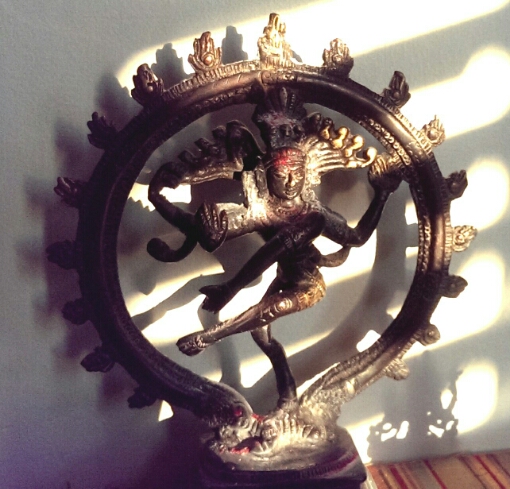
Tandava (and the Play of Shadow and Light)
This morning, when I was reviewing in my head some of the meetings and other work matters upcoming this week, I thought, “what a good time to practice all the things I have been studying.”
It felt like progress to think that and then notice my first thought was not, “this week is going to be awful,” or even, “this week is going to be challenging,” instead of thinking the latter and reminding myself of the former.
And having a homemade popsicle after a long day certainly helps make this heat wave more enjoyable.

Lime, cucumber, mint popsicle (cucumber and mint from the garden)
Joseph
Thank you Joe. I have been giving to WWC since the late 1980s. When I was in my 20s and 30s I had close friends die of AIDs or go through the tribulations of the early drug trials for HIV. I like that I can now give in a more personal way.
Peace and light,
Elizabeth
“It will make you both laugh and cry,” said Josh, who is a long-time neighbor and the proprietor of the newly re-opened West End Cinema, which is currently showing The Kings of Pastry. “I don’t think I will be crying just because a sugar sculpture breaks,” I responded with some skepticism. “Let me know afterward,” he said, and there the conversation ended. I needed to get seated, and he needed to help the next movie-goer.
What I found loveliest about the film — besides getting to surrender to the delicious sensation of being completely awed by the extraordinary technique exhibited — was that there was no competition in the sense of there being “winners” or “losers.” All of the finalists — I don’t think that this is a spoiler — could achieve the designation of “master” if they demonstrate their virtuosity as pastry chefs within a short period of time under intense scrutiny.
The movie, in revealing a little of what it can mean to have the talent, passion, and single-mindedness to seek to be a master of a craft, a livelihood, an art, invited me to reflect on when I have been tested and when I have wanted a certain achievement marked by an outer designation. Undergraduate and law school were highly competitive; by being ranked, excellence seemed to be prized not as much for how it would enable the students ultimately to be better able to serve society and themselves upon having developed a certain required level of mastery, but more for creating a ranking within that segment of society. The dance world, for me, also felt strongly competitive. With injuries early on and having developed the “wrong” body, I could not rise to the competition.
The support, encouragement, and mentoring of the pastry chefs in The Kings of Pastry — although clearly only a select few were finalists — highlighted for me what it can mean to strive for excellence without having it be structured by win-lose/pass-fail competition; it only makes the world of pastry better if more of the pastry chefs are true masters. In this regard, watching the movie led me to think about what it was like to work for Anusara yoga teacher certification in contrast to my earlier education. When I was working for my Anusara certification, the standards for achievement of the “goal” were still very high, but it was not about winning/losing or achieving/failing. It was a period of intense study, practice, learning, and humbling experiences. On being certified, I knew that the efforts to be certified were just the beginning. Part of the reason for being so deeply challenged to be certified, to meet the level of initiation (in Sanskrit diksha), was to see if we would continue studying and practicing at that rate out of love and deep commitment. It took going through the process and addressing all the old emotions and patterns of reaction and response that came up in the context of being tested to help me to start fully appreciating the difference between being in a competition and seeking the best we can be for ourselves and for others in our work and study. When I started to have a lived appreciation for the distinction it carried through to all aspects of my relationships in life.
Without answering them, The Kings of Pastry opened for our own contemplation the questions of what does striving for excellence or mastery mean for the one on the path and for those on the path with him or her? How does coming face to face with an obstacle when being tested or finding out that one has or has not received the public recognition impact the rest of one’s life, one’s sense of self-worth, and one’s relationships with family and friends? It was an sweet act of film-making to bring these questions to the viewer’s awareness in a way that is completely engaging and endearing.
Yes, Josh, I got a little teary-eyed towards the end.