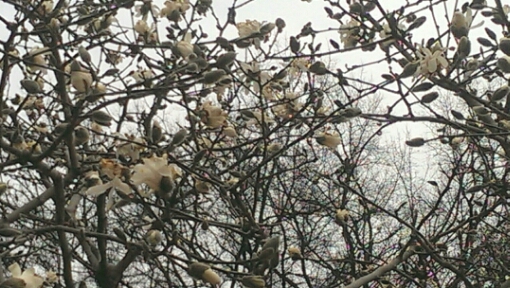
And so the flowering begins (again)
From a German language spammer advertising “female viagra” comes this bit of universal wisdom on a day when I found myself needlessly anxious about a mistake that was fairly easily rectified: “It sounds like you’re creating problems yourself by trying to solve this issue instead of looking at why their [sic] is a problem in the first place”
If I were one who just trusts naturally that many simple things can be fixed easily if I just ask for help, there wouldn’t have been any need to be anxious. It would have been better not to have made the mistake in the first place, but as much as I might dislike it, I will inevitably make mistakes–here, not getting my dates right for asking for sub coverage for a yoga class. With the wonderful community in which I am blessed to be a member, it only took a few phone calls to work things out.
It is one of my biggest challenges to have to ask for help. Having to ask for help because I made a mistake made it even more challenging. A big part of my yoga is learning to soften and trust in such situations. When I did just that, I not only was able to ease away from needless anxiety, I was able to allow in more love and support. Sometimes we need to be put face to face with our toughest stuff to open at another level.
When I read Kate Swift’s obituary yesterday, it lead me to think more deeply about a recent conversation I had about the Bhagavad Gita. The Bhagavad Gita, not surprisingly, is required reading for most yoga teachers. It is an integral part of the history and philosophy of yoga thought and practice. It is, though, about a battle in the middle of war, in a time and place where a woman’s highest and best (and arguably only role in life) is to be obedient first to parents and then to husband. Purity, obedience, and beauty (as decided by society) are the great virtues of women. As a dialogue between a male warrior (Arjuna) and a male incarnation of the deity (Krishna), all of the spiritual and social teachings are presented in terms of men and males, right down to the pronouns. The translation that was being discussed was that by Juan Mascaro. As a mid-twentieth century translation by a Spaniard at Cambridge University who has lectured on “Literary and Spiritual Values in the Authorized Version of the Bible,” the translation no doubt perpetuates (without any specific or willful intention to do so) the inherent sexism that is also found in the English language and in the Bible and its notion of God.
The question raised was how a book that perpetuates sexist stereotypes could be required reading to be a yoga teacher. (See my previous blog entry on how we, as yoga teachers, can rely on a book that is primarily about war.) How would it read, it was suggested, if all the pronouns in the Gita were changed from he to she? The person raising the question said that making this change made the spiritual guidance more accessible to her. For me, shifting the pronouns from male to female does not address the challenge because I do not believe in spirit that can be given gender. I read the Gita and other yoga texts in two ways: (1) as historical and literary/philosophical documents that are products of the author’s time and place in history; and (2) as a source of universal human truths. The Gita, as a dialogue between a warrior and a male avatar of “God,” does not have much place in the ideals I hold dear. Neither the caste system nor the roles for women espoused in the text support my own beliefs about equality, justice, fairness, or love. The extraordinary teachings of yoga, though, transcend the history out of which they arose. To do justice to the yoga texts — and not just the yoga texts, but the great teachings and texts that are an integral part of our social fabric — we must both recognize their historical context and be open to learning what has transcended history and cultural boundaries to make them living words.
In attempting to make the shift to a modern interpretation that allows for “feminism,” I know many who try to address some of the challenge for modern readers by saying that we all have characteristics of the masculine and the feminine, and so we can read the guidance in the texts as being valid for both sexes. The problem I have with that is Kate Swift’s point. If we label various personality traits and characteristics as being elementally male or female, we are still perpetuating sexism through linguistic bias. It is not enough for me to make the warrior female and allow her “male” characteristics. What I think is that all human characteristics are gender neutral. If the teachings are not to be biased when we as teachers transmit our reflections on the texts to our students (after recognizing how history has done it), then we need to say that all people can be assertive or passive, strong or sweet, rigorous or soft, etc, but not just say that some are masculine and some are feminine and that in having all of these traits to some degree, we are showing that we are both god and goddess, masculine and feminine.
Or we could just not do any labeling at all, instead concentrating on the truly universal yoga teachings of right action, selfless service, and deep abiding love–none of which have anything to do with gender.
This murti of Nataraja has been in the window of a store near where I work for at least 20 years. I often walk past is and just as often stop to admire it. I have never really considered taking it home, lovely as it is. The murti is simply too large for any of my rooms. I have mentioned its needing a home to a couple of different friends, who were looking for large murtis of Nataraja, over the past few months, but none have followed through.
Today, when I was walking past it on a lunchtime walk to the bank, I noticed a “commercial property for rent” sign in the window. I will miss having this resplendent image in my work neighborhood, but not enough to buy it and bring it home. I decided, though, to take a photograph. I know the owner only very casually, but well enough to know he is retiring, rather than being driven out by rising rental costs or the recession. The neighborhood has gotten trendier since Nataraja first appeared in the window. Nataraja might be replaced with a delicious restaurant or a fabulous store purveying things that entice me. Or the space could stay vacant or be used for something that holds no interest for me whatsoever.
Nataraja–lord of the dance of concealment and revelation, of dissolution and manifestation–is dancing here. The murti will be sold or transported away when the shop closes and will physically be gone.
I will have my memories of the image, a photograph I took with my BlackBerry, and will have had a sweet opportunity to observe the lord of the dance dancing away his own image.

Though there is still snow on the ground, the days are about to be longer than the nights, and my inbox is full of both expensive and discount offers for cleanses of various sorts, and I’m seeing Facebook posts asking about good spring cleanses with all sorts of suggestions in response. If I were a different kind of reader and practitioner, I’d no doubt be beset with explanations and special offers for dieting into a bikini-worthy body. If I were an even different sort of reader, I might be thinking I needed an official spring cleanse, one of the ones that yoga acquaintances say make them feel light or high, etc.
I don’t much believe in cleanses, but I do believe in listening–really paying attention–to my body and emotions and how they relate to the cycle of the seasons. In winter, I tend to gain a few pounds from spending more time inside and eating the heavy, dense food my body wisely craves in winter both for warmth and protection from starvation (granted the latter is not a real threat for the middle-class, but my genetic make-up doesn’t know that). I fully trust that when the days get warmer and lighter and I can spend more time outside walking and spring vegetables and fruit start to show up at the market, I will lose a few pounds.
Before you get too caught up in thinking that to have the body you’re supposed to have (whether it be for looks or some fashion-driven notion of health) you need to go on some formal diet you might not need or spend money having someone tell you what to eat and when (although if you find that works for you, who am I to say no?), why not try noticing whether the change of light and temperature alters your natural cravings (not the ones for junk food or excess sugar or salt)? If you can notice a change in what food attracts you, try honoring the change.
You might find that small portions of kitcheree (lightly spiced rice and lentil porridge), along with plenty of fruits and vegetables (and as spring produce comes in, you’ll find spring vegetables and fruit want less cooking than do winter ones, or perhaps none at all), feels like a nice way to lighten up for several days as the seasons transition. Ssssh! That’s pretty much what’s in a spring cleanse. If you want to make your change of diet feel sanctioned by the yogis add some reading on Ayurveda or mindful eating to invigorate your practice and your dedication to paying loving attention to your body and how it relates to the seasons and the web and cycle of being.