| |

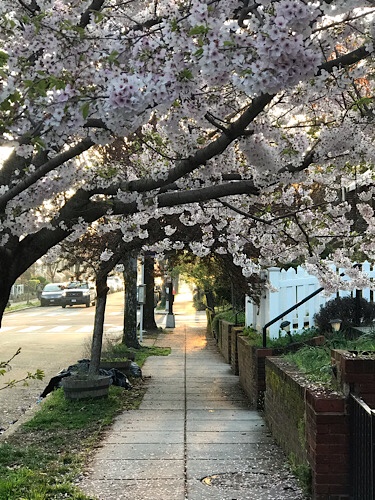
On the Way Home from Tuesday Night Yoga Practice at William Penn House

image

Tonight, in addition to the regular students, a group of high school girls who were staying at William Penn House for the week, joined us. Their school, which is a Catholic girls school in Kentucky, requires the students to select a work of service in their senior year that involves the quality of mercy. 

On the initiative of two of the girls, the group came to DC to lobby their senators on global climate change for their mercy service.  They mostly hadn’t taken any yoga, but were enthusiastic to have it be part of their experience, and we explored a little how yoga practice might support them in such service.

Similar Posts

  • | |

    Early Morning Light

    I’ve been going out just at full light, before even most of the workers, to be safe and actually practice physical distancing.

    I am realizing just how dependent I am on walkabout, and this next phase is requiring me to find other ways to soothe spirit and best exercise for my body.

    I’m blessed to have internal stairs. I’ve been going up and down them a lot.

  • | |

    Special Holiday Thank You (Web Version of E-News)

    Dear Friends,

    You’ve just received an unexpected gift that does good! rose garden yoga sent you a gift card from Oxfam America Unwrapped.  Follow this link to see your card. And learn about how you’ve made a difference.

    Much love and gratitude.  News for the holiday and new year to follow in a separate e-mailing.

    Peace and light,

    Elizabeth

  • | | |

    The Svadharma of the Pinky Toe (and Radical Affirmation)

    Svadharma, from sva (self) and dharma (duty) means our personal path, duty, calling, or place.  The principle of svadharma is a significant teaching in various yoga texts, such as the Bhagavad Gita, especially emphasizing the importance in acting in accordance with one’s caste (for example, Arjuna needing to act in accordance with his dharma as a warrior) or one’s sex (consider Sita’s role in the Ramayana).

    Extrapolating this teaching and taking it onto the mat, during one of the practice sessions the previous week at the Certified Teachers’ Gathering, John Friend said that “every part of the the body has its own svadharma to increase the pranic flow.”  He then said that if you just took a photo of the feet of an Anusara yoga practitioner in any pose, you should be able to see that the whole body was fully engaged and active.  John Friend’s teaching here was not just using the yoga philosophy as a catalyst to better understand the body.  By using the principle to illuminate the practice, the practice reflectively illuminated the principle itself, without denying or denigrating its original context or getting bogged down in its historical baggage of perpetuating the caste system and demarcated, subservient roles for women.

    Thinking about the svadharma of the pinky toe has no such baggage.  The pinky toes are homely looking things, they do not fit well into most women’s shoes, they rather painfully bump into things, and they are hard to move independently.  They are not essential for living and do not have the emotional charge of the heart and brain, the exquisite connection to the world of the sense organs, or the connection to life itself of the lungs.  Despite this, the call to lift and spread the toes, to draw the pinky toe toward the heel, or the hip happens just about every time I go to the mat in my practice or teach a class.  Activating the pinky toe by opening it and spreading it apart from the other toes is a conscious act of opening that helps hug the shins to the midline.  In hugging the shins in by means of activating the pinky toe, the yogi on the mat can then safely move the thighs back and apart, creating an expansion of the pelvic floor that provides room for more strongly tucking under the tailbone to access core power.  The pinky toe thus is an important part of our practice, even if we could manage to get by without it.

    But the svadharma of the pinky toe on the mat is not just to be able to help us access the movement of “shins in” so that we can better do “thighs out,” although that is an important physical part of its essence.  The toe does not move on its own.  We have to start by bringing our awareness and consciousness to the toe.  Part of the pinky toe’s svadharma, then, is to invite the infusion of consciousness to show how full participation of even an apparently insignificant part of the body can lead us to a better understanding and personal experience of the pulsation between reaching out and hugging in and affirming ourselves.   By intentionally bringing our awareness to the power we can unleash in the pose by the movement of the pinky toe, we bring the opportunity for greater strength, expansion, and flow of energies.  This is why, I think, John Friend suggested that by just seeing the toes we should be able to know the engagement of the whole body and mind in a particular pose.

    As a practical and therapeutic matter, recognizing and bringing into play the svadharma of each and every part of the body serves to help us increase the flow of energy and expand our range of movement.  In addition, activating the parts of the body that are inclined to slack (for example, the pinky toe or the adductor and abdominal muscles) will bring ease to the muscles that tend to overwork to compensate, such as the neck and low back muscles.  We are not just stronger and more flexible when every part of the body does fulfills its svadharma, but we eliminate much pain and suffering.  (More to come on this particular concept in other posts.)

    Off the mat, when all parts of the whole are fully conscious of and know their svadharma, the whole will itself have more consciousness, more light, and better experience the bliss of being.  It is easy to see, without judgment or question, that the pinky toe cannot do the work of the heart, although when the pinky toe is working it can help contribute to an integration of mind and body that will further the opening of the heart and thus the whole person.  Finding our svadharma as a whole person within society does not have to be about conforming to preconceived social norms that no longer serve.  The better we are able to understand where we are in time, space, and the interconnected web of being, though, the more fully we can participate in leading society itself to a more conscious and light-filled place, just as bringing our conscious awareness to the actions of the pinky toe can do the same for us as individual yogis on the mat.  When we recognize and live out our true svadharma as such, we radically affirm ourselves, the community, and the very essence of all being.

  • | |

    Should I Be In Alignment or Should I Relax Completely? (and Namah Shivayah)

    For the first few years I was teaching, one season a year, I would have as my overall session theme the Anusara invocation (for the words written out, click on “invocation” in the menu bar above).  In so doing, I invited myself and others to contemplate at the heart level the meaning of each word, of why we were making the invocation, of how the invocation might inform not only our practice, but how we bring our practice off the mat and into our daily lives.  Each time I chant the invocation–and it has been hundreds of times now over the years I have been studying, practicing, and teaching Anusara yoga–I seek to invoke into my practice the deepest qualities of the heart that it represents.

    Over the winter break, when I was preparing for this session, the invocation called to me.  I decided it was time to make it as a specific offering again.  Last week and this week, including in the restorative workshop offered at Willow Street Yoga last Saturday, I have been exploring namah shivayah from the first line.  Namah–which has the same verbal origins at the English word “name”–means to bow, to honor, to name.  It forms the basis of the greeting namaste–with the light in me, I bow to the light in you.  Sivayah here is our siva nature.  It is variously the light within, auspiciousness, spirit, divine nature, elemental goodness.

    When I was practicing in preparation for teaching the week’s classes and the restorative workshop and contemplating (practicing bhavana on) namah shivayah, I thought about a question I often get when I teach restoratives:  “should I be maintaining the alignment principles or should I be relaxing completely?”  When I get the question phrased this way, I look the student straight in the eye and respond, “yes.”  I get a quizzical look; how could the answer be “yes” to an “either or” question?  The answer is “yes” because in each pose, we are seeking to embody the fullest expression of namah shivayah. Taking the time to make sure to be in alignment when setting up for a pose, moving into a pose, reaching the pinnacle of a pose, and then moving out of or dissolving a pose, is out of loving respect for your body and the energy that courses through your body.  We seek to be fully in alignment in all stages of each pose, not only to minimize the likelihood of being in pain or getting or aggravating an injury and to increase the likelihood of healing any existing injuries and expanding our capacity to feel free in our bodies, but also out of a profound respect and honor for the self, the teachings, and the practice.

    Sometimes people think that focusing on getting the alignment just right is fussy or rigid and the antithesis of relaxation.  In the case of restoratives especially, everyone coming to the practice wants to be at peace and feel free of effort.  In the hunger to get to a place of relaxation, some hurry into the pose without honoring the alignment.  Oftentimes, it is the hurry to relax and the loss of attention to the details of alignment (of both the mind-body and the props) that leads to pain or discomfort in a pose that is meant to be held for a long time, as are restoratives.  When a student tells me that they are in pain in a particular posture, I invite the student to back off, set up the pose again, and far more often than not, all discomfort disappears, and the student is able to move into a blissful place.  The student then experiences for herself how much the alignment enables the surrender to the exquisite opening to siva and the blissful attributes of siva (satcitananda).

    One of the reasons I find restoratives to be such a powerful practice is because they require such focused attention on alignment to enable full relaxation.  As such, they are a great way to understand the need for the perfect and simultaneous balance of effort (tapas) and surrender (ishvara pranadhana).  So the answer is “yes;” the answer is “nama shivayah.”  In everything we do, in every aspect of our practice on and off the mat, we want to be consciously in alignment.  We want to use all the knowledge that has been imparted by our teachers and experienced in our own practice as a way of honoring and naming and helping to enable an unceasing, simultaneous, and full surrender to our own siva nature.

  • | |

    Outside the Federal Courthouse at Lunchtime

    “Sometimes,” said the woman in red sitting outside the courthouse.

    “Sometimes you gotta,” she said to her co-workers, the red jersey

    Of her dress clinging to her ample curves while she kicked

    The granite ledge where she sat amidst a din of everyone talking

    At every one else, not listening, some smoking, but not eating, on a break

    Of some kind.  Maybe they were jurors not court staff or perhaps visitors.

    Funny that they didn’t have some kind of badge, all of them talking.

    All of them talking and looking like they did the same type of work or had something

    In common, talking all at once to a group that was familiar, but didn’t care to listen.

    Amidst the talking, too many at once, and the clacking of her heels, like a kid, against

    The granite ledge, “sometimes you just gotta be quiet,” she said to nobody listening.

Leave a Reply

Your email address will not be published. Required fields are marked *

This site uses Akismet to reduce spam. Learn how your comment data is processed.