Requests Around Town
The other day, after having worked, been on the phone, and continued in the social whirl of the holidays, the thought sprung up in my mind that I wanted to “go to the place of no words.” It felt absolutely essential that I go into the space of deep meditation. It was not so much for escape, as for rest. For me, meditation can provide more of an opportunity for my mind to rest and renew than can sleep. I rarely have dreamless sleep, and when I am very busy, my dreams get more so. My meditations, like everyone’s, can be full of thoughts and words. Thoughts will inevitably arise. What is different in meditation, though, is that even when my mind is full of thoughts, I know I do not have to follow them. I can just let them be — as if there were some radio or television program on that I just allow to be on, but to which I do not give my attention. It is this rest from paying attention, from having to follow and direct thought that I wanted so that when I returned to active thought there would be more clarity, discrimination, and, where needed, detachment.

Peace and light, E — Posted with WordPress for BlackBerry.
Whenever I am studying with John Friend, and we are invited to move into balasana I recall as story he told of seeing Gurumayi move into the pose. He told us of the reverence with which she did the pranam — the bowing forward to touch the earth as she went into the pose. I like to start my asana practice with balasana because it reminds me to honor the teachings, the history of the practice, my teachers, and myself for coming to the mat. I think of the name of the pose, and I am reminded of the wonder (abhuta) of being embodied. I think of how children marvel and delight at everything they encounter. It is all new for them, but we can cultivate the sense of everything being new and wonderful. When we cultivate a sense of wonder, it brings us to the other meaning of bala, which is strength. For our lives will be stronger and fuller, if we can approach each pose on the mat, and each moment on and off the mat, with wonder and interest.
Balasana is also a good way to start the practice because it is a sweet, gentle way to open up the hips, groins, low back, and shoulders. It is a good way to shift from more active poses towards savasana because, as a forward bend, it is inward-going and quieting.
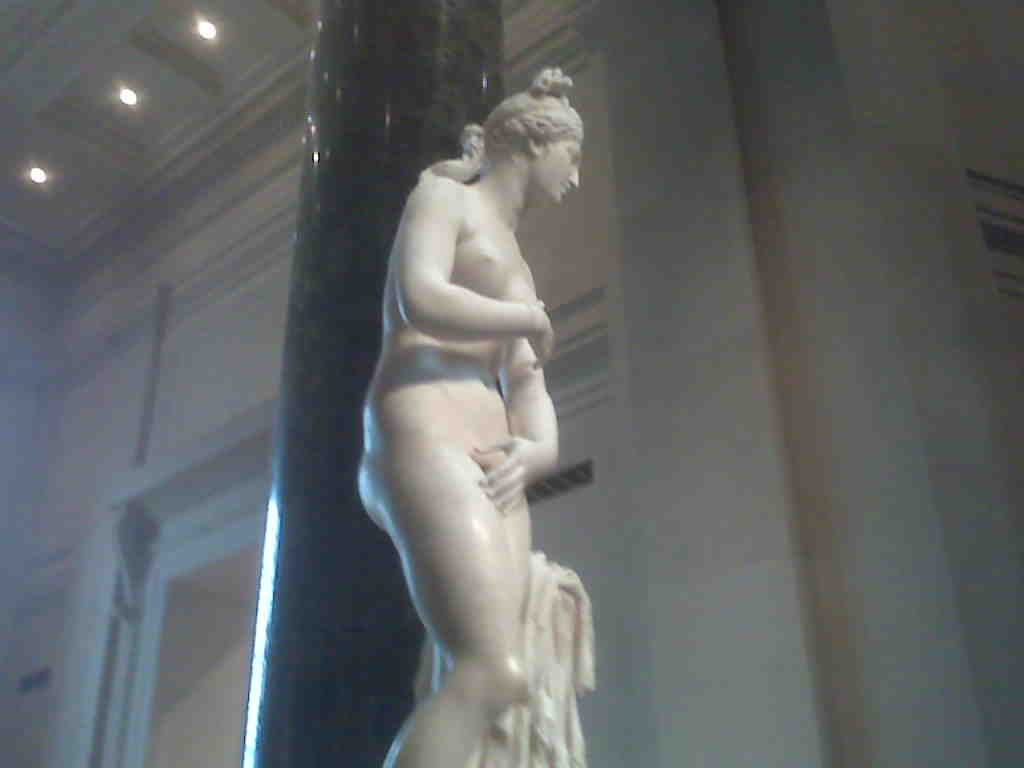
The Capitoline Venus arrived in DC last week from Rome–the first time this circa 200 CE sculpture has been out of Rome in nearly 200 years. What makes it especially beautiful is the apparent softness of flesh of the cool, carved marble, the seeming etherealness of the ancient solid stone.
Looking at the Venus made me think about how carving in stone can help us understand the concept of sruti. The hindu scriptures generally are classified as either sruti (revealed) or smriti (remembered) and until recent centuries were passed on through oral tradition. Those scriptures that are sruti are said to have been revealed by a divine source to the original listener. They were already there as part of the wholeness of the universe and then manifested to a particular enlightened being in a way that could be witnessed and passed on. The essence of the text was always already present, but not tangible, until it was revealed in the mind of a listener, who then passed it on.
Carving in marble takes both the emergence of idea and form in the mind/imagination of the artist and the revealing of that idea from the original stone by the craft of the artist. The sculptor has studied and practiced art and is always open to the emerging into consciousness of a particular image or idea, just as the great yogis continuously meditated and studied, open to what might be revealed.
As the sculptor may find the block of marble first or have the idea and then go looking for the right stone to express the idea, the yogi pulses between experiencing spirit and enhancing the experience through practice. It is not just an act of imagination that builds and creates something out of nothing. To some extent, the form of the final sculpture is already there in the stone. The work of the artist is to remove that part of the stone that is obscuring the witnessing and expression of the exquisite shape revealed from within by the educated and painstaking act of making art.
Peace and light, E — Posted with WordPress for BlackBerry.