Found Exhortation (and Sangha?)
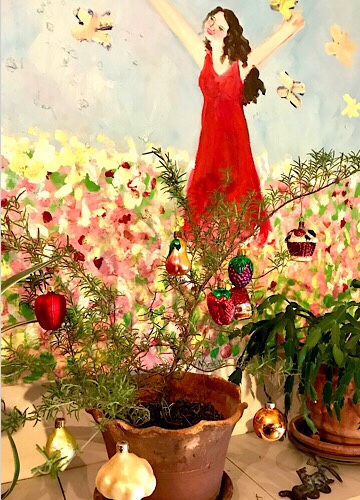
It’s been years since I’ve had a tree. I think it unlikely I would do another full-size one. I decided to see what decorations I was ready to pass on to others; many I found by the side of the street, so perhaps it is time. The rosemary was inclined to wear a few of them. Some others went into a bowl.
On Friday night, I went to a neighbor’s house for a “meet and greet” with Tommy Wells, who is running for reelection for the Ward 6 Member of the DC Council. I had received an email invitation and was thinking about going. Then on Friday morning, a neighbor who is just around the corner stopped by to give me an invite in case I hadn’t gotten the email. I decided it was important to go to connect with neighbors I already know and like, to meet new neighbors, to clarify my thoughts further about the upcoming primaries (don’t forget to vote!), and to get a chance to talk to my council member.
I walked the two blocks to the party with nothing in my pockets but my keys. Even though I did not know the hosts, I knew or recognized from the neighborhood at least half the people who were there. Given the purpose of the gathering, much if the discussion about what changes we would like to see in the neighborhood and the city to make our lives better (and, of course, I gave information about installing solar panels to a couple more neighbors).
Tommy Wells speaks to my condition, because he takes action in connection with his campaign slogan: “a livable, walkable city.” After we all had time to catch up with each other, Tommy’s campaign manager gave a solid introduction, talking about key accomplishments in the past four years. Tommy then talked about what he wanted to do next and fielded questions, including ones about the disposable bag 5 cent fee, which has cut down pollution in the river significantly) and what is going on with the community gardeners at Virginia Avenue v. the marines.
I, like the others, came with a specific question, but I did not ask it in the group. I was not sure that everyone present would be in agreement with me, and I did not want to cause controversy. I asked about it afterwards, when people went back to connecting and enjoying the food. Tommy recognized me, probably from my three-year stint as a member of the Board of Directors of the Eastern Market Preservation and Development Corporation, which coincided with the time when Tommy was getting noticeably serious about his engagement in politics as a way to make some visions actual.
“I gave up my car for the war,” I started. “That’s great,” replied Tommy, “thank you.” We followed up a little on living without a car in the neighborhood. Then I got to my point.
“Every time I walk to work, it feels like I am taking my life in my hands,” I continued, after thanking the District for having put a four-way stop and zebra crossings at the intersection of Constitution Ave. and 10th St., NE. “I did not want to bring this up in the group, because I was not sure how everyone would feel, but I have a few locations where I think it would be great to have a traffic camera.” I then described the intersections I had in mind. He told me that he has a task force on pedestrian issues, and that if I went to his website, I could contact Ann Phelps, who would be interested in hearing the suggestions for particular intersections. He left me know that the District is getting more cameras and the cameras are mobile, so it would not be hard to try the different intersections suggested.
“Wow, that’s wonderfully more responsive than I’d dreamed,” I thought. I thanked him and left to talk to other friends and to give other people time to ask their own questions.
These are the times when I truly love being part of a neighborhood. It is not just about being able to walk to a party two blocks from your house hosted by someone you have never met and know or recognize at least a few people and find all sorts of connections and commonalities. It is not just about sharing a way of life that holds a similar commitment to the city, even if politics, religion, work, and lifestyle in other ways are diverse. It is also about meeting people who care and have depth and out of a true calling for service truly give of themselves to make things better for all of us.
I’ve been working on illusion busting this week, finding more places where my eyes have been turned away.

March Against Mass Incarceration, Lafayette Park, August 19, 2017
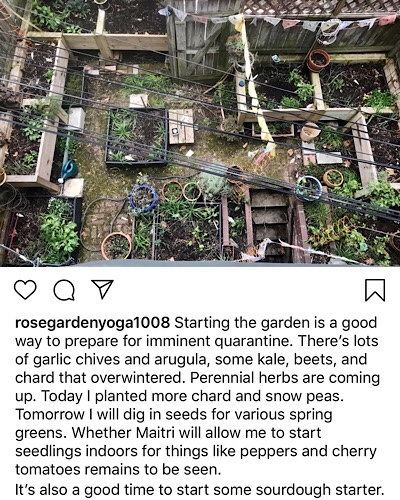
Growing some of your own food–even if just herbs on the countertop–connects us to the earth and the rhythm of growing things and to the place we are inhabiting. And if we all grew some of the basics, what needs to be shipped to us is reduced.
Ayyappa is the half-brother of Ganesha and Subramanyam. Ganesha and Subramanyam’s mother is Siva’s wife Parvati. Ayyappa’s mother is Siva’s brother Vishnu while he was the woman Mohini. Even in the glossed over versions that don’t get into what a modern reader might think of Ayyappa’s mother, he is the extra and unwanted child of the family, although he is needed to save the world from evil. Ayyappa is the character in the story who represents those who have ever been or felt unwanted or third-wheel or lost or excluded or is somehow missing in society or in relationship, but is still inherently worthy and divine and essential to the functioning of society, even though he is cast out into the wilds of the forest.
Being the god of such, at the festivals at a major temple in Kerala on the pilgrimage route, all castes are welcomed. No need to be a Brahmin.
But only prepubescent girls and elderly, post-menopausal women are permitted; women who have the capacity to conceive are forbidden. Those connecting with the god of the unwanted, the extra, the missing, the cast out, themselves deliberately exclude from access to this god others they make even less privileged. Even for the men of the lowest caste, the step-brothers, the bastards, and the otherwise unwelcome and unrecognized for their intrinsic worth, by the exclusion of all women of child-bearing age/capacity, Ayyappa’s pilgrims get to experience the sense of inclusion and privilege in society of the more powerful and glorified and popular brothers who have never been themselves cast out.
Could this by design? Is it that one cannot really understand what it means to be excluded unless one also experiences the power of being able to exclude in turn? If yes, how easy to pick, in a patriarchal culture, women of child-bearing age as the outcast and denied. (Do they ask any woman who shows up whether she still bleeds? If a woman has stopped bleeding, but doesn’t look “elderly,” does the prohibition still apply?).
I have personally experienced far too many things that have been partly or completely closed off to me, overtly or invidiously, because I am a woman or not of a particular social or religious background, and much where it was worth risking ease to challenge the status quo.
As for an Ayyappa pilgrimage, I’ve seen photos of half a million escstatic and determined male worshippers surging towards the temple for festival (looks something like returning to the tube station after seeing the Rolling Stones at Wembley Stadium in 1982 or the infield on a muddy day at the Preakness only more testosterone than that), and what first came to mind was not, wow, I really want to join that party. Rather, I asked myself where do they urinate and defecate.
I personally cheerfully leave this one to the men (and my more intrepid and determined sisters), even if it makes some of them feel special in part because they have excluded a whole class of people from being able to formally worship. I’d much rather spend time with Kali. Thank you very much.
Maybe I’d go stand outside Sabarimala in off season, when the temple is closed. I’d take a photograph and contemplate what the idea of Ayyappa–god of the unwanted, the unwelcome, the third wheel, the excluded, the extra, the cast out from the benefits but saddled with the hardest task–means to me–both as one who has experienced the pain of exclusion and one who has excluded others (as most all of us do even when we try not to), and how it can inform me to relate to others with more grace and compassion.