Art and Culture | Asana, Pranayama, and Yoga Practice | Community and Family | Dance/Contact Improvisation | Food for the Mind (Yoga Philosophy, etc) | Meditation | Poetry
Invitations Around Town
In Paths to God, Ram Dass speaks of satgurus and upagurus. A satguru is the true teacher. The upaguru is anyone who teaches us something, which, when we are truly open to recognizing the good in all, is literally every one.
The satguru may refer to that within us that is the power, or the essential pulsation, or the light, or the illuminative wisdom, or the heart unbound by space and time that leads us to know the true Self. As such, the satguru unfolds the means to experience the love that the satguru is/experiences. The very rarest of individuals do not have to make any effort either through the various yoga practices (yama, niyama, asana, pranayama, pratyahara, etc.) or practices in another spiritual tradition to experience the fullness of consciousness unbound by self, or time, or space. The rest of us must engage in shifting our lives to align better with nature to experience the highest bliss of being. For this, we need teachers and we receive, if we are paying attention, teachings.
Sometimes a person will will recognize the satguru embodied in a particular human form, as Ram Dass has with Neem Karoli Baba. Sometimes, the teachers illuminating our journey are acharyas, great spiritual teachers who illuminate pathways and practices for finding the satguru within ourselves and in others. They are important teachers for many and a profound influence, but except to the extent that we are all the satguru, they are not “gurus,” nor do they hold themselves out as such. I think of my primary teachers–those I have studied with personally and a couple, like Ram Dass and J. Krishnamurti, whose writings have deeply shifted me–as acharyas. That they may have human foibles does not diminish the power of what I have learned from them and the joy I have experienced and shared from studying with them.
Other people we meet — all of them — are upagurus; we can learn from everyone and anyone. That is what Quakers are taught and seek to practice; that is what Ram Dass is offering for us to consider in both Paths to God and in more detail in Be Love Now. Sometimes we meet a stranger just for a moment, but the stranger in that moment exhibits such grace, that the stranger is one of our teachers for life. It is by being open and spacious that we get the opportunity to recognize those who have just one perfect teaching for us. When we are closed off, we can miss both teachers and teachings.
If we are open enough to seeing the light in everyone, we will also find that even those that trouble us can help us better respond in the highest. Those are the ones Ram Dass calls “teachings” instead of “teachers.” And those who will trouble us will come. We will meet someone and that person will push our buttons. Perhaps the person demonstrates too strongly some behavior or trait we don’t like in ourselves. What a great teaching that can be. When I see such a reflection of myself, I know that when I respond or act in similar ways, I am out of alignment, and it is a great motivator to release the behavior or trait.
Perhaps someone shows up to help us reenact an old emotional pattern that has not served. That someone is the laboratory upaguru who has arrived to give us the opportunity to discover whether this time around we are able better able to embody the principles that we are studying. In being faced with our old stuff, we are given an opportunity, by changing how we respond, to dissolve the old patterns (samskaras) that, if not dissolved by practice, commit us to perpetuate the suffering resulting from our past actions (karma).
Sometimes the upagurus come from the past. They are seeing you through the filter of their own past and have reappeared for something on their own journey. In such people, we perhaps get a teaching that reminds us why we are seeking to better align, why we have sought to shift and change old patterns. We might also meet in an upaguru who has been part of our past someone who has shifted and grown and inspires us to go further on the path, sharing it for a while. Those who are parts of our life for a long time, I think generally serve as both teachers and teachings, and we are the same for them.
With regard to everyone we meet, from an embodied satguru to the most troublesome, the more we are open, the more we hold all that we encounter in what John Friend calls “luminous spaciousness,” the more able we will be both to recognize the true teachers and to learn from the teachings.
Svadharma, from sva (self) and dharma (duty) means our personal path, duty, calling, or place. The principle of svadharma is a significant teaching in various yoga texts, such as the Bhagavad Gita, especially emphasizing the importance in acting in accordance with one’s caste (for example, Arjuna needing to act in accordance with his dharma as a warrior) or one’s sex (consider Sita’s role in the Ramayana).
Extrapolating this teaching and taking it onto the mat, during one of the practice sessions the previous week at the Certified Teachers’ Gathering, John Friend said that “every part of the the body has its own svadharma to increase the pranic flow.” He then said that if you just took a photo of the feet of an Anusara yoga practitioner in any pose, you should be able to see that the whole body was fully engaged and active. John Friend’s teaching here was not just using the yoga philosophy as a catalyst to better understand the body. By using the principle to illuminate the practice, the practice reflectively illuminated the principle itself, without denying or denigrating its original context or getting bogged down in its historical baggage of perpetuating the caste system and demarcated, subservient roles for women.
Thinking about the svadharma of the pinky toe has no such baggage. The pinky toes are homely looking things, they do not fit well into most women’s shoes, they rather painfully bump into things, and they are hard to move independently. They are not essential for living and do not have the emotional charge of the heart and brain, the exquisite connection to the world of the sense organs, or the connection to life itself of the lungs. Despite this, the call to lift and spread the toes, to draw the pinky toe toward the heel, or the hip happens just about every time I go to the mat in my practice or teach a class. Activating the pinky toe by opening it and spreading it apart from the other toes is a conscious act of opening that helps hug the shins to the midline. In hugging the shins in by means of activating the pinky toe, the yogi on the mat can then safely move the thighs back and apart, creating an expansion of the pelvic floor that provides room for more strongly tucking under the tailbone to access core power. The pinky toe thus is an important part of our practice, even if we could manage to get by without it.
But the svadharma of the pinky toe on the mat is not just to be able to help us access the movement of “shins in” so that we can better do “thighs out,” although that is an important physical part of its essence. The toe does not move on its own. We have to start by bringing our awareness and consciousness to the toe. Part of the pinky toe’s svadharma, then, is to invite the infusion of consciousness to show how full participation of even an apparently insignificant part of the body can lead us to a better understanding and personal experience of the pulsation between reaching out and hugging in and affirming ourselves. By intentionally bringing our awareness to the power we can unleash in the pose by the movement of the pinky toe, we bring the opportunity for greater strength, expansion, and flow of energies. This is why, I think, John Friend suggested that by just seeing the toes we should be able to know the engagement of the whole body and mind in a particular pose.
As a practical and therapeutic matter, recognizing and bringing into play the svadharma of each and every part of the body serves to help us increase the flow of energy and expand our range of movement. In addition, activating the parts of the body that are inclined to slack (for example, the pinky toe or the adductor and abdominal muscles) will bring ease to the muscles that tend to overwork to compensate, such as the neck and low back muscles. We are not just stronger and more flexible when every part of the body does fulfills its svadharma, but we eliminate much pain and suffering. (More to come on this particular concept in other posts.)
Off the mat, when all parts of the whole are fully conscious of and know their svadharma, the whole will itself have more consciousness, more light, and better experience the bliss of being. It is easy to see, without judgment or question, that the pinky toe cannot do the work of the heart, although when the pinky toe is working it can help contribute to an integration of mind and body that will further the opening of the heart and thus the whole person. Finding our svadharma as a whole person within society does not have to be about conforming to preconceived social norms that no longer serve. The better we are able to understand where we are in time, space, and the interconnected web of being, though, the more fully we can participate in leading society itself to a more conscious and light-filled place, just as bringing our conscious awareness to the actions of the pinky toe can do the same for us as individual yogis on the mat. When we recognize and live out our true svadharma as such, we radically affirm ourselves, the community, and the very essence of all being.
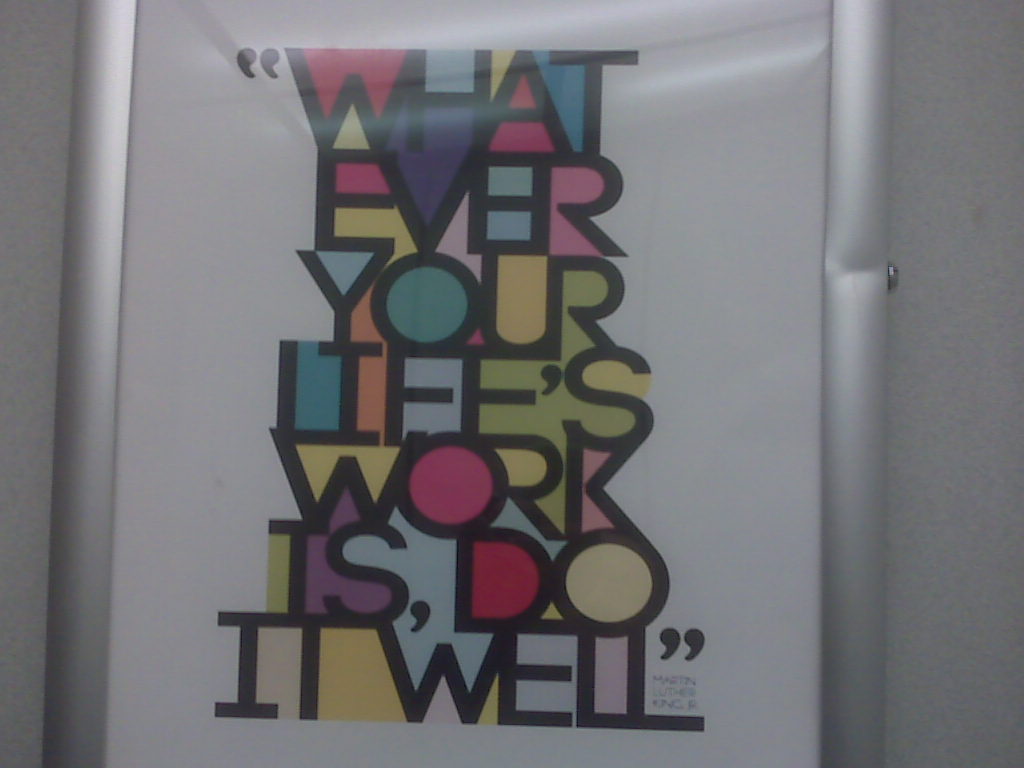
This week’s Department of Labor elevator poster. Krishna said as much to Arjuna in the Bhagavad Gita. Except that Krisha told Arjuna what was his life’s work (dharma).
Peace and light, E — Posted with WordPress for BlackBerry.
 I returned home last night from eight days away, five of which were truly on retreat — just meditating, bathing in hot springs, hiking, eating well, practicing yoga, and celebrating with dance and music. To see pictures, click here.
The focus of the week was honoring the past and engaging in the present so as best to serve the future.
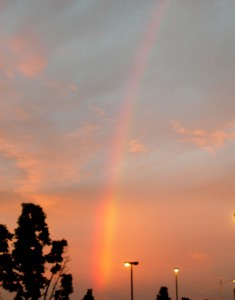
We left Breitenbush Hot Springs mid-afternoon on Thursday. Rather than take a red eye, I stayed Thursday night at an airport hotel and took an early morning flight home on Friday. I woke early Friday morning and rested in meditation to ease the shock of going from an off-the-grid community in the forest to an airport hotel. This rainbow glowed over the airport while I was waiting for the hotel shuttle to take me there for my flight.
The rainbow reminded me to carry the deep joy of the retreat home with me.
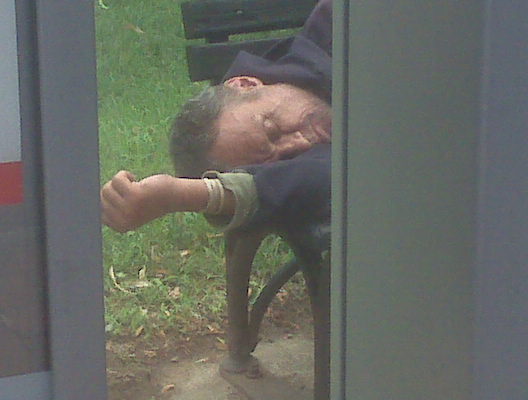
When I was waiting for the bus this morning, a woman walked up the sidewalk with two dogs off leash. The back, belly, and hindquarters of one dog had been shaven; he looked post-operative and stayed close to the woman. The other was eager to check out the man sleeping on the bench.
“Venus, come,” said the woman to little effect as she walked in front of the enclosure to get some distance.
“Venus, come,” I joined in with more directive tone. Though she’d never met me before, on hearing me say her name, she trotted up to me and sniffed my hand favorably before allowing me to pet her head.
“She doesn’t bite,” said the woman.
“No, I expected not,” I replied, continuing to pet Venus (after all, how often does a goddess condescend to allowing pettings from a stranger), “but I think the man on the bench might be wary of her.”
“That’s why I walked on this side of the bus stop,” the woman added and off she, and Venus, and the other dog, he limping, went to buy milk at the grocery store across the street.
It only takes one thing to put a dog in danger–traffic, other cars, strangers who don’t know how to deal with dogs, bicyclists racing down the sidewalk, etc. I’ve seen the harm done. In the city, please keep your dog on leash.
Peace and light, E — Posted with WordPress for BlackBerry.