The Whole World

I’ve always wondered what’s really meant by saying that you’ve got the whole world inside of you.
I’ve always wondered what’s really meant by saying that you’ve got the whole world inside of you.
On the Friends Meeting of Washington list serve this week, there has been a fair amount of email exchanged about an upcoming “meeting for discernment for peace.” Very roughly described, a meeting for discernment begins with a period of silent worship in which those present settle into the silence and surrender thought to allow the light of spirit to illuminate a specific subject of contemplation. The subject of the meeting serves to enlighten both the individuals participating and to further both the business and spiritual state of the meeting as a whole.
As I read the emails and invited myself to contemplate the questions offered for the meeting (I will not be able to attend because I had previously committed to volunteer work), it led me to think not only about the topic under discernment, but about how similar it seems to me to the yoga practice of bhavana and how bhavana supports the Anusara teaching method of “heart-oriented posturing language.”
When we practice bhavana ,we invite the fullness of consciousness to illuminate ever deeper levels of understanding of particular teachings from the yoga texts or similar ideas. It is similar to meditation in that we don’t try to think our way through the concept, but rest with it. Bhavana differs from meditation exactly because it is focused on the deepening of a particular concept rather than simply going into the space of meditation as an end in itself.
Although a meeting for discernment is practiced as a form of collective worship rather than an individual practice, it is much like bhavana, and I brought the Quaker method of resting in the light to reveal deeper insight regarding a concept when I first starting teaching Anusara yoga with its emphasis on having a class theme and using heart-oriented language to invite myself and students to experience a heart quality through asana practice.
The queries for contemplation at the meeting for discernment for peace, include the following:
From the small picture to the large, the large to the small, from the perspective of another?
 Diana with a hound at the National Gallery of Art
I came out briefly to sit and contemplate and write in my journal before a staff meeting at lunch time (no lunch provided).
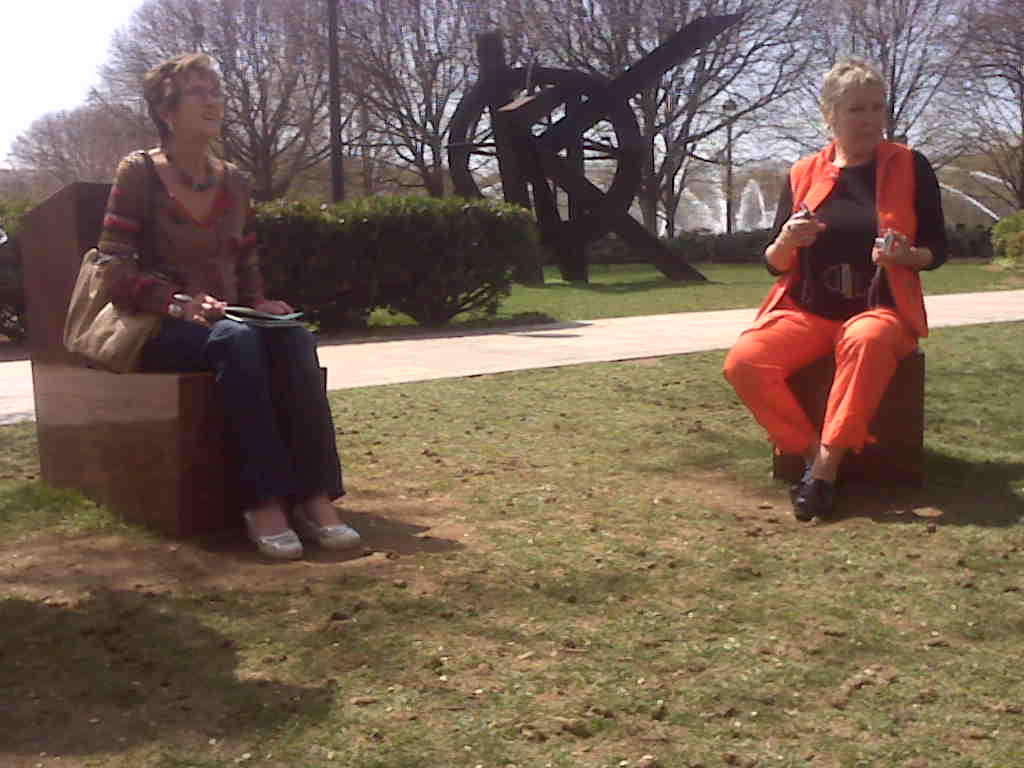
The Scott Burton chairs in the National Sculpture Garden are one of the more delightful places to sit outside near my office.
First, I was joined by several birds. Then some tourists came along. The one with all the jewels sat down at the direction of her friend in orange for a photo. “We’re not allowed to sit here,” the sitter said with a little glee in her voice.
I directed her to the sign near the seats giving permission. This led the photographer both to sit down with her friend, but also to lose any real interest in taking the photograph.
What was it about the loss of transgressiveness that made the photo less desirable? The chairs are the same whether permitted or not. In fact, with sitting permitted, there is more time to explore fully their function as chair as well as their form as art.
This set me wondering about how much our desires are driven by social ideas, rather than needs and comforts.
A father and his son approach the chairs fro the other direction. After reading the sign giving permission to sit, they promptly sat down. The bare statement “granite chairs,” was all that was said before they got back up and went on they’re way.
Peace and light, E — Posted with WordPress for BlackBerry.
It is hard to imagine how this tree–sundered down the middle–continues to live upright.

Peace and light, E — Posted with WordPress for BlackBerry.
 I took this picture the other day when I was walking to work. I have seen TV cameras set up at this spot dozens of times to film news interviews. I have seen tourists galore photographing each other. I’ve seen a couple of photo shoots of brides and grooms dressed in their wedding clothes. I’ve seen the fountain full of ducks or gulls. I’ve seen it empty of water, with rain pelting on it to eliminate any reflection, in a blizzard, iced over, full of algae, as a play spot for dogs who like to swim, in fog, in beating down sun, with cherry blossoms floating on the water, and with waves from a strong wind. Although (or more likely because) I’ve walked past this view hundreds of times in the 25 years I have lived on Capitol Hill and the 18 I have worked for the Department of Labor, I have never taken out my camera and photographed this incredibly photogenic spot.
When I took the photograph on this day when the reflection just happened to be perfect, it led me to see the spot the way tourists see it: full of freshness and wonder, beauty, and excitement to be in this place that represents a certain mind-blowing type of power. Reflecting on the act of taking the photo from my perspective as a resident, led me to think about the Anusara alignment principle of “opening to grace.”
One of the many aspects of “opening to grace” is having a “beginner’s mind.” What does it mean to have a beginner’s mind on or off the mat? I think it means being open to new insight, to a sense of joyous discovery, to a feeling of fresh intoxication and wonder, no matter how many times we have done or seen something before. How many times have you done lunge or downward facing dog? Eaten a green bean or a potato chip? Petted a dog? Turned on a light switch? Filled a glass with potable water out of the tap? If it is the “same old, same old,” then you will lose the desire to practice and the possibility of growing. But most of what we do, especially as we get older, is a repeat of something we have done before. Grasping at new experience as a cure for boredom or jadedness will only make us unhappy. If we can see each day with newly opened eyes, then we can find fulfillment in each moment and be better able to grow. We will be open to ever deepening refinement and exploration within the space of our existence.