Statuary Around Town
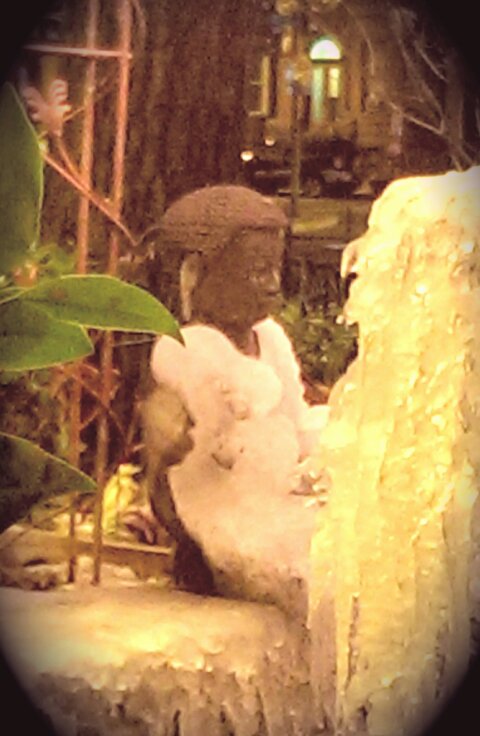

Eastern Market, August 2018
Surely that’s what life was all about? Opening doors and peering through them–perhaps even finding the rose gardens there… (Colin Dexter, The Dead of Jericho)
The good murder mysteries — the ones that teach much about human nature and do not dwell graphically on gore and violence — can teach us much about the power of sadhana (yoga practice). The best mysteries are ones in which the protagonist teaches us by his or her investigation into the mystery that with careful, steady discipline, the application of well-developed technique and study, consistent effort, and an openness to trust intuition tempered by discrimination, we can reveal to ourselves the truth of the matter. The truth revealed is not just the identity, means, and motive of the murderer (mystery solved), but the knowledge of the extraordinariness of human being in all of its manifestations, both good and evil.
A friend from the DC Sunday contact improv jam (one of my favorite places to play) sent this link showing a clip from a documentary in progress about the importance of play to our health. One of the things that I love most about Anusara yoga is that John Friend has always described its practice as being “seriously playful.” I was born serious nature and have worked hard in my adulthood to learn to play spontaneously, and what is being offered here resonates for me.
This is a long clip, but well worth the time. Anusara yogis, notice how familiar some of it sounds. Enjoy!
A couple of weeks ago, a good friend gave me a box of perfect vidalia onions. She had been given two boxes. She said, “These onions were so good; I wanted to give them to someone who would truly appreciate them. I first thought of you.” I was delighted, “yes, I’d love some vidalias.” They are exquisite. I’ve been making delicate sautes, grilling them, dicing them into salads, and marveling at their sweetness. I passed a few on to others that both would fully appreciate the onions as a culinary matter and also know my friend, who is a former co-worker.
Last night I went to take class at Willow Street and was talking a little with the work study students at the desk after class before heading home. “Would you like some onions?” asked one of the work study students, who does great work with the Fresh Farm Markets around town. “Oh, how lovely, no, no thank you,” I replied, “A friend just gave me a box of vidalia onions and I have shallots, baby leeks, spring onions, and garlic chives in my garden.” “I think you have enough in the allium family already,” she agreed, “would you like a cucumber?” “A cucumber? Yes, that would be great. I’ve only gotten one ripe one so far; they aren’t liking the cool wet.” She gave me a cucumber and a zucchini from a farm visit she had done that morning, which made my evening (I am so easily pleased).
This morning I wondered about these offers of onions. It is not as though it is a regular thing for me twice in a space of a couple of weeks to be given bounteous offers of exquisite onions. Did it mean something?
Onion comes from the same latin root as “union.” Unlike garlic, in whose family onions belong, onions grow a single, undivided bulb, which is the likely reason for the development of the word onion. From sketchy researching on the internet, I find onions are also the symbol of “good” and fullness — hence the onion domes in architecture. The ancient Egyptions thought the onion a symbol of eternity (layer upon layer of being) and truth. Yes, I like thinking these onions (those I took home and those that were gifted instead, no doubt, to some other appreciative soul) were meant to bring me to think of good, of union, of the eternal truth in gifts and shared pleasure in sharing delicious, healing, fresh food with friends.
Yesterday afternoon when I came home from teaching I wanted to be out for a walk in the neighborhood more than I wanted to be alone in the garden, but I also wanted to be serving the garden. I combined the two by walking the ten blocks to Gingko Gardens — our wonderful Capitol Hill nursery. It is a little more expensive than some of the nurseries out in the burbs, but I know the owner and have friends in common, I always bump into neighbors when I am shopping there, and they are experts in what grows and works in our little urban gardens. I was thrilled when they opened a number of years ago and want them to continue to thrive, so I make a point of shopping there. I bought some seeds and some planting medium for starting seeds indoors and ordered a few containers and organic potting soil for delivery.
In addition, after having done a bunch of research on rain barrels over the week, I also asked whether Gingko would deliver and install rain barrels from Aqua Barrel, which is located in Gaithersburg. Answer, “yes.” (For those of you in the suburbs, Amicus Green also carries and installs them). It took me a long time to assess what style barrel would work for me and where it should be placed. I was hoping to support a local manufacturer to cut down on wasteful transportation. I also know that given my circumstances it is critical that it be installed correctly with a good diverter system. It is good for me to do the research but then bring in a professional to make sure it is right. I made an appointment and am looking forward to being able to align a little better with nature (by using rain water run-off instead of scarce, potable water for the garden) and to support the neighborhood (by buying locally and hiring resident professionals). And I bumped into a fellow yogi and gardener while I was shopping; inspired by the chat, she, too, made an appointment to discuss rain barrel installation.
To me, this is one way of bringing yoga off the mat. One of the key principles in Patanjali’s yoga sutras is the practice of brahmacharya, which literally means aligning with Brahma. The classical translation is celibacy. Many modern translators substitute “moderation.” This way of living, is of course, moderate. It is living a western lifestyle on the grid, but choosing to consume in a way that supports friends, neighbors, and manufacturers who use recycled materials to create products that will help us all to be a little kinder to the environment, while nurturing my home and self.
