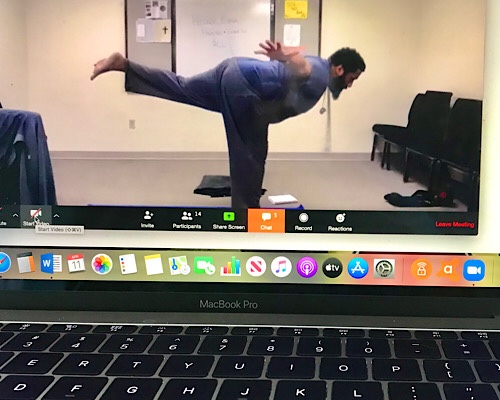
A regular reader of this blog, who was a member of the Willow Street Yoga community until she moved out of the country, wrote and said that though she enjoyed the classes in her new home, she missed the adjustments and alignment instructions at Willow Street. She asked in this context the following: “I’ve been wondering lately, when teachers leave anusara, can they still use the same terminology in their classes? If not, why not? Does JF have a copyright on some of the words?” I cannot speak to any copyright and trademark issues–I took a copyright class in law school, but that was 25 years ago.
All that I can speak to is how I will continue teaching, both at William Penn House, where the only class of the week is the one I teach, and at Willow Street Yoga Center, where I will continue to teach my gentle/therapeutic class, and the other workshops and classes I may teach. Although I have not tendered a formal resignation, I have removed the title “certified Anusara instructor” from the header of the blog. At this time, I do not even know, given John’s decision to step down for at least some period of time, what is the organization from which I would resign or whether a renewal license would be sent. For the moment, there is no need for me to make any specific changes in how I teach.
If my formal affiliation with Anusara as a corporate entity were to change, the thousands of hours I have spent contemplating, exploring, and studying the principles of alignment and how to teach them will still be the major part of my asana practice and teaching. Anusara is a deep, strong, significant presence and has been the most significant physical and energetic component of my practice and teaching and to some extent my yogic framework for being in the world for a decade. Given the healing and delight I have experienced from practicing in accordance with the principles, I do not expect anything to be otherwise. As I have been taught only to teach what I have practiced and experienced myself, and not just what I have heard from a teacher or read in a book, although obviously I cannot have experienced in my own body healing for all the various challenges of embodiment that my students have experienced, how could I not be teaching from my own interpretation of the principles of alignment, regardless of a possible need to shift vocabulary?
What will happen with the organization from a business perspective remains to be seen. The name of the system carries a trademark. Whatever happens and wherever I am led in my practice and commitments in the future, as have always done, I will honor John Friend and Anusara as the source of much of my learning and it will be a recognizable influence on my teaching. I will say in class or when I am writing that the alignment principles I have just articulated would be called [insert Anusara alignment principle] in Anusara. This will be true regardless of how the Anusara community is reconfigured and what my relationship is to any future organizational structure.
In answer to the question of what will my local yoga class be like now from my own perspective: Yes, I will be offering the same alignment instructions and adjustments–and hoping to get better over time with continued study and practice. But also, I will be even more precise about attribution, and I will be less likely to be using the “short hand,” which I already use relatively minimally. I have always found that a description of the actual physical and energetic aspect of one of Anusara’s “Universal Principles of Alignment” that applied to what was going on in the practice far more helpful than just using the name of the principle as a pointer to the action being emphasized.
It is a great question, and I am sure that the answer will be slightly different for each teacher, though I trust that all are committed to offering the best yoga class possible, just as they were before. For me, it will take a little feeling my way around the changed landscape to see how it influences my teaching. All I can say is that I am still committed to offering yoga practices that bring healing, joy, and connection, and I hope that I can do an ever better and fuller job of living up to my commitment. This is true wherever I teach and whatever name is given to the hatha yoga I teach.