|

Today’s Cucumber

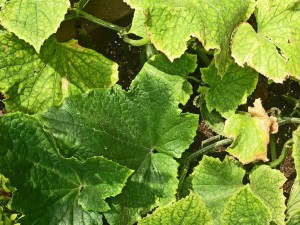
Every day, it seems, another cucumber (though this shall pass soon enough).  And baby carrots–first new carrots of the season.  I asked friends and neighbors who were at the house this morning whether they would like a cucumber.  As fellow gardeners who are also members of a CSA, they denied with almost a shudder.  It is evidently a good year for cucumbers not just in my garden.

Similar Posts

  • “No-Knead” Bread

    In November 2006, the New York Times published a recipe adapted from Jim Lahey’s Sullivan Street Bakery for “no-knead”bread.  I immediately adapted it further (as did many of those who commented on-line).  Many thought the NYT adaptation benefited from more salt.  I also have made it much more energy efficient (the NYT recipe expects the dough to rest in a 70F room and for the oven to be pre-heated for at least a half hour).  In the winter, I keep my house at 62F, and pre-heating for only 10 minutes (or baking something else first that doesn’t need pre-heating) is much better for the environment.

    As I was baking a loaf (whole wheat, flax seed variation) this week, I thought about how much this recipe teaches about skill and steadiness.  The reason the bread doesn’t need to be kneaded, but still yields a crusty peasant-style loaf, is the high liquid content of the dough relative to kneaded breads and the very slow rise time.  That one can achieve the results of active labor by mere patience and an understanding of the science of the process recalled for me  something I learned at a Rod Stryker workshop a number of years ago about having a steady practice.  Rod Stryker was asking students at a week-long intensive whether they had a steady meditation practice.  One woman raised her hand and said that she had sat and meditated every day for 30 years.  We were all thoroughly impressed.  Rod Stryker asked her how long she sat.  I think she said three minutes a day, it might have been five.  I don’t remember exactly.  I was still impressed.  Not because she would claim to have a 30 year practice when it was just a few minutes a day, but that she had the self-knowledge to set an amount of time to practice that she could keep.  The daily few minute sit was obviously not her only practice or she would not have been at a relatively advanced yoga workshop.  It is easy not to develop a home yoga practice, a good home-cooked diet, a garden, or anything else that needs steadiness, if we set the bar too high at the beginning.  We don’t want to set it too low either, but finding what we can do with steady commitment and then allowing growth to be spontaneous is the way to keep at it without feeling burdened.

    Every once in a while I bake bread that takes attention every day for seven days in a row and then involvement multiple times on the day of baking. It is my having spent the time making more difficult breads that has enabled me to create variations the “no-knead bread” and know it will still come out well.  The “no-knead” bread, only modestly varied, I can make whenever I’m out of bread whether I’m busy or not.  It just takes throwing a few ingredients in a bowl on a night when I know I’ll be at home the next afternoon or early evening for a three-hour block of time (doing other things almost the entire time).

    The basic recipe is as follows:

    3 cups of flour.  (At least half needs to be bread flour; you should add a tablespoon of wheat gluten for each cup that is not bread flour, e.g., whole wheat or rye.)

    1/4 teaspoon instant yeast

    2 teaspoons salt (NYT had 1 1/4)

    1 and 5/8 cups water

    cornmeal or wheat bran for dusting

    Day one:  mix all the ingredients in a large bowl.  If you store your flours in the freezer (which helps keep them fresh and lowers electricity usage because a full freezer is more efficient than an empty one), let them come to room temperature before making the dough. Dough texture is sticky.  Cover bowl.  Let dough rest for 15-20 hours depending on room temperature.

    Day two:  dough is ready when the surface is dotted with bubbles.  When dough is ready, lightly flour a work surface, place dough on it, sprinkle dough with a little more flour, and fold dough over once or twice.  Cover loosely and let rest for 15 minutes.  Using just enough flour to keep it from sticking to work surface (I have a cutting board I use only for baking) or hands, shape dough into a ball.  Coat work surface and a kitchen towel (not terry) with flour, bran or cornmeal.  Place ball of dough, seam-side down on work surface and cover with floured towel.  Let rise for about two hours until doubled in size and dough does not readily spring back when poked with your finger.  If dough is slow rising because of cool room temperature, put near radiator or put it near stove when cooking something else and when starting to pre-heat oven.

    Pre-heat oven to 450F with a 6-8 quart covered pot (cast iron, enamel, pyrex, or ceramic) in oven while pre-heating.  When pot and oven are hot and dough is ready, carefully put dough, seam-side down into pot and shake pan to distribute dough more evenly.  Don’t worry, it will straighten out as it bakes.  Bake covered for 25-30 minutes.  Then remove lid and bake for another 15 to 30 minutes until browned.  Cook on rack.

    Variations:  Use just 1/4 cup rye flour along with bread flour.  It will taste like a classic french bread.  Incorporate a teaspoon or two of olive oil.  Semolina flour works well and turns the loaf a beautiful shade of yellow.  You can add constituted cracked wheat, but you have to know what dough should look and feel like, because it changes the moisture content.  Same for oat bran.  I’ve taken to adding flax seed meal into most of my baked goods for the nutritional benefits.  Because flax seed meal can be used as an egg replacer, you cannot replace it one for one with flour, but if you replace a quarter cup of flour with a third cup of flax seed meal, and keep the liquid the same, it has worked for me. Try it without a variation first.  Practice, enjoy.  The more you know about bread-baking, the more options you have.  I’ve done it with beer and molasses as part of the liquid and mostly a mix of whole wheat and rye flour to make it taste like pumpernickel.  Not my favorite, but it worked.

    Play in the same kind of way with your yoga practice at home.  Start with a favorite pose you you learned in class.  Start small.  Start simple, and then let yourself get inspired by the desire to create your own variations.

  • |

    Food, family, friends, life (and leftovers)

    Yesterday I celebrated the bounty of Thanksgiving with my friend Pat and her children, which was just delightful.  The food was bounteous and delicious, but not to the point of groaning excess.  While I was at the yoga fundraiser in Takoma Park, Pat and the children were cooking.

    Jonathan, who is eight, made the cranberry sauce.  Being the superb cook that she is, Pat said it’s just the recipe on the back of the bag (one bag cranberries, one cup sugar, one cup water, cook until the cranberries are split and liquid starts to gel), except that she replaced the water with apple juice, replaced the sugar with brown sugar and halved the amount, added currents (nice touch), and then put in orange rind, cinnamon, all spice, cloves, and powdered ginger.  Only a true cook would think that is just the recipe on the back of the bag, but I know what she means.  As long as the proportions are right you can vary anything to taste.  The addition of the dried fruits and spices were just right for the latin-influenced cooking of the rest of the meal.

    Rebecca made the mashed potatoes, which we had because she wanted them.  They are amazing, they are miraculous, she claimed, mashed potatoes.  All you do is mash them and then they are amazing.  Ordinary potatoes completely transformed, just by mashing them.  Rebecca also offered grace, giving thanks for “food, family, friends, and just for being alive.”  Simply said from the heart; no more needed to be said.

    I was sent home with the leftover vegetarian rice and peas, which Pat had specially prepared for me to honor my preference to eat vegetarian.  As is traditional in her family, I brought home the leftovers with the understanding that when I returned the container, it would have within it a food offering in return.

    Pat did cook a turkey as part of the meal.  When we were cleaning up (I was carving the rest of the turkey to store for future meals), I asked Pat whether she would be making stock with the turkey bones, so I would know the best way of carving.  She said she did not have time, so though I am mostly vegetarian, I took the bones to make stock.  I had, then, the leftovers one would never have if you’ve long since stopped roasting birds, and Pat felt more content knowing that we would be using all of the bird that fed us.

    Today, when I am home cleaning and cooking and enjoying a precious vacation day, I will make turkey stock.  With the blessing of these particular leftovers, I can make what would be traditional to a Thanksgiving meal that I would have cooked:  roast winter squash and stuffing (using the turkey stock, the remains of a loaf of bread I baked last week, dried mushroom, and celery).  My delicious meal of stuffed roasted squash, will be enhanced by the lingering (not leftover) energy of the friends with whom I shared a delightful meal and the knowledge (that by minimizing what goes uneaten) that we are eating in a more sustainable manner) [yes, it’s all about balance; my vegan friends would no doubt be compelled to remind me that eating vegan would have been more sustainable].

    Many thanks to Pat and her family for welcoming me and for sharing.

Leave a Reply

Your email address will not be published. Required fields are marked *

This site uses Akismet to reduce spam. Learn how your comment data is processed.