Ganesha Greeted Us at the Airport

Peace and light, E — Posted with WordPress for BlackBerry.
Peace and light, E — Posted with WordPress for BlackBerry.
I get lots of emails asking me to engage in e-activism — write letters to Congress, write letters to corporate executives, write letters to the President, sign petitions — and, of course, requests for donations. The requests I get are from a wide range of public interest organizations, including environmental, women’s rights, peace, civil rights, worker’s rights, care for animals and other wildlife, organic food, good science, enhancing education, the list goes on. Sometimes I just hit the delete button. Sometimes I sign the petition. Sometimes I hit the send button on the form letter. Sometimes I edit the letter personally to make it a more powerful statement. Sometimes I give money. Sometimes I both write and give money. Sometimes I learn something that invites me to change how I consume or invest my money, and I try to make a shift.
I received an email today from the Rainforest Action Network asking me if I would make a pledge to help end mountain top removal. I power my electricity with 100% wind energy, now through Clean Currents, so I am not using coal-powered electricity myself at home. I sent RAN another donation; I really believe in what they do. I also agreed to do a blog post on why it is important to end mountaintop coal mining as part of my pledge. It’s utter and nearly permanent devastation is horrifying and wakens me to the repercussions of consumption without conscious knowledge of the impact. Seeing the pictures makes me think about everything I consume (and I am already an overthinker). I welcomed the invitation to pledge to spread the word.
In yoga, the concept of “sangha” or community carries with it the meaning that you become those with whom you keep company (so therefore keep good company). I subscribe to all these activist list serves and seek out those who are more engaged than am I, so that I will be inspired progressively to live with more consciousness. I thank RAN for inspiring me to extend the invitation to look more closely at how we can shift our energy consumption still to enjoy reasonable fruits of our technology, but not in a way that destroys the possibility of a good life for others in the present and for eons into the future.
One of the important principles of yoga practice is viveka — discrimination. The longer and more steadily one practices, the greater ease with which one will find path that leads towards recognition and remembrance of our own light and the light in others. In modern culture, I think one of the critical aspects of practicing viveka is having a healthy doubt and willingness to question claims that consuming certain things will make us happier, or better, or will make the world better. Paying too much attention will probably just create a tangle of intellectual confusion that will not lead to a greater openness of spirit. Learning to listen well to your body and mind and what and how you feel and hear on and off the mat will help you start to know better your body and mind and how they interrelate with all around you, is likely to shift your choices and actions.
It is now fashionable to be “green.” Discerning what that means, though, is where we need to practice discrimination. For example, claims of “natural” foods, “organic” foods, and “green” products are now ubiquitous by companies that are part of the existing Wall Street profit-driven industrial and marketing complex because they think they are money-makers and expect most consumers not to question the claims. We are also seeing more and more articles and stories debunking these claims and calls for regulation so that consumers will understand what is bunk. If we stop and pause, we can probably figure out some of this without reading about the pros and cons. Do you know who is selling it to you? Does it come in packaging with a lot of small print? Is the packaging recyclable? Are shareholder profits critical to the entity selling you the food or garden supplies or other consumer good?
Taking the example of the success of the big companies, small entities are using “green” in their names and advertising without discrimination. Around town I see fairly regularly, landscaping companies with cozy-sounding “green” names. When I watch them working, though, they are using Round-up or other chemical weedkillers, throwing into the trash compostable yard waste, and planting non-native shrubs. They may be making a garden the color green, but they certainly aren’t doing “green” gardening.
Here’s some great information on having a “climate-friendly” garden from the Union of Concerned Scientists. The tips are more helpful for a yard large enough to have a lawn, and do not fully apply for my small patio (though I have a tree in front, don’t leave bare soil, and do not use pesticides or chemical fertilizers. I haven’t yet tried planting winter crops in my containers, but I’ve rearranged the patio so that I have a place for a raised bed (to sit on the brick where the table and chairs once were). This winter, I’m hoping to add the bed and a cold frame to lengthen the growing season.
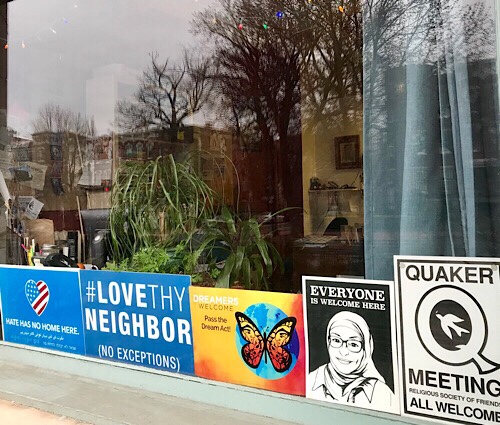
We did have practice at William Penn House, but I fell asleep before posting. Here’s the front window of William Penn House. We’re going to work on a sign for the yoga.