Virasana?
When you are working on hip openers, don’t forget to stretch you quads, even if it doesn’t feel particularly heroic.

Peace and light, E — Posted with WordPress for BlackBerry.
When you are working on hip openers, don’t forget to stretch you quads, even if it doesn’t feel particularly heroic.
Peace and light, E — Posted with WordPress for BlackBerry.

Peace and light, E — Posted with WordPress for BlackBerry.
After work and before going to an evening asana class, I joined in at the People’s Filibuster on the looming tax bill. Speaking were a mixture of dedicated elected officials and people of the cloth. Several of the latter were arrested today for reading the Bible out loud inside the Capitol–perhaps because instead of reading the passages that support ill treatment of women and those who don’t follow a traditional heterosexual mold, they were reading the passages about how Christ advocated treating the poor and the sick.
The crowd chanted “kill the bill” and “not one penny,” but it had the resonance of gospel or kirtan.
Have you called your elected officials (or sent a postcard)? Do you have friends or family you can get out to vote? How are you going to use your voice to further spirit?

What do we mean, exactly, when we say a thing is “by” someone? Yes, we are attributing the thing’s creation to that someone. But how is something just by us when it is based on all the input and teachings to which we have been exposed or immersed? How do we give credit when it is due? How do we honor and acknowledge what has influenced us? When is attribution called for?
The yoga sages speak of the parampara, the lineage of teachings. For some the lineage is just that: a linear chain passed on from one generation of teachings to the next, and the attribution is clear. Those in such lineages or who would lead one of their own making often teach that one should pick one path (one style of yoga/meditation) and stick with that form or teacher to succeed (with the mythic goal of enlightenment).
From my unattained perspective, I question who is to say how “enlightenment,” assuming it is indeed something that can be achieved, would or could or should be attained by anyone else? Practice tips for enhancing the experience of human embodiment (is that not the real path?) are nice, though.
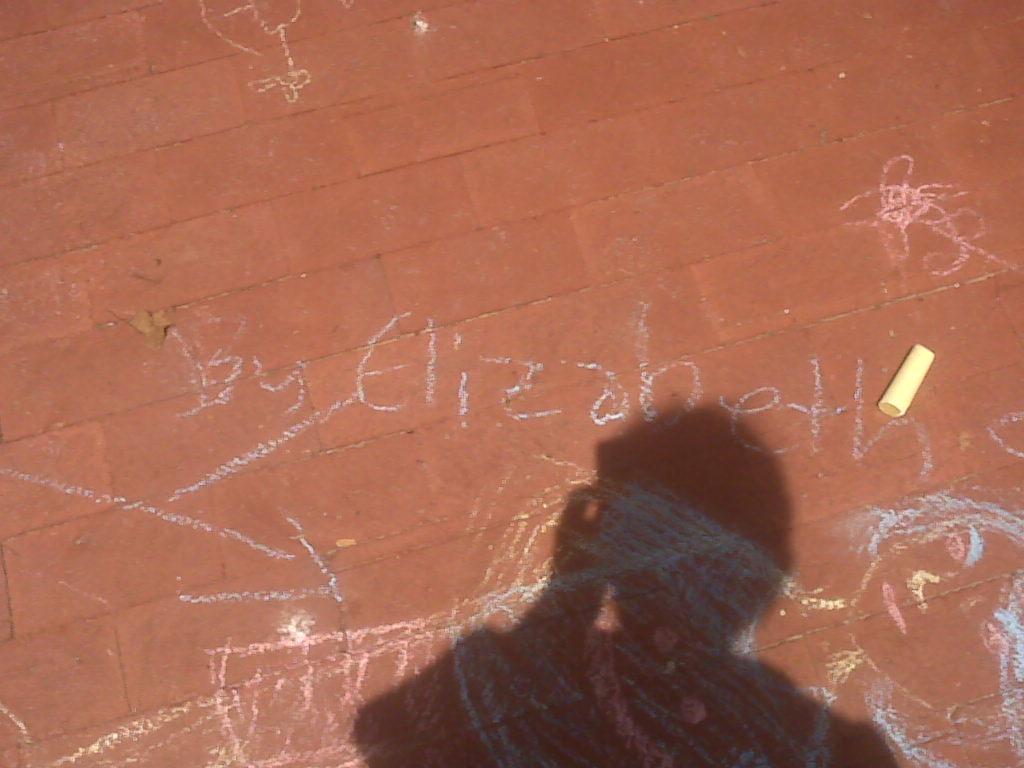
I do not know the Elizabeth who drew on the sidewalk. She is quite possibly about the age I would have been when I first read (not saw the movie) Mary Poppins and dreamed of entering another world through a chalk drawing on the sidewalk.
Peace and light, E — Posted with WordPress for BlackBerry.
I think one of the most wonderful things about the Anusara principle of skull loop is that it uses the head to bring mind into connection with the body. Far too often, staying in our heads or using our mind can disconnect us from the body. Skillful practice of “skull loop” reminds us that the head is part of the physical body. Skull loop, like all the loops, is a refinement that typically would not be the focus of alignment after not only the major principles (open to grace, muscular energy, inner spiral, outer spiral, organic energy) are set in the pose. It is also the refinement that generally would be done last in most poses because of its distance from the foundation of the pose.
I rarely work skull loop as a focus without also concentrating on shoulder loop and the relationship between the two. Both start in the upper palate. While shoulder loop acts to integrate us and draw us in by hugging the shoulder blades onto the back of the heart as a refinement of muscular energy, skull loop helps us to reach out and serves as a refinement of organic energy — inviting us to extend more fully out of the crown of the head.
Even though skull loop helps remind us how much organic energy — a reaching out with offering that goes all the way from the focal point (more on that another day) out through the periphery, including the head — can empower us, skull loop also has a sweet and subtle reminder to come back to the first principle. Skull loop starts in the upper palate and goes up the back of the skull to the crown of the head. That initial action is what helps with organic energy, and when done powerfully, it can really give a lot more strength and lift to a pose. The second part of the loop softens the forehead and lower eyelids, bringing our inner gaze (drishti) back to the heart. Skull loop thus shows us both that the head is physically an powerful and important part of the movement of the body and that no action of the head is complete unless it brings us back to the heart and the ultimate purpose of our actions and offerings.