Similar Posts
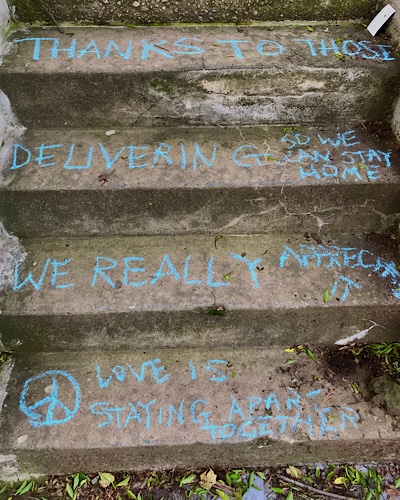
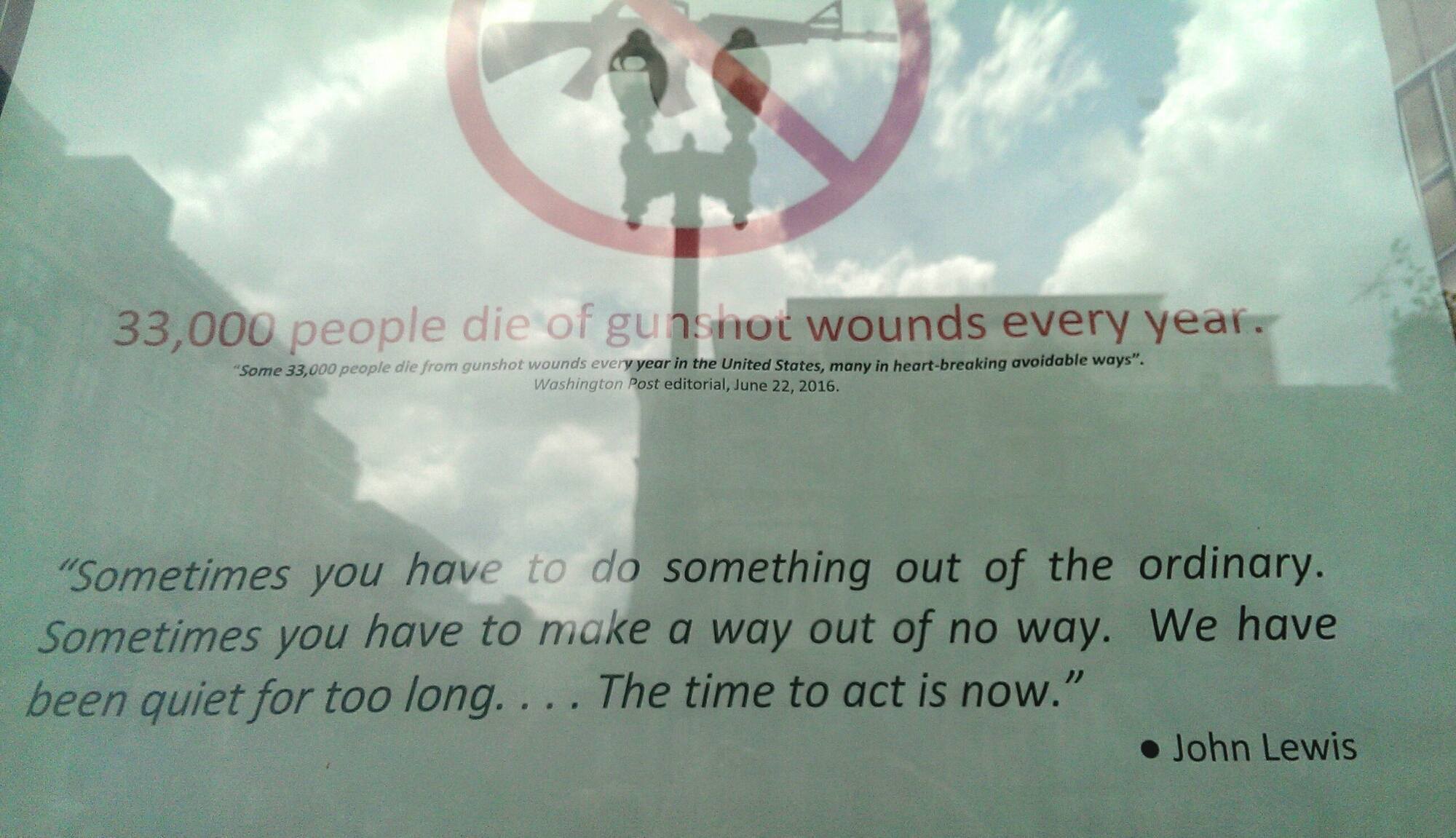
Signs Around Town
I bumped into former neighbors on the street and one asked whether I was currently leading a regular, public yoga practice. I invited them to invite themselves over to my house to practice. This invitation goes to you, too.
It’s a good time to have practices to nourish us.

- Art and Culture | Asana, Pranayama, and Yoga Practice | Community and Family | Food for the Mind (Yoga Philosophy, etc) | Meditation | Photos
Mantra
The texts on sadhana — yoga practice — say in simplified essence that mantra is the fulcrum between the unknowable universal and manifest particulars. What language we use and how we use it can either lead us towards skillfully navigating life informed by illuminated understanding or blundering through things with obscured vision (or, I add, somewhere in between, but which do you want to be your goal?). If you listen for your authentic voice, what words do you want to utter, which do you want to embody, which do you want to offer? The mantra is a tool (in the best sense of the word) to find a source for our own language (thought and spoken) that recognizes the common bond of dwelling together as neighbors (near or far) on this earth, in this universe.
New York City, June 13-14
- Art and Culture | Asana, Pranayama, and Yoga Practice | Community and Family | Food for the Mind (Yoga Philosophy, etc) | Photos
Expanding to Receive the Beauty, Opening to Grace, and the Isha Upanishad
In Anusara yoga, one of the ways the first principle of “opening to grace” can be experienced and practiced is as a radical expansion of the capacity to receive and appreciate the very wonder of being. During my visit to India with Professor Douglas Brooks, I found myself repeatedly thinking of the concept of radical expansion and also the preamble to the Isha Upanishad (long a favorite of mine; Shantala on their first CD, Love Window, have done an exquisite rendition), which can be roughly translated as saying that adding fullness to fullness is itself fullness (fullness can also be translated here as perfection).
What I believe this is saying that being itself is infinitely full; thus, we cannot make it more infinite by adding to it. Human consciousness of the infinitude of being, though, is limited by the filters of space and time. One of the key reasons to practice yoga (including meditation) is to expand both our capacity to appreciate the fullness and to receive its full wonder by uniting our own consciousness with the infinitude. When we can appreciate ever more the wonder of our being, we will naturally be more joyous, and I believe, led to be more compassionate and generous with ourselves and others.
Day after day on the India pilgrimage, just when I thought my heart and mind were already full to bursting, there were yet more experiences of the beauty and extraordinariness of life and creativity and nature. I found myself chanting the Isha Upanishad—purnamadah, purnamidam, puranata purnamudatacyate. Fullness and fullness is fullness. “Let me expand still more to appreciate to its utmost yet more beauty,” I thought to myself again and again. Though I already thought I’d developed a fairly full understanding of the concept through study and practice, I thought, “this is what John Friend means when he is talking about radical expansion.” I look forward to studying and practicing to experience and share ever more beauty.
Slowing Down (and vinyasa krama)
I wanted to share this article on “ecotherapy,” a term I had not heard before. I found the article interesting because for years now, I have gradually practiced all the elements listed in the article as treatment for depression, not because I had been told by a therapist to do so, but because, despite my feeling the repercussions of going against the grain, I felt happier and healthier settling in one place, traveling more slowly, connecting with my pets, and tending a small patch of nature.
These shifts in lifestyle simply feel to me more in alignment with my own nature and that of the earth. I found, incidentally, it gave me much more time overall to do things. People ask me how I do so much (usually referring to the day job, the yoga teaching, the gardening and cooking, the volunteer work). Thinking of the way they live, and what they do, they ask when do I rest? I say that my life is in fact rather slow and restful. I rest when I meditate. I rest when I am taking the time to make a home-cooked meal — every day when I am in town, often two or three times a day. I rest when I am tending the garden. I do not think of cooking and gardening as chores, but as ways to nurture myself.
I rest when I am commuting because it is on foot or sitting on the bus or metro (note: instead of getting anxious or angry when metro is slow, think of it as an opportunity to draw into yourself and meditate, contemplate, or read).
Not having moved or changed jobs in years, even though there have been serious challenges with both where I live and my job, I had the time, money, and energy that would have been used up in a major upheaval, to engage in the study and practice to become a certified Anusara yoga instructor, and before that, to study drawing and photography and to exhibit my art. Staying in place, I continue to have time to study and to read (not watching TV helps alot, too, for finding time). The choices are different with children in the house, but it is still possible to make choices that require less racing around for the family.
This, to me, is a larger aspect of vinyasa krama, the art of sequencing. When we sequence how we move in space and time in a holistic, sensitive way that honors the rhythms and cycles of our bodies and the earth’s, then we feel less trapped or overwhelmed. When I was trying to keep up with society, I was often sad and anxious. Now I am much less so. I have often attributed it to these choices. Now, I see, society has given us a word for it — ecotherapy. With a word coined for it and put in the press, will people feel more comfortable practicing it?