Found Exhortation
Third Floor, Glen Cove Community Hospital

Peace and light, E — Posted with WordPress for BlackBerry.
Third Floor, Glen Cove Community Hospital
Peace and light, E — Posted with WordPress for BlackBerry.
I have lived in my house for almost 20 years. The house came with a bottom of the line, circa 1977 Hechinger’s bathroom. The bathtub has been rusting for a over a decade, part of the faucet would come off when turning it off, etc.
Finding myself without any pets and between tenants, it seemed like a good time to renovate. Last week, in just a day, what was a bathroom, is now a gutted space. Amazing how quickly something can be rooted out and undone. It will be taking a lot longer to reconstruct.
What I am finding most challenging is not the physical chaos. I am used to it as an old house often needs work, and this house needed work (though it was not the kind of fixer-upper that was completely missing floors, electricity, and plumbing).
Rather, what I am wrestling with is my emotional reaction to the idea of having a brand new, beautiful bathroom. There is a big feeling guilty component to be spending money on something that feels not entirely necessary when so many are in need. So while the contractor is working on the construction, I am working with a wonderful opportunity to help reconstruct (post deconstructing) my emotional relationship with things. How do I find balance between honoring those in need, my impact on the planet, maintaining my house, and my enjoyment of beautiful things? How do I feel at peace with my decisions once they already have been made? How do I apply discrimination in my aesthetics to assist in this balance?
My studies today (it is a very rare day that I do not read some of a yoga text or commentary) included a mention of the body’s nine openings. The yoga treatises ubiquitously mention the “nine openings” of the body through which prana enters or leaves (is dissipated). Certain practices are designed to open the tenth, which is an energetic opening that corresponds to the fontenelle at the crown of a baby’s head.
A few month’s ago, my astute friend Jane, who has given birth and nursed, pointed out that a woman has 12, not nine openings.
What is a woman to do in response to this apparent disconnect or male exclusivity? Reject out of hand the teachings as only being misogynistic and of limited utility because they originated for male physiology and not female? Interpret the teachings and correlative practices as being based on the anatomical and energetic openings common to both sexes? Deeply explore the practices relating to this teaching and discover whether there are subtle ways to modify and reinterpret and apply the teachings and practices to address the lack of reference to and recognition of the three crucial additional openings that are fundamental to a woman’s being?
Guess which of these I am most likely to advocate and practice.
Peace and light, E — Posted with WordPress for BlackBerry.

Spring is busting out all over.
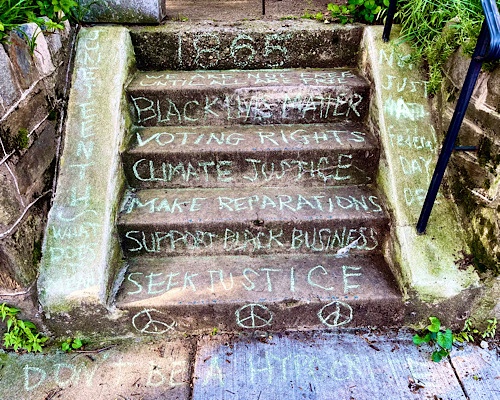
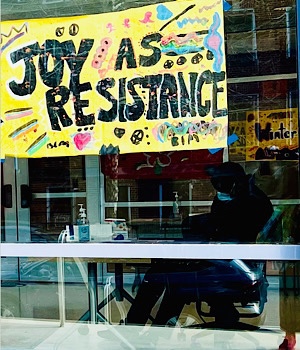
Asteya in Sanskrit means non-stealing and is the third yama of the yamas and niyamas set forth in Patanjali’s Yoga Sutras as a critical part of the path of yoga. White people giving themselves a holiday created by Black people for themselves without both taking action against current injustice and inequity is a classic example of what would be stealing.
Could you give extra support to a Black business today? Donate to a Black-run organization working to fight for civil rights or voting rights or equal access to health care, education, and support services or against police brutality? Give mutual aid? Write to your elected officials about said issues?
We don’t have to do everything every day, but it is not ok to do nothing.