Conundrum of Language?

Thanks to my friend Patrick McClintock (and massage therapist extraordinaire) for being willing to circle around the block while were on our way to lunch so that I could take this photo.
Thanks to my friend Patrick McClintock (and massage therapist extraordinaire) for being willing to circle around the block while were on our way to lunch so that I could take this photo.
What do we mean, exactly, when we say a thing is “by” someone? Yes, we are attributing the thing’s creation to that someone. But how is something just by us when it is based on all the input and teachings to which we have been exposed or immersed? How do we give credit when it is due? How do we honor and acknowledge what has influenced us? When is attribution called for?
The yoga sages speak of the parampara, the lineage of teachings. For some the lineage is just that: a linear chain passed on from one generation of teachings to the next, and the attribution is clear. Those in such lineages or who would lead one of their own making often teach that one should pick one path (one style of yoga/meditation) and stick with that form or teacher to succeed (with the mythic goal of enlightenment).
From my unattained perspective, I question who is to say how “enlightenment,” assuming it is indeed something that can be achieved, would or could or should be attained by anyone else? Practice tips for enhancing the experience of human embodiment (is that not the real path?) are nice, though.
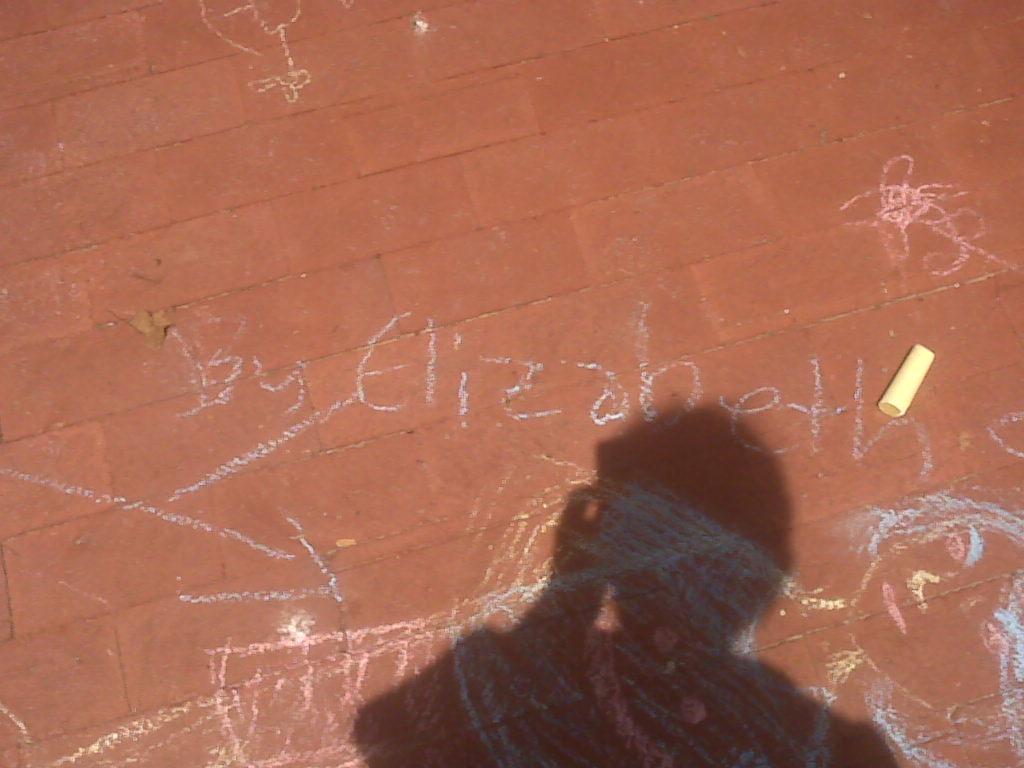
I do not know the Elizabeth who drew on the sidewalk. She is quite possibly about the age I would have been when I first read (not saw the movie) Mary Poppins and dreamed of entering another world through a chalk drawing on the sidewalk.
Peace and light, E — Posted with WordPress for BlackBerry.
The mahabhutas are the grossest, most physical of the 36 tattvas described in Kashmir Shaivism. They are: prithivi — earth or solidity; ap (or jala) — water or liquidity, agni (or tejas) — fire or formativity; vayu — air; akasha — space. When we practice asana, we can focus our practice on discovering one of the elements in our bodies and how we move. As we get more skillful, we can choose which element seems out of balance and emphasize one or the other to bring ourselves more into balance. This week, for example, I have noticed that my mind has been scattered and distracted because of all of the excitement of the Inauguration. After being blown about by the cold and the wind and all the excitement, I had gotten to airy (which is my tendency anyway). It is a good time, therefore, to explore prithivi (earth) in my practice. By emphasizing a strong foundation coupled with the Anusara principle of muscular energy, I can literally bring myself to a more solid, stable, and grounded state.
We can work with the tattvas as described above, to realign our energies so that our physical and mental state is more balanced. We can also explore the more concrete tattvas as we embody them to understand better how they are manifestations of the subtler tattvas — the tattvas that the great yogis who have described them would call more real and we dwelling in our bodies and minds might think of as observably less real. Where we can best appreciate and experience the relationship between the gross and the subtle elements is in meditation, and our asana practice can help lead us there.
Look forward this week to working with the earth element in your bodies and minds, practicing strong standing poses and shaping your physical and energetic bodies like clay. Use your earth nature to sculpt the art of your intention.
For suggested readings see my earlier post on the tattvas.
The dogwood’s red blush
Tells, on this bright hot dry day,
Of cold storms coming.

Peace and light, E — Posted with WordPress for BlackBerry.
Today it is quite overcast and yesterday, as it will be again, was a perfect day to watch the clouds.