Sculpture (Including Statuary) Around Town

Peace and light, E — Posted with WordPress for BlackBerry.
Peace and light, E — Posted with WordPress for BlackBerry.
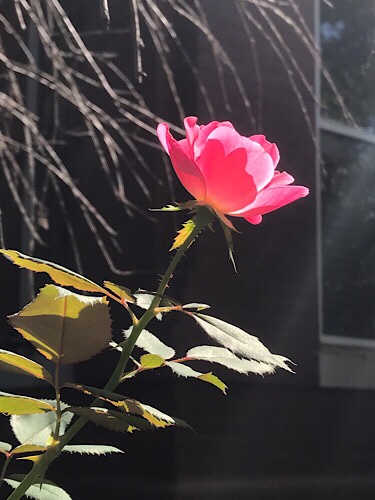
On unexpectedly beautiful days like yesterday, I make sure that I get out during the workday. I’ll ask a co-worker, “did you go out?” Often the response is, “I couldn’t go out; if I went out, I wouldn’t have wanted to come back in.” This is not an uncommon response. I so treasure the spaces of delight in the midst of any day, that it is hard for me to appreciate that response on an emotional or visceral level.
But what my co-worker is saying is that she will get so caught up in longing (pain) that pleasure for a short time is not worth the pain. Thinking about it in that way, I understand. Patanjali cautions us not to get caught up in the “pairs of opposites,” pleasure and pain. Both the longing for pleasure and the avoidance of pain take us out of the moment and make it hard for us to connect to the essence of being. If we are always yearning and avoiding, we cannot rest in the bliss of being.
When we take a walk outside, or stop to eat a nourishing lunch, or pause for five minutes to meditate during the work day, it will only have fleeting benefits if we do it just for the pleasure. If we can consciously bring ourselves into the moment and simply rest in our own being, then it will help us just be (in the state which is free from pleasure and pain/longing and avoidance) while we are in the whirlwind of activity and challenges of our day.
“Nothing is more important than that you see and love the beauty that is right in front of you, or else you will have no defense against the ugliness that will hem you in and come at you in so many ways.” Neal Stephenson, Anathem
The young woman sitting next to me on the train north from New York, who is impossibly tall and has lovely, strong features (i.e., is perfectly cast), is memorizing Lady Macbeth’s lines.
I had on my own lap print-outs of mantras that Paul Muller-Ortega has invited us to memorize as part of our continuing studies.
To enter the character of Lady Macbeth, one of the first steps is to memorize the lines, to know completely what she says and not just to hear it and appreciate it. Memorizing the lines is an essential part of the route to becoming Lady Macbeth.
Paul Muller-Ortega has suggested that the reason to memorize various mantras is not to acquire them, not to be able to demonstrate a superficial knowledge or skill, but to aid in the profound practice of
bhavana–deep contemplation at the heart level. It is not the fact of memorization, but the activity of memorizing. It is no accident that we call memorizing, “knowing by heart.” We seek to learn by heart to invite ourselves into the space of concentration that requires. It is a slow and difficult process for me. I persist, though, because of the deepening and expanding understanding it facilitates.
I note for those yogis (and other readers) who might find the idea of learning mantras alien or uncomfortable or apparently at odds with your own religious beliefs or practices, that studying the mantras does not require or make one a Hindu. I think of it as an invitation to understand and embody the highest archetypes and principles they invoke and represent and compatible with my other observances.

Peace and light, E — Posted with WordPress for BlackBerry.
Do you ever pause and think about how amazing it is to be able to get jet lag. It is, after all, the result of moving so quickly through space that one becomes disoriented in time.

Peace and light, E — Posted with WordPress for BlackBerry.