| | | | |

Another Storm Passes Without Any Rain Falling Inside the Beltway

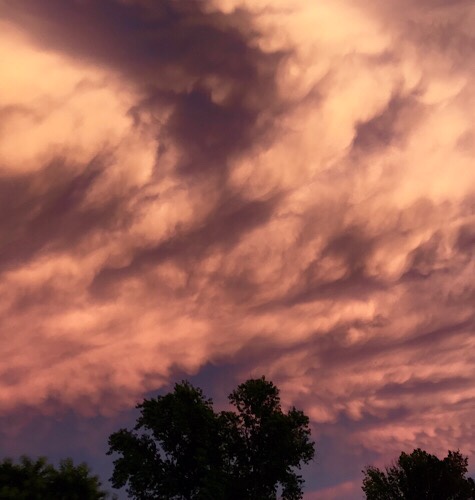
What’s a gardener and concerned for the trees and the health of the planet citizen to do?  I’ve got enough water in the rain barrel to water the vegetables and herbs once or twice, but what impact does that really have?  At work, people were grumbling because it was cloudy.  They seemed shocked when I advised them that we are an inch under normal rainfall for August and have a fairly significant deficit for the summer despite the July rains.

Wouldn’t it be great if we could move some of the flood waters that have fallen only a couple hundred miles away to irrigate our fields without disrupting our eco-system?  Part of me just wants not to know about the consequences of global climate change, but it is hard not to notice that all the weather patterns I used to know and understand do not seem to apply quite the same way anymore.  What do we do when the systems and practices we have in place for our ease, comfort, well-being, and understood day-to-day peace of mind are disrupted?

Yoga will not fix the big outer problems, but it can provide us with the steadiness and ease needed to stay present and be flexible in the face of crisis, upheaval, or disease.  It can also provide insight into how we can live in better alignment.  In the meantime, I am practicing gratitude.  I know how blessed I am that, so far, the wild upheavals I read about in the news have not kept me from all the food and comfort that a person could possibly want.  And I pay attention, because to be ignorant ultimately never serves ourselves or others.
Similar Posts

  • | | | | |

    Shanti Yatra

    Yesterday I walked over to the White House and joined at the final step of a pilgrimage for peace in Gaza. Among the walkers and those giving voice at the White House were Jews, Muslims, Catholics, Baptists, AME, Hindus, Quakers, Lutherans, and other Christian denominations.

    The speaker representing Hindus for Human Rights said this was a shanti yatra—literally a pilgrimage for peace. Every step, every action, every word for peace a prayer embodied.

  • | | | | |

    “I See It Every Morning” (and Jnanam Bandaha) (DWTD)

    When I walked out of the back of the hotel through the pool area just after day break, one of the pool side assistants was out getting things ready for the guests. “Windy,” he said, as I was wrapping and knotting my meditation shawl around my neck into the face of a strong breeze coming from offshore. “But look,” I replied, pointing to the sun rising over the ocean, “it’s so beautiful!”

    “I see it every morning,” he answered, partly with a shrug of weariness and partly with a grin of delight. I guessed he was in his mid 50s–hard for me to tell, his skin was so leathery from the sun. Probably an old stoner surfer was my thought, and the shrug of resignation was for the fact that taking care of the lounge chairs and umbrellas for endless legions of tourists was what he needed to do to eat and still be with his dearest love–the sea and the sun. The smile was for the sun and the sea itself and to be able to share their beauty once again with someone who is seeing them with fresh delight.

    During the course this week of study, we spent time discussing the Shiva Sutras. The second sutra–jnanam bandahah–literally means “knowledge is bondage.”

    “Why do we automatically assume bondage is a negative?” John asked us at one point. Any time we make a choice, we are to some extent binding ourselves because we are, by making a choice and being limited by space and time as we are in this human form, forgoing other possibilities.

    The Sutras also say that knowledge is freedom. Though the sanskrit words are different for the knowledge that binds (limited knowledge) and knowledge that leads us to freedom (highest knowledge or knowledge of the divine), using logic equations, one could say that if knowledge is bondage and knowledge is freedom, then at some level, bondage, too, is freedom.

    If the pool side attendant regards himself as being utterly beaten down by his job, feels stuck with drudgery because he had nothing else he could do to survive, and then forgets about the beauty surrounding him, that would be an example of knowledge constricting or limiting us, putting us into bondage that takes us away from spirit.

    If, on the other hand, he looks at the ocean each morning with joy in his heart and recognizes that he chose his job to be able to be with the ocean and sun every day, that would be knowing that bondage can actually free us (in our limited form) to dwell in and from the heart.

    What the tantric yoga and meditation practices that come out of such teachings as the Shiva Sutras are designed to do, is to help us find the freedom in our limitations, to make choices in our associations and actions — our bindings — that lead us to love and wonder rather than disappointment and fear.

    What do you choose?

  • | | | | |

    Web Version of E-Newsletter (Yes, I’m Still Teaching)

    Dear Friends,

    My apologies for being so long in sending a proper newsletter.  2014 was a challenging year for me.  I started the year sick, ended the year sick, and was limited by injuries for several months out of the year.  Work was intensely challenging on just about every level, day after day, week after week, and it continues to be so.  And then there’s concern about the state of society and the planet and trying to figure out what I, honoring my capacity and limits, can do to do more good and less harm (I’ll never get this sent if I get side-tracked in that direction).

    I also had some great adventures, including a major home renovation and an extraordinary trip to Cuba, but then was working too hard in between to appreciate and integrate fully my experiences (which is a yoga lesson in itself–addressing whether we need more stimulation when we haven’t had time to address/process previous experiences whether delights or challenges to mind, body, emotions, creativity).

    Yes, I’m still teaching, even though working as much as I am these days.  You can find me leading an all levels group practice with a wonderful group of people on Tuesday nights from 6:30pm -7:45pm at William Penn House in Capitol Hill.  100% of the proceeds (pay what you can; suggested donation $12-15) support the work camp program at William Penn House.  There’s also a weekly group practice for more advanced students on Wednesday nights.  Email if you are interested in the Wednesday night practice.  More info on classes on my rose garden yoga website.

    Yes, for those of you who don’t subscribe,  I’m still blogging.  With the help of wonderful web designer, friend, neighbor, and fellow yogi, Jess C, I just updated the look of the website.  I hope to find time to blog about the many layers of meaning that went into the new design, which has the colors of Kali (goddess of sequencing); the murtis are  Dakshinamurti (Siva as teacher) and Saraswati (goddess of learning, the arts, etc.); the books are a small, but important to me as yogini, portion of my library.

    If you’re in town, join me for practice one of these weeks or perhaps we’ll run into each other another class or workshop.  Please let me know how you are.  Best way to be in regular touch are to subscribe to the blog.  When there isn’t an interval between working and living and loving, and all the rest, to share more detailed written contemplations about living yoga,I’ll share the signs and exhortations I see around town and remind myself and anyone else who wants the reminder that no matter what is going on, there’s always a moment to appreciate a little beauty–perhaps to notice a heart-shaped cloud in the sky.

    Feel free also to friend me or like “Rose Garden Yoga” on Facebook.  Instagram possibly coming soon in my copious free time.  Ha.

    Peace, love, and light,

    Elizabeth

  • |

    Winter Reading on the Tattvas (the elements)

    I am returning to a contemplation of teachings about the tattvas (the 36 elements in Kashir Shaivism; in Vedanta only 25).  Each time I go back to study, practice, and contemplate the tattvas, a new understanding arises about how I am in the world and how I might want to shift my alignment to be better able to serve, for want of a better word, the good.  The tattvas provide a way of understanding the structure of consciousness [Consciousness], from the most metaphysical, universal elements to the most diverse, individual, physical elements and the relationship between the two.  Practicing asana with the Anusara principles of alignment at the same time as reading these teachings has, for me, helped bridge the space between the intuitive and concrete understandings of being in the world.  The point of trying to understand these extraordinary philosophical ideas is not for the sake of acquiring academic learning, but rather is an invitation to use the joyous experience of wrestling intellectually, intuitively, and physically to illuminate understanding, as a way to dwell more consistently in the heart.

    Reading Sources:

    Kashmir Shaivism, The Secret Supreme, Swami Lakshmanjoo, ed. John Huges, Universal Shaiva Fellowship (2003)

    Kashmir Shaivism, J.C. Chatterji (SUNY Press, 1986)

    The Triadic Heart of Siva, Paul Eduardo Muller-Ortega (SUNY Press 1989)

One Comment

  1. The 20th Century was a time of massive change, and was celebrated as such. But while those changes were seen as beneficial, the jury’s still out about the changes we face now.

    We can seize hold of trivial matters and manipulate them to our liking, feeling confident that we at least have some control no matter how banal, or we can seek to make peace with the greater reality beyond, knowing our hand will never grace the tiller.

Leave a Reply

Your email address will not be published. Required fields are marked *

This site uses Akismet to reduce spam. Learn how your comment data is processed.