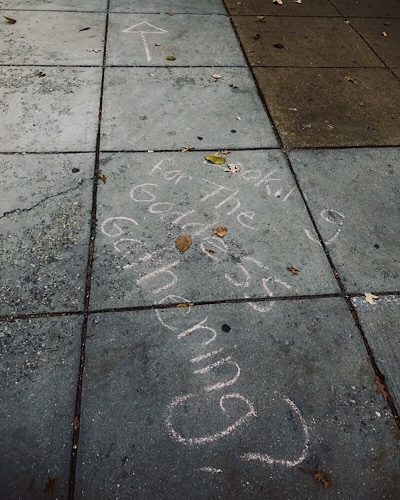
(Documenting) the Real and the Unreal

A woman on a list serve I read invited others to a “mending party.” “How delightful,” I thought. I have a few things in my mending basket. I usually use mending or knitting time as an opportunity to sit and think and listen to music and sometimes write down in my journal what seems like an interesting thought. It would be a most enjoyable alternative to sit and converse with others, all of whom have at the least a shared interest in beautifully mending clothes so that they last. And at the end of the evening, my mending would be done. I am sure it would be quite alright to knit or crochet or embroider, if there was no mending that needed to be done.
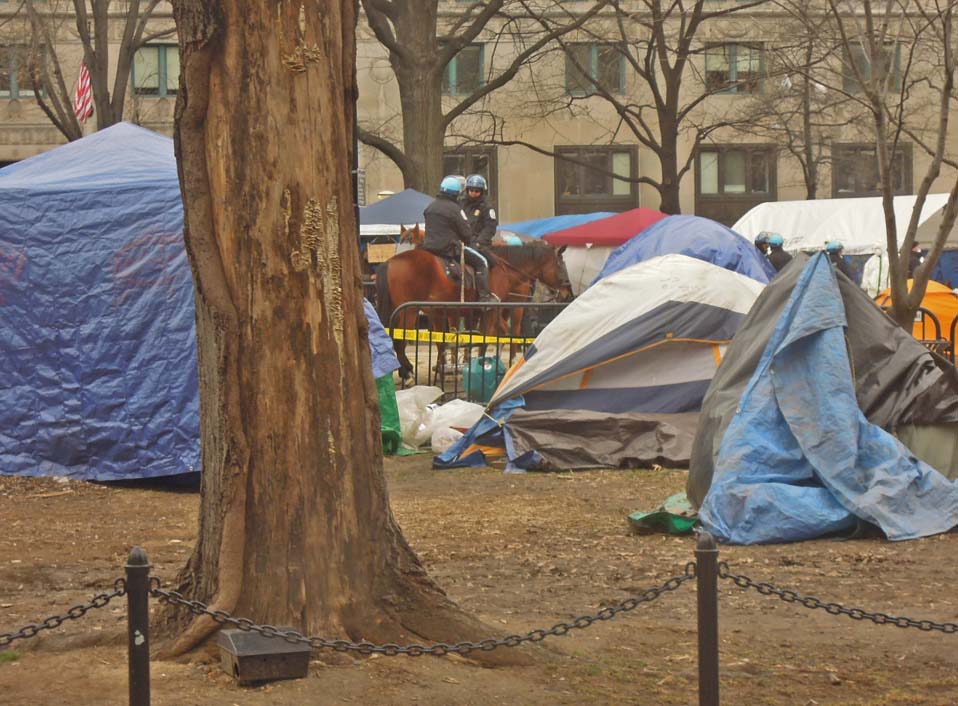
When I was on my way to do volunteer work this morning, I rode the bus past the dregs of Occupy DC-McPherson Square. The police presence was thick. I wasn’t sure why the heavy construction equipment was necessary. It is hard to know what will happen to the movement when it loses its physical location. It is clear that the idea of “occupy” has already entered popular culture, and the idea of the 99% will be part of this year’s Federal elections.
As things are created and dissolved, it is always hard to know what will stay and what will disappear from the fabric of our lives. Part of it depends on the strength of the ideas. Part depends on the commitment of those involved to transform and evolve to keep what is good moving forward even when beset with challenge and upheaval. As for the last photograph, which was taken just down the street (the cop cars were clearly related to those in the Square)–I couldn’t tell you what god or whose country; could you?

The yoga teachings say that we need to be unattached to the pairs of opposites–pleasure (sukha) and pain (dukha). When all of our motivations come from seeking pleasure and avoiding pain, we suffer. Even the tantric yogis, who invite us to fully engage in the vast array of experience that is being human, say we need to turn to the auspicious and recognize the divine play in all experience and not get entangled in thinking what we desire is all that is.
Today’s spam is a nice illustration of why taking any praise or criticism as a reflection of how one should feel about one’s creative output is a recipe for suffering:
Good post! Your strategies as well as insights happen to be easily worth seeing. You truly others worthwhile content. Thank you for posting this!
simply had to appreciate you yet again. I’m not certain what I would have achieved without these basics discussed by you concerning that concern. It has been the traumatic scenario for me, but understanding this well-written technique you treated the issue forced me to cry over fulfillment. Now i am happy for this guidance and as well , wish you comprehend what a powerful job you were undertaking teaching the mediocre ones by way of your web page. I’m certain you’ve never met any of us.
Considerably, the article is actually the sweetest on this deserving topic. I suit in with your conclusions and will thirstily look forward to your next updates. Saying thanks can not simply be adequate, for the amazing lucidity in your writing. I will certainly instantly grab your rss feed to stay informed of any kind of updates. Authentic work and also much success in your business dealings!
This website has a great concept but to be honest its too sloppy.