| |

Start with the Foundation (On and Off the Mat)

John Friend tells us in teacher trainings that when we are observing students, start at the foundation.  In order to help a student have the highest, most joyous and expansive experience in a pose, the foundation must be secure, aligned, and basically in the correct form.  If the student does not already have a steady and aligned foundation, adjustments to other aspects of the pose will not well serve growth and understanding.  When we are practicing on our own, starting with the foundation is also critical.  If we do not make sure that we have the physical, energetic, and mental understanding of a pose, at best, we will have little appreciation for our practice and, at worst, risk injury.

Off the mat, the principle of starting with the foundation is even more important.  If we do not teach all of our children basic reading, math, history, and civics, how can we have a functional democracy?  If a house does not have a sturdy, well-built foundation, what is the point in spending lots of money decorating it?  If we do not plant a seedling at a depth where it can be properly rooted and supported, how can it best flower and give fruit?  If we do not provide all with adequate shelter, feed ourselves in a way that fosters both the environment and natural health, build an infrastructure that makes drinking water and breathable air for all, and have proper respect for the process of dying, how much true health care can come from privatized insurance, however regulated?
Similar Posts

  • | | | |

    My First Five Thoughts (Compound) Before Getting Out of Bed This Morning

    1. Still dark, too early to get up; oh right, daylight savings time.
    2. Wait; wake up call is Sri Rudrum; here’s the part I’ve learned by heart to help invoke auspiciousness, wisdom, compassion, light, interconnectedness, steadiness, fierce will, etc; good reminder; don’t sleep through it.
    3. Nuclear reactors in Japan; wars in Iraq and Afghanistan; Libya; aftermath of BP oil spill, Katrina, and 9-11; budget talks prioritize war and business as usual; no senators or Congress person for DC; mountaintop coal mining; tar sands; diabetes/obesity epidemic.
    4. Time to nurture cats and plants and sit for meditation; I am indeed blessed.
    5. How do I bring “2” and “4” to my response to “3”?

    Peace and light, E — Posted with WordPress for BlackBerry.

  • | |

    Intention, Discipline, and Freedom

    One of the primary themes at the Anusara certified teachers’ gathering this week with John Friend has been how discipline and technique serve our yoga. In keeping with the elemental Anusara principles of “attitude, alignment, and action” (iccha, jnana, kriya), the point has not been to emphasize rules for the sake of rules, form over substance, or technique for its own sake. Mastering technique, by itself, will not bring us to the ultimate intentions of yoga: living liberated (jivamukti), experiencing the very wonder, bliss, and dance of being.

    But just playing or seeking freedom for its own sake, while we are embodied in human form, will not likely lead us to the most expansive and steady experience of ultimate freedom (svatantra). It is discipline and technique with the constant remembrance of the reaon for being disciplined about how we practice and live that will take us further on the path.

    It can be nice, for example to go to a class where there is little emphasis on form, and the call is just to flow and feel. For me, though, because of my physical limitations (degeneration in my spine, old groin injury, etc–these do not define my being; they just inform how I practice), I feel far freer and more able to expand how much I can play the more attention I give to the physical alignment. In such a situation, the rigorous attention to detail is not for the sake of an external idea of what is right and what is wrong. Rather, it is the constant disciplined attention to alignment that frees me to play as free from injury, pain, and fear of injury as is possible in my body.

    The discipline then becomes a way of self-affirmation. It is the limitations that lead me to have to focus more on technique than if I did not have the limitations. That attention then provides a ground for a more expansive practice and a deeper appreciation for the beauty of what the practice can offer.

  • | |

    Steadiness

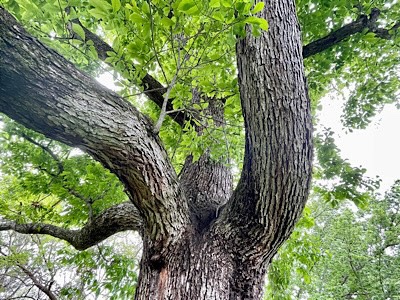
    I woke up violently beset with cold/flu symptoms on Tuesday (fortunately, I’d voted early). I hardly got out of bed for two days and while I was able to work some from home because there were deadlines that needed to be coordinated, I ‘m days from being better. Instead of being out this week bearing witness, I’ve contributed extra to support recount efforts and am glad for the steadiness of committed monthly giving. I am concentrating this long weekend on recovering because this is for the long haul. And look at this beautiful tree, which clearly has enjoyed the overly wet autumn.

  • | |

    Forgetting to Take a Break (and a reminder of the importance of practice)

    I got caught up in something in the middle of the day today.  By the time I could reasonably take a break (I did eat my lunch from home), it was too late to be able to get a real break.  I then worked fairly late.  By the end of the day, I really noticed the difference between a day when I have taken a walk, met a friend, sat at the Botanical Garden or the museum for even 15-20 minutes and this day, when I let myself get so tangled in the demands of work that I did not take a break.

    I work better in the afternoon when I have taken a break, just as my work, my body, my digestion, my sleep, and my relationships are healthier when I practice consistently.  I no longer need a reminder how important it is both to take a good break each day and to find time for practice.  I am looking at this day, though, as a teaching lesson, an extra reminder of the importance of finding some delicious time to bring into the rest of the day.

    Do you take a break to eat quietly or take a walk in the middle of your day?  Can you notice the difference the days you do and the days you don’t?  What about the weeks you practice and the weeks you do not?  Does this not fire you up with resolve to be steadier in your practice and kinder to yourself?

Leave a Reply

Your email address will not be published. Required fields are marked *

This site uses Akismet to reduce spam. Learn how your comment data is processed.