|

Yoga Citta Vritti Nirodaha

I slept restlessly last night and woke early with concern for those who were in the metro crash.  Being already a bit agitated, worries about getting things done at work also were arising.  Despite my restlessness, I made sure to sit for meditation.  Thoughts kept arising, but by the time I was into my sit, I was able to find a space, where I was not tangled or unsteadied by the thoughts.  I felt more peaceful and able to meet the challenges of the day.

In times of agitation, I often find myself drawn to contemplate again Patanjali’s sutra 1.2:  Yoga citta vrtti nirodaha. In classical yoga, it means to still the thought waves.  This is meant to be the ultimate purpose of yoga:  to still thought so that what is beyond mind and body can be revealed.

Practicing and studying from a tantric perspective, I think not so much of stilling my thoughts when I practice and meditate, but rather, finding a sense of alignment, an allowing of and making allowance within my being for the rhythm of the thoughts like a sailor getting sea legs on a boat, so that I can be steady (sthira) and have a greater sense of peace (shantaya) and light (tejase), no matter how wild are the thoughts arising and sensations entering in the field of my consciousness.

Similar Posts

  • | |

    Yoga for Householders

    Paul Muller-Ortega, who teaches philosophy and meditation from similar roots to those that inform Anusara yoga, spoke yesterday of the differences between the path of the renunciate and the path of the householder.  He strongly stated that neither path was better.  What he suggested, though, was that a householder will better flourish practicing yoga designed for the householder rather than attempting to practice renunciate techniques, while still staying in the householder path.

    What does this mean?  I think it means that we become unhappy and conflicted if we try attempt the practices of the path of complete non-attachment and transcendence of body and mind while we are still very much staying in society and responsible for family, work, and citizenship.  The tantric, householder path, including that of the Shaivite tradition of Kashmir and Abhinavagupta, offers practices that enable one to live liberated in society, instead of suggesting that the only way to true liberation is to reject and transcend work, family, and community.  In yoga terms, the householder path is one that realizes moksha (liberation), through ardha (physical and material well-being), kama (love/relationship), and dharma (right work/path) rather than by transcending them.

    Taking the householder path does not mean just indulging.  It still requires sensitivity, dedication, discrimination, and alignment.  I think it may be even harder than renunciation.  I know it is easier for me to just stay alone and practice, for example, than to bring yoga off my mat to how I work, consume, relate to others, and participate in society.  The householder path, though, is the one for me.

  • | | |

    Trishula

    image

    The trishula represents all the philosophical threesomes:
    sat cit ananda (being, consciousness, bliss);
    iccha, jnana, kriya (will, knowledge, action);
    siva and shakti and the dance of relationship between the two.

    The me and the you and the us–for where there are two ones there is also the third and all the play (lila) and pulsation (spanda) that is part of the dance cosmic and divine and personal.

  • | |

    Shiva, Brahma, Vishnu (and the health care act)

    In Hindu philosophy, the powers of creation (Brahma), sustaining or preserving (Vishnu), and destruction (Shiva) are all given equal weight in the balance of the universe.  Without destruction, there is no place for new creation.  Each aspect of this triad is an essential part of the elemental unity of being.

    I think that a repeal of the health care act, if it only were to open the path to a single payor system that actually provided health care for most, would be a good human level demonstration of the need for destruction to allow for creative flowering.  Alas, I don’t think that is what the would-be destroyers have in mind.

    I remember at these times that I am not in charge, and I cannot see the biggest of the big pictures, but somehow, that is not always of much comfort.

  • | |

    Signs Around Town (and Dharma)

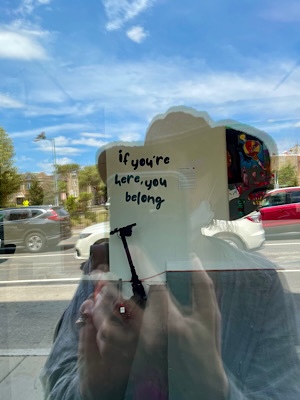
    We tend to think of giving our lives in terms of willingness to die, but is not any life lived in accordance with dharma a life dedicated to the service of what is greater, one in which we abandon gratification for aligning with a higher purpose?

    Peace and light, E — Posted with WordPress for BlackBerry.

Leave a Reply

Your email address will not be published. Required fields are marked *

This site uses Akismet to reduce spam. Learn how your comment data is processed.