|

Standing Poses with John Friend

If you are looking for a good way to practice and enhance your standing poses, please check out this video by John Friend.  If the link doesn’t work for you, go to Yoga Journal on-line and go to their videos section.

I never cease to marvel at the wonders of technology.  I never cease to be grateful for my teacher and the teachings.  Don’t take anything for granted.

Similar Posts

  • | |

    Knowing Your Garden (and svadyaya)

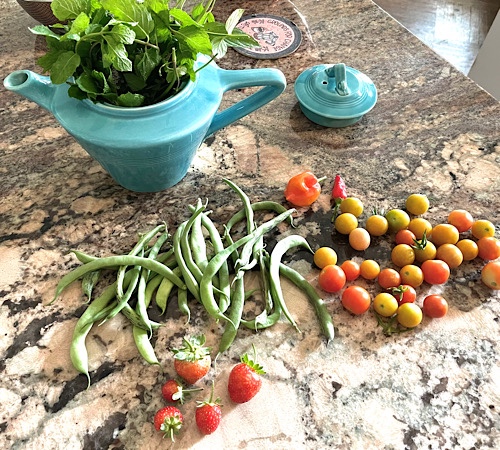
    This will be my 20th season in my garden.  I know that my back garden — where I grow my herbs, flowers, and vegetables —  is easily 4-5 weeks earlier than the gardens of my friends’ in Potomac and Silver Spring and the outer suburbs.  It is even almost that much earlier than my front garden.  I have a brilliantly sunny, south-facing, protected back garden with a brick patio that is against an unpainted brick house and a densely shaded, north-facing front garden.  Not only is the back garden sheltered from the wind by the house on one side and the fence on three sides, but the bricks retain enough heat to change the temperature by a a couple of degrees.  I have a special micro-climate.  My climbing rosebush (pictured in the header) is already in leaf.

    What does this mean?  While my friends in the suburbs or those with east/west facing houses are starting seedlings for kale and spinach indoors, I can put seeds into outdoor containers in the next week or two without compunction.  The seedlings I would need to start (if I don’t instead choose to purchase them from the organic farmers at the market) are peppers and tomatoes for planting in mid-April.  If I start with strong 8″-12″ plants in mid to late-April (depending on the 15-day forecast), I can have and have had for at least 10 of the past 20 years, cherry tomatoes in May and peppers in early June.  My greens, obviously, bolt earlier.  I’ve figured out that certain varieties of chard do better in these conditions, and that spinach and lettuce do better sheltered by the fence where they get afternoon shade, so that I can have them farther into the season.

    This kind of knowing by combining general book and teaching knowledge with personal observation of my little space, is much like the yoga practice of svadyaya (self-knowledge), which is the fourth niyama of Patanjali’s yoga sutras.  Svadyaya is literally study of the self through the scriptures.  Implicit in that is the guidance of a teacher or guru.  Ultimately, though, self-knowledge or awareness must be experiential.  We make the effort to study and we listen to our teacher, but then we practice.  We soften and open to who we (or our garden) truly are — another way of practicing and experiencing the Anusara principle of opening to grace — and then in the context of the teachings, accept who we are.  As gardeners, that means accepting what zone we are in, how much shade, water, space, and sun we have.  As yogins, it means accepting our strengths and our limitations.  We can shift our zone by treating certain plants as indoor/outdoor or as annuals rather than perennials; we can enhance our water flow by storing it in rain barrels, but that is merely expanding the edge rather than making a complete change.  We can expand the edge of our practice, but still need to accept the bodies with which we were born.
  • | | |

    Reflection (Prakasha and Vimarsha)

    At the Thillai Kali temple in Chidambaram, and at other temples I am sure, but that was where I particularly noticed this aspect, there is a mirror on the altar, so that one also sees one’s reflection when watching the abhisheka puja.

    One is there, too, along with the priests and the gods—watching and a part.

  • | |

    Ganesha (Deity of the Marines?)

    A senior colleague and I spent several hours today working together on a very challenging aspect of a long-term project.  When we were wrapping up for the day, I showed him a murti of Ganesha that another co-worker had brought me from the Norton Simon Museum when she had gone on a business trip to Pasadena, where our Los Angeles office is located.

    I said that I do not believe in the Hindu deities as gods, but find them helpful for contemplation as archetypes (in the Jungian sense).  I said that being on this project has taught me much about yoga and about Ganesha.

    “Ganesha,” I explained, “is not so much the remover of obstacles, but the one who places obstacles in your way to teach you the wisdom to grow and find a more enlightened path from having confronted the obstacles.”  “Oh,” said my colleague, “like the Marines:  adapt, improvise, and overcome.” “Well, sort of,” I replied, enjoying that we found a way to share laughter after our difficult afternoon.

  • | | |

    State of the Garden

    I was staying at a retreat center in Peru on 9/11. I was not with anyone else from the United States. I remember at the first meal after the planes hit, another guest suggesting that the United States deserved it. I also remember the brief moment of gathering sympathy that, as a country, we threw away with the aggressive response.

    The best thing about the retreat center was that instead of tea bags, every morning there were fresh herbs from the garden for tea. I continue to make my tea that way as much of the year as the garden is able.

  • | | | |

    Fences, Freedom, and Viveka

    Refining how and to what we say “yes” and “no” in the world is one of the purposes of the yoga practices.  The dedicated yogin seeks ever-growing discernment (viveka) of his or her own limits for the purpose of living ever more expansively and in fact more freely than is possible for those who fight against or ignore limits.

    If we stick up or hold onto fences and defenses where they are not needed, we miss the opportunity to connect.  Conversely, if we fail to honor the extraordinary combination of limits that makes us our exquisitely individual self and shapes our embodied connection to the world around us, we will be less free in ourselves and in the world and with each other, which leads to suffering.

    fence

Leave a Reply

Your email address will not be published. Required fields are marked *

This site uses Akismet to reduce spam. Learn how your comment data is processed.