Patanjali

  • |

    Agni (the fire element)

    Agni or fire is the third of the mahabhutas. Fire does not just give us warmth and light.  It also transforms.  Just think of what happens to the humble ingredients of flour, water, yeast, and salt when they are baked. When working with agni in our asana practice, using the Anusara principles of alignment, I have drawn on the intersection of pelvic loop and kidney loop (which together create the action of uddiyana bandha, using these principles as I understand them to activate and strengthen my core.

    One of the niyamas of Patanjali’s eight-fold path is tapas, which means heat or austerity.  We are exhorted to bring fire or fervor to our practice to experience bliss, to know true consciousness.

    Fire without balance, without a sense of detachment or surrender, though, will burn us up.  We must be careful how we work with agni as the element.

    Note:  Agni is also the name of the god of fire.  Not only do we need to be careful how we draw on the fire element — this town’s culture places perhaps too much value on “fire in the belly,” but we should be wary of how we invoke the gods:  India’s nuclear missile program is named “Agni.” Of that invocation of the gods and of fire, I am afraid.

  • | |

    Yoga of Housekeeping

    Last week Orie suggested that as I have a “Yoga for Gardeners” workshop, I should also do a “Yoga of Housekeeping” workshop.  A blog post isn’t a workshop, but here are a few preliminary thoughts on yoga and housekeeping.

    From an alignment perspective, I have found that the Anusara principles of alignment make safe everything I do off the mat, as well as on.  Overwhelmed by all that needs to be done? Doing heavy lifting?  Bending and stooping?  Reaching for something way up high?

    First, soften (open to grace).  Appreciate that you have a home and things to clean.  Honor each item in the house.  Things have energy, too., and they like to be touched and cleaned.  If you have anything that you do not appreciate or does not fit in the house, give it a new life in a new home (freecycledc is a great way to pass things forward).

    Use muscular energy, drawing the muscles to the bone, hugging into the mid-line, and drawing energy into the focal point (for most housecleaning activities, this will be the pelvis).  Using muscle energy will definitely help to keep you from tweaking a muscle or straining the low back or shoulders. When you are reaching, keep the arm bones integrated by hugging the shoulder blades onto the back and then reach from the waist, though each rib to extend the length of your torso (organic energy).

    Especially for bending and lifting, after you bend your knees, hug your shins in (muscular energy), take your inner thighs back and apart (inner spiral) and then tuck your tailbone (outer spiral).  If you just bend from the knees but hunch your back, your low back will still be vulnerable.

    Switch sides for activities like sweeping, vaccuuming, and scrubbing.  Yes, it can be difficult and awkward, but it’s worth it to shift sides.  Imagine doing all of your yoga practice only on one side.  How much imbalance would you be encouraging?

    The first niyama of Patanjali’s Yoga Sutras is sauca, which means cleanliness or purity.  It is easier to think and live and be hospitable in a clean home.

    The first yama is ahimsa, or non-harming.  Do your best to use safe, biodegradable cleaning products.  Your skin and respiratory system will be grateful.  So will the earth.  Try to make cleaning your own space and act of honoring your self, your home, and the greater home of the earth.

    Fully absorb yourself in the task of cleaning.  Make it a meditation.  Integrate fully the act of cleaning, the item being cleaned, and you as the cleaner.

    Finally, be playful.

  • | |

    Hot Water Bottles and Wristwarmers

    One of my father’s joke bits of wisdom is “everything in moderation, including moderation.”  When I first studied philosophy academically, I was very much taken with Aristotle’s concept of the “golden mean,” which (this is a gross oversimplification) advocates living in moderation as a way of right living.  Pantanjali in the niyamas in his Yoga Sutras invites the yogin to balance effort (tapas) and surrender  (ishvara pranadhana) in our practice.  The Bhagavad Gita suggests that extreme austerities are just as indulgent as wildly excessive consumption of food, sleep, and comforts.

    What does that mean in our modern, middle class lives in a time when we are being confronted head-on with the impact on the earth and our fellow beings of the way we, as a society, have been consuming?

    In part, I think it is mindfulness.  It is not denial, but balance — choosing ways to consume less, but still not feel deprived.  I am fortunate in that much of what we are learning now about both lifestyle and impact (the stuff under the “green living” umbrella) is not new to me.  My parents were children of the Depression and my father had a modest income. I went to Quaker youth camp in upstate New York in the 1970s, and I did volunteer work for the first Earth Day when I was in college.  We turned the lights off when we weren’t in the room, we turned off the faucets when we were brushing our teeth, or lathering our hair in the shower.  We creatively changed what we cooked out of Julia Child, Craig Claiborne, Virginia Lee, or Diana Kennedy or the New York Times Food Section with what we learned from Diet for a Small Planet.  We wore warmer clothing inside to be able to keep the heat down.  It is important for me to try to live mindfully, but I also very much like to be warm and comfortable, love the feel of beautiful fabrics, and one of my greatest pleasures is eating well.

    I have a number of reasons I like to keep the heat down in the winter:  it feels better on my sinuses because the air is not as dry and I do not like to have to run a humidifier (yet another electrical appliance); it costs a lot of money to keep an old row house at even 65F in the cold months; and I am concerned about my carbon footprint.  I can get really cold when I am working at my desk or getting ready for bed.  I don’t like being cold, and it seems silly to insist on being miserably uncomfortable just so I can feel better from the perspective of some perceived moral ground.  So I try to create a balance.

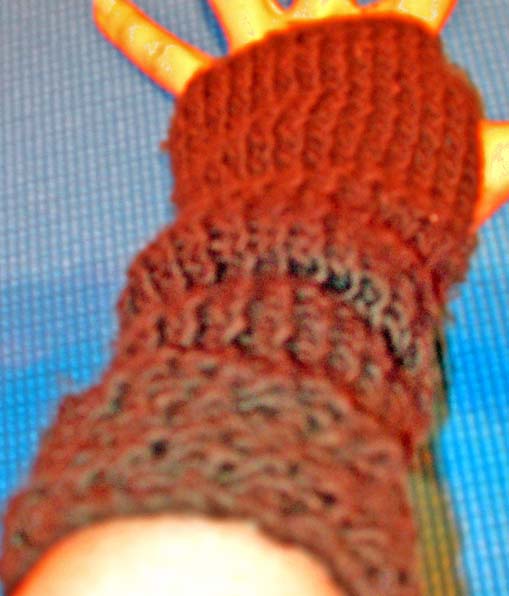
    Hot water bottles and wrist warmers are part of the balance.  Two hot water bottles taken to bed (and then I use the water on the plants the next morning) makes going to bed toasty and delightful, but not too hot in the middle of the night.  If I am working at home and it is midday, I can warm myself up with a two-minute handstand or a few sun salutes or some abs work or other arm balances. That’s not an option if I am on a conference call or at the office.  Nor does it make sense after dinner when it is time to get energetically quiet.  The wrist warmers, though, make an amazing difference (I also enjoy wearing them when I start practicing until I warm up as another layer that easily can come on or off.  I kind of like the way I look and enjoyed all the complements I got when I was meandering around New York over the holidays.  They are a great way to use scrap yarn (especially if you don’t have the time, yarn, or inclination for a larger project — see my post on “Sauca (and the blanket).”

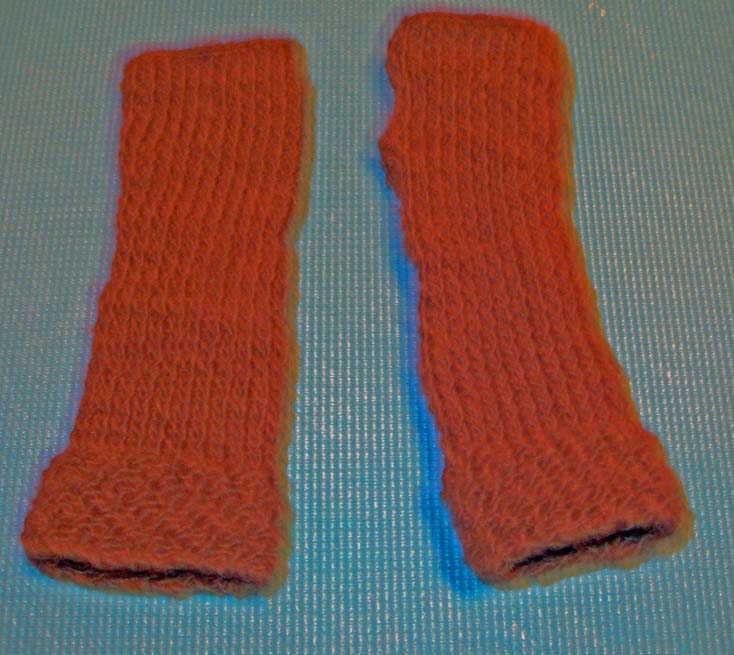
    If you want to make your own wrist warmers and you are a fantastic knitter, you can go for four double-pointed needles, multiple colors, and add a thumb section.  For those of you who are newer to knitting or who want wrist warmers very quickly, here’s all it takes to make the one’s shown above.

    1.  Two needles of appropriate gauge and less than a skein of yarn.

    2.  Measure loosely around your knuckles.  That’s the right width for your wrist warmer (notice that the girth of your knuckles and your forearm a couple of inches below the elbow are about the same).  Then knit about a two-inch square to make sure you know how many stitches you get per inch horizontally.  When you have your gauge correct, unravel your test square to use that yarn in your wrist warmers.  I recommend rechecking the gauge about an inch or two into your first wrist warmer to make sure you were right.  It is easier to start over at that stage than to try and fix it later or have to give them away to someone larger or smaller (unless you want to).

    3.  Cast on the correct number of stitches for how many stitches per inch you get with your yarn and needles and the width you measured around your knuckles.  It is OK to round to the nearest half inch.  First two rows are simple rib — k1, p1.  Then do basic plain knitting (k first row, p return row) until the first wrist warmer is about 6-8 inches long and reaches almost the desired length up your lower arm.  Then do 6-8 rows of moss stitch (row 1 — k1, p1, row 2, p1, k1) [or you could just do more ribbing].  Cast off.  Measure second wrist warmer against the second.  Turned inside-out, using the knitting yarn, sew into a tube, leaving a whole for the thumb a the end with just the double row of ribbing.  The sewn part at the knuckle end should be about 2/3 to 3/4 inches, then there should be about a 1 1/2 to 2 inch whole (just hold it up on your hand to make sure it fits).

    4.  They will stretch out as you wear them, but if they are a little too wide or tight, you can wet them and then make them either longer and thinner or shorter and wider by blocking.

    4.  Bored with the colors you have at home?  It’s pretty easy to swap with a fellow knitter.

    5.  Want to be just a little fancier?  Do stripes by alternating colors when you change rows.  Want to practice cables.  Do one center cable, just remember that it won’t be in the center if you want it to go on the top of your hand; it will start a quarter of the way in.

    6.  New to knitting?  Go into any yarn store, tell them that this is your project, and they’ll tell you a good yarn, what needles you need, and show you how to cast on, knit and pearl.  There are farmers at the Dupont Circle Fresh Farm Market on Sunday who have beautiful homespun, hand-dyed yarns.  They might not show you how to knit, but they include patterns for hats.

    7.  Have fun.  Be creative.  Be part of a fashion wave.  Stay warm.
  • | |

    Hard Freeze Forecast (Heyam Dukham Anagatam)

    My favorite sutra in Patanjali’s Yoga Sutra’s is, II.16, “heyam dukham anagatam.”  This translates roughly as “the pain that is yet to come can be avoided.”  What does this have to do with a forecast of a hard freeze?

    My chard, beets, and turnip greens are still flourishing.  They can manage with a night or two in a row in the high 20sF, and that is all we have had so far.  The forecast for later in the week, though, is for the first true cold snap since 1994 (you may remember that as the year when lots of people’s pipes froze).  My winter garden (which does not have a cold frame due to lack of space — maybe I’ll get more creative next year, and I’ll try an experiement with plastic bags on Thursday night) cannot survive lows in the low teens highs in the twenties.

    I could suffer today by bemoaning the coming cold, worrying about the garden, and remembering that I don’t like cold.  That would be present suffering in anticipation of potential future suffering.  I certainly can avoid that.  I can also do what I did yesterday, which was harvest lots of the chard and most of the beets, put the beets into cold storage (vegetable bin in the refrigerator) and make pasta with sauteed garlic and chard.  Between now and Wednesday night, I’ll harvest most of the remaining greens.  I’ll make a big vegetable soup with the beets and the chard, maybe make chard pie or calzones (truly delicious), and eat the rest over the following days.  I’ll feel grateful that in the bitter cold, I can be eating fresh garden greens.  I’ll be even more grateful that I can just shop at the grocery store or the farmers’ market and don’t need to rely on my garden feeding me year round.  I’ll also be happy for the hard frost.  Part of the reason the aphids and the mosquitoes have been so bad is the absence of a hard frost in winter.

    Some bitter cold in winter in a temperate zone is inevitable, as are sickness and death.  We can avoid suffering by not just getting anxious and unhappy and suffering in the present, but not taking action to alleviate potential suffering.  With preparation and practice, we can avoid some suffering.  Just has preparing for winter in the garden can allow it to be productive for greater parts of the year, so too, with a steady practice of asana, pranayama, and meditation we can avoid some physical and emotional pain and suffering.  Most important, with steady preparation (preparing for the potential for difficulties in the future is not the same as being anxious about it), when the inevitable comes, we will likely suffer less, at least in our hearts, if not in our bodies.

  • Sauca (and freecycle)

    The first of the niyamas or ethical restraints set forth by Patanjali in his Yoga Sutras is sauca, which means cleanliness or purification.  BKS Iyengar in his Light on the Yoga Sutras of Patanjali says that sauca is both internal and external and that mastery of yoga is unrealizable without observance of the ethical principles of the yamas and niyamas [non-harming, truthfulness, non-stealing, aligning with the good, greedlessness, cleanliness, contentment, fire for practice, self-study, and acceptance — my definitions] is not possible.
    What does cleanliness mean in this time in our society?  Scrubbing the kitchen and bath with toxic cleaners and slathering ourselves with chemical products and taking long showers may make our house and body look and feel clean, but it is soiling the earth.  It is definitely easier to practice in a neat room than a messy one, but we need to learn how to be clean also keeps the earth’s environment clean as well.
    Earlier this week, I started cleaning out the “art closet.”  I have always created visual art, and before I shifted to teaching yoga, I spent a number of years creating at a wild pace (partly at the encouragement of a live-in partner), using a room in my house as a studio, and exhibiting and selling my work.  One side effect of that intense period of creation (and one of the key reasons I shifted away from it), was that it created a lot of stuff — for every painting or photograph I sold or gave as a gift, another five or eight accumulated in the house.  When I entered yoga teacher training, I turned the art studio into a yoga studio.  I was unable at that time to make a decision as to what to keep and what to discard.  Thus paralyzed, I put it all in a closet — art works and extra supplies alike.
    Having a closet full of stuff long untouched and only some of which was wanted makes a house energetically stale.  Finally, this week, I cleaned out most of the painting materials.  I even decided not to keep images that I did not want to sell or exhibit again.  It was tempting just to break everything up and put it out on the curb for trash.  But the stretchers for the canvas are completely reusable by a working artist.  So I took the paintings apart and and then did a posting on “freecycle dc” offering the art supplies.  If you are not familiar with freecycle, it is pretty simple.  You join the group in your area and let people know what you have to give away.  Nothing is for sale.  Nothing is bartered.  The point is to transfer something you no longer want to someone who wants/needs it.  The recipient is local, so only limited fossil fuels are used to transfer the goods.  What you no longer want is saved from the landfill.
    I’ve cleaned my closet.  Another artist will be creating new art with old materials instead of new.  Less goes into the landfill.  That’s a great example of sauca.